Plaid Link for underwriting apply portals
Plaid Link for underwriting apply portals — production notes by Nitin Rachabathuni, tech lead on embedded finance and Revenued FinTech case study.
Link token creation
Create link_token server-side with client_user_id, products (auth, transactions), webhook URL, and environment-specific keys. Never mint tokens in the browser.
const { data } = await plaidClient.linkTokenCreate({
  user: { client_user_id: applicantId },
  client_name: "Apply Portal",
  products: [Products.Auth, Products.Transactions],
  country_codes: [CountryCode.Us],
  language: "en",
  webhook: "https://api.example.com/plaid/webhook",
});
Exchange public_token once on your BFF, store access_token encrypted, and enqueue async underwriting jobs.
Why teams search for this
Engineering leaders evaluating Plaid Link for underwriting apply portals need decision-grade detail: what breaks in production, how to instrument underwriting funnels, and how Plaid fits with Auth0 merchant sessions. Generic tutorials skip idempotency, mobile session recovery, and ISO referral edge cases — this article frames the work from Nitin Rachabathuni's delivery on Revenued FinTech case study.
Production patterns I implement
- Link token lifecycle — short TTL, user-bound
client_user_id, webhook URL registered per environment - Webhook hardening — signature verification, dedupe keys, dead-letter queues, Datadog alerts on handler latency
- Underwriting UX — progressive disclosure, explicit consent copy, retry when Item enters
ITEM_LOGIN_REQUIRED - Auth handoff — after Plaid success, issue Auth0 session for merchant portal with least-privilege scopes
- Observability — trace Link open → token exchange → webhook → portal unlock as one funnel SLO
Architecture notes
FinTech apply portals rarely fail on Plaid API calls alone. They fail on state: duplicate webhooks, partial Item updates, or merchants abandoning Link on mobile Safari. I connect Plaid to HubSpot lead capture, ISO referral attribution, and Marqeta draw flows with explicit contracts between Angular UI, Node BFF, and async workers.
Patterns from Revenued FinTech case study:
- BFF owns secrets — never expose access tokens to the browser; exchange public tokens server-side only
- Idempotent webhooks — store
webhook_idbefore side effects; return 200 on duplicates - Update mode ready — when credentials expire, relaunch Link in update mode without re-running full KYC
- EU readiness — country codes, redirect URIs, and Hosted Link when embedding is undesirable
Pitfalls I help teams avoid
- Shipping Link without webhook verification in staging
- Treating sandbox Item behavior as production parity for Institutions with MFA churn
- One global webhook endpoint without environment isolation
- Missing canonical URLs and internal links to evidence — case studies hurt SEO and buyer trust
Compliance and audit trail
Regulated FinTech flows need immutable audit logs: who consented, which Institution, which products were enabled, and which webhook payloads drove state transitions. I store redacted webhook bodies with correlation IDs tied to Datadog traces and HubSpot deal stages. Underwriters should replay a timeline without SSH access to production.
Testing matrix before launch
- Sandbox Institutions with OTP and wrong-password flows
- Webhook replay from Plaid dashboard — confirm idempotency
- Mobile Safari Link return path and third-party cookie edge cases
- Load test token exchange endpoint separately from Link UI
- Disaster drill: rotate Plaid secret without dropping in-flight Items
Authoritative references
Consult Plaid Link overview, Plaid Auth product, Revenued FinTech case study alongside the official references block below. Cross-check guidance with your compliance, security, and SRE stakeholders before setting SLOs.
Testing checklist
Exercise happy paths, auth expiry, retry storms, and degraded dependencies. Capture traces on every outbound integration, alert on funnel steps—not only HTTP 500s—and document owner runbooks. Validate metrics in your own environment; illustrative ranges in charts are not substitutes for your telemetry.
Leadership takeaway
Plaid Link for underwriting apply portals succeeds when teams align scope, measurable outcomes, and inclusive UX from sprint zero. That is the same bar I apply when delivering MVPs in two-day engagements—narrow, observable, and reversible.
Metrics snapshot
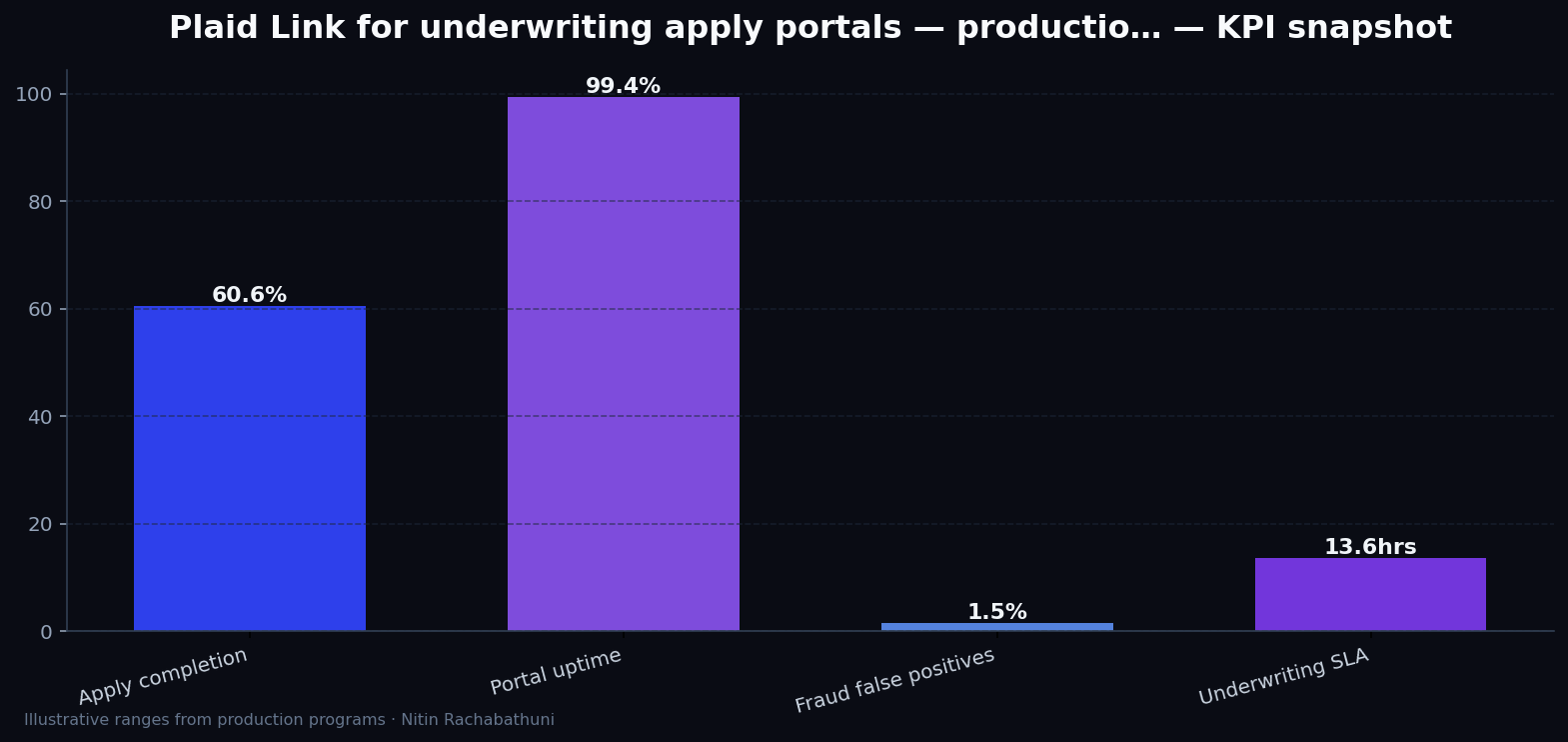
Illustrative fintech KPI ranges observed on programs like “Plaid Link for underwriting apply portals — productio…” — validate against your own telemetry before setting SLOs. Methodology: production-like staging traces + weekly review with product and ops.
Architecture flow

Code sketches
/* linkTokenCreate */
// Plaid Link — create link_token + exchange public_token (apply portal)
import { Configuration, PlaidApi, PlaidEnvironments, Products, CountryCode } from "plaid";

const client = new PlaidApi(
  new Configuration({
    basePath: PlaidEnvironments[process.env.PLAID_ENV],
    baseOptions: {
      headers: {
        "PLAID-CLIENT-ID": process.env.PLAID_CLIENT_ID,
        "PLAID-SECRET": process.env.PLAID_SECRET,
      },
    },
  })
);

export async function createLinkToken(userId: string) {
  const { data } = await client.linkTokenCreate({
    user: { client_user_id: userId },
    client_name: "Revenued Apply Portal",
    products: [Products.Auth, Products.Transactions],
    country_codes: [CountryCode.Us],
    language: "en",
    webhook: "https://www.nitin-rachabathuni.com/api/plaid-webhook",
  });
  return data.link_token;
}

export async function exchangePublicToken(publicToken: string) {
  const { data } = await client.itemPublicTokenExchange({ public_token: publicToken });
  return data.access_token;
}
/* identityGet */
// Plaid Identity + Auth — underwriting signals for apply portals
export async function fetchUnderwritingSignals(accessToken) {
  const [auth, identity, transactions] = await Promise.all([
    client.authGet({ access_token: accessToken }),
    client.identityGet({ access_token: accessToken }),
    client.transactionsSync({ access_token: accessToken, count: 100 }),
  ]);

  return {
    accountOwners: identity.data.accounts.flatMap((a) => a.owners),
    achNumbers: auth.data.numbers.ach,
    cashflowWindow: summarizeTransactions(transactions.data.added),
  };
}
Official references
Related on this site
Related case study
Revenued FinTech — Embedded finance — Plaid bank linking, Auth0 portal, partner referral flows.
Article slug: plaid-link-underwriting-apply-portals-production-guide · Engineering notes by Nitin Rachabathuni — MVP in 2 days specialist.

Plaid Auth: instant account verification in production (2026 guide)
FinTech

Plaid Identity Match and kyc_check: production identity verification guide
FinTech
Plaid update mode and relink when Item login is required
FinTech
Plaid Auth and Identity for underwriting — production guide
FinTech
Plaid webhooks — verification, idempotency, and FinTech handlers
FinTech
Plaid Hosted Link and EU open banking — implementation guide
FinTech