The Evolution of Enterprise Storage: Moving Beyond the Proprietary Tax
For years, the enterprise storage market has been dominated by a specific business model: the "proprietary tax." Organizations were forced to pay premium licensing fees for high-availability features, sophisticated snapshots, and data integrity checks—features that are often bundled into expensive, monolithic hardware stacks. While these systems provided stability, they also introduced significant complexity and overhead that many organizations didn't actually utilize but paid for nonetheless.
Ubiquiti’s introduction of an Enterprise NAS built on ZFS marks a strategic pivot in this landscape. By leveraging the ZFS file system, Ubiquiti is targeting a middle ground: high-performance, scalable infrastructure that strips away unnecessary management layers and licensing hurdles. This isn't just about hardware; it's about architectural philosophy. It’s a move toward "scalable simplicity," where the goal is to provide enterprise-grade reliability without the bloated cost structure of traditional vendors.
In my experience as an engineering lead, the most successful infrastructures are those that prioritize clarity over complexity. When you remove the proprietary layers, you reduce the surface area for bugs and simplify the training required for your team to manage the system effectively. Ubiquiam's move suggests a shift toward infrastructure that empowers the user rather than locking them into a vendor-specific ecosystem.
Why ZFS is the Foundation for Modern Infrastructure
To understand why this news matters, we have to look at what ZFS actually provides. Unlike traditional file systems that treat volume management and data integrity as separate layers (LVM + a filesystem), ZFS integrates them. This "pooled storage" model allows administrators to manage capacity more fluidly across multiple physical disks.
For an enterprise environment, the benefits of ZFS are practical rather than theoretical:
- Self-Healing Data: ZFS uses checksums to detect and automatically repair silent data corruption (bit rot), which is critical for long-term archival and high-availability systems.
- Efficient Snapshots: Because it tracks changes at the block level, snapshots are nearly instantaneous and take up very little space until they are modified.
- ARC and L2ARC Caching: ZFS intelligently uses RAM (Adaptive Replacement Cache) to speed up frequently accessed data, significantly improving performance on high-traffic paths.
By building their NAS platform on ZFS, Ubiquiti is opting for a battle-tested foundation. They are betting that the community's work on ZFS provides more reliability and flexibility than any proprietary "black box" could offer in 2024. This allows them to focus on hardware optimization rather than reinventing the wheel of file system integrity.
Engineering Trade-offs: Simplicity vs. Customization
One of the most important lessons in systems architecture is identifying where you want your complexity to live. In many enterprise setups, "customization" often becomes a synonym for "unnecessary complexity." A team might spend weeks configuring complex proprietary rules just to achieve what a standard ZFS configuration could do natively.
The move toward scalable simplicity means finding the sweet spot between ease of use and raw power. Ubiquiti is targeting organizations that need high-performance storage but don't have a 50-person engineering team dedicated solely to managing the underlying file system nuances. They are providing a "production-ready" experience where the heavy lifting—the replication, the parity checks, and the caching logic—is handled by the robust ZFS core.
When we evaluate these systems as engineers, we have to look at the p95 metrics of our operations. A system that is 10% faster on average but has massive spikes in latency due to complex management layers is often less desirable than a consistent, predictable system. By stripping out the "proprietary tax," Ubiquiti aims to provide a more stable and predictable performance profile for end-users who just need their data to be available and safe.
Strategic Implementation: Moving from Localhost to Production
When we talk about moving toward this type of infrastructure, it’s important to think like an engineer when evaluating the transition. If you are currently running on a legacy system with heavy licensing fees, your first step isn't just swapping hardware; it's auditing what features you actually use.
Are you paying for high-availability clusters that your team never configures? Are you paying for "premium" management consoles that simply provide a GUI over standard CLI commands? If the answer is yes, then moving toward an open architecture like ZFS isn't just a cost-saving move—it’s a modernization of your tech stack.
To succeed in this transition, I recommend three core principles:
- Reproduction with Production Loads: Don't test your new storage solution with "dummy" data or small local scripts. Test it against the actual throughput and concurrency levels you expect during peak hours.
- Measure Tail Latency (p95/p99): Averages are a lie in user-facing paths. You need to know how the system performs under stress, not just when things are calm.
- Versioned Infrastructure: Ensure that your storage configurations and cache keys are versioned alongside your deployments so you can roll back quickly if an update causes issues.
If you're looking to streamline your infrastructure or move toward a more scalable architecture without the "proprietary tax," I can help you navigate these architectural decisions for your next MVP. You can reach out for specialized engineering guidance at nitin-rachabathuni.com/contact.
FAQ
What is the primary advantage of a ZFS-based NAS? The main benefit is the integration of volume management and file system integrity into a single layer. This provides features like "self-healing" data, efficient snapshots, and smarter caching without the need for complex third-party software layers.
How does Ubiquiti's approach differ from traditional enterprise storage brands? Traditional brands often rely on proprietary licenses to gatekeep high-end features. Ubiquiti’s model focuses on "scalable simplicity," using open standards like ZFS to provide those same features without the associated licensing costs and complexity.
Is this transition suitable for small businesses as well as large enterprises? Yes, because it removes the barrier of entry created by expensive licenses. By providing a high-performance system that is easier to manage, it allows smaller organizations to have "enterprise-grade" infrastructure without the enterprise price tag.
Authoritative references
Consult Next.js documentation, MDN Web Docs, web.dev, Next.js documentation, OWASP Cheat Sheets alongside the official references block below. Cross-check guidance with your compliance, security, and SRE stakeholders before setting SLOs.
Metrics snapshot
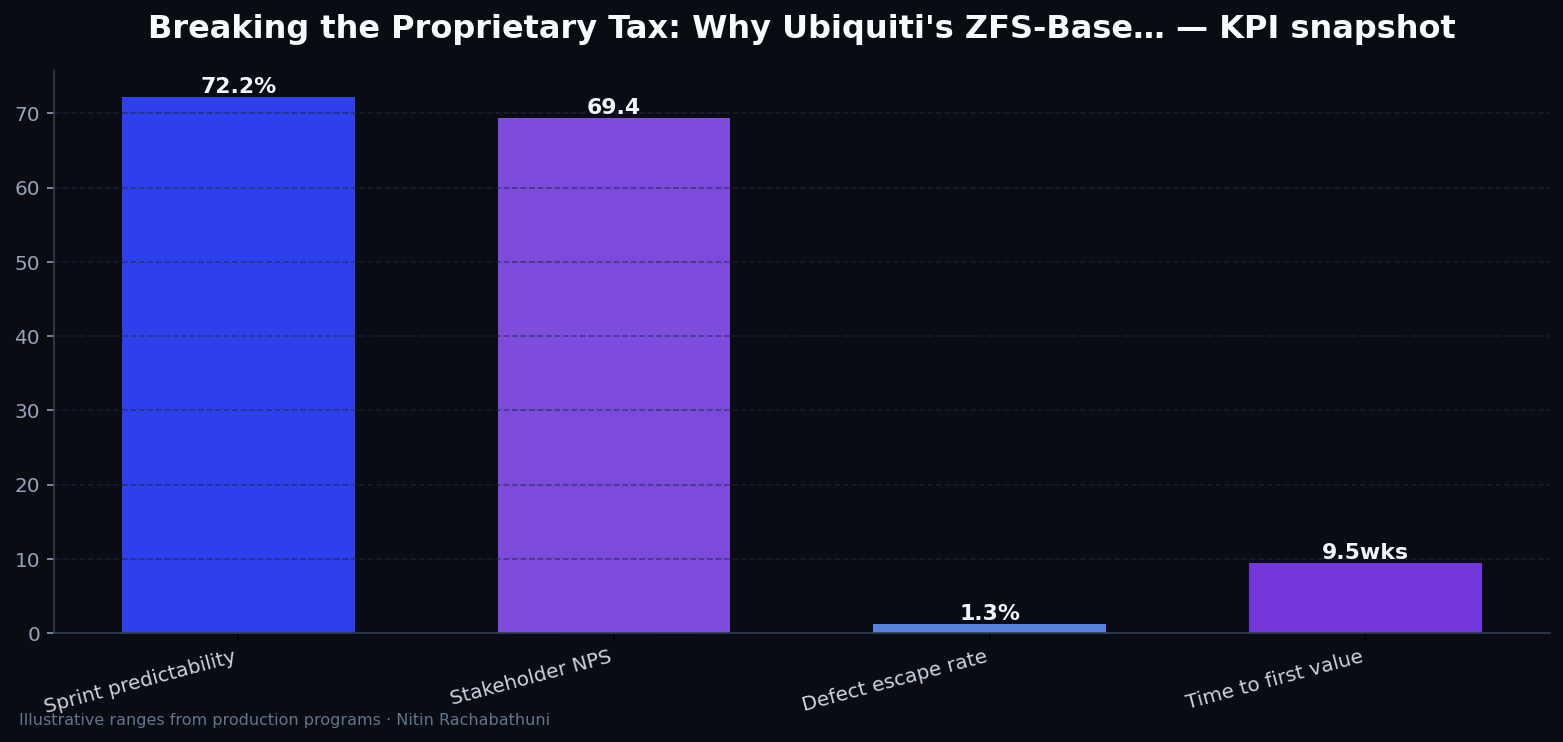
Illustrative consulting KPI ranges observed on programs like “Breaking the Proprietary Tax: Why Ubiquiti's ZFS-Base…” — validate against your own telemetry before setting SLOs. Methodology: production-like staging traces + weekly review with product and ops.
Architecture flow

Code sketches
/* Integration sketch */
// Breaking the Proprietary Tax: Why Ubiquiti's ZFS-Base…
export async function rolloutUbiquitiEnterpriseNasZfsProprietaryTax() {
  const checks = ["telemetry", "auth", "rollback"];
  return { ok: true, checks };
}
Official references
Related on this site
Article slug: ubiquiti-enterprise-nas-zfs-proprietary-tax · Engineering notes by Nitin Rachabathuni — MVP in 2 days specialist.