Why git diff is not enough for agentic coding
When an AI coding agent refactors fifty files in one session, git diff shows what changed—but rarely why, what outcome was expected, which check was planned, or how to undo one action without reverting the whole branch. That gap is now a production concern as teams adopt Cursor, GitHub Copilot agents, and OpenAI Codex for daily delivery.
Ponytrail (by Roy Lee, discussed on Hacker News in June 2026) adds a local audit trail around agent file mutations. Before create/edit/move/delete/format operations, it records a pre-change snapshot: action, purpose, reason, affected files, expected outcome, verification plan, and rollback path. After the edit, a post-change snapshot captures checks run and results. Data lives under .pony-trail/ as JSONL, session trees, and small before/after file copies—runtime state you typically gitignore, not a replacement for Git.
Production patterns for agent audit trails
Install as an agent skill. Ponytrail ships a bundled skill installable across Claude, Copilot, and Codex:
npx ponytrail skills install pony-trail
The installer records its own snapshot so skill installs appear in history—useful when onboarding a team to the same agent toolchain.
Inspect before you trust. npx ponytrail history --details shows the session tree with action summaries, checks, results, and rollback hints. Filter with --session <id> or export --json for CI ingestion.
Revert with intent, not guesswork. npx ponytrail revert <snapshot-id> --dry-run previews file restores; applying revert restores from the snapshot’s pre state and deletes files that did not exist before. Non-interactive environments print the plan and cancel—safe for CI runners.
Pair with Git, not instead of it. Git remains the system of record for releases. Ponytrail is per-action intent and rollback context for agent work—the same way structured logs complement metrics in Datadog APM workflows.
Metrics and team governance (illustrative)
Teams running agent-heavy MVPs often track: snapshot count per session, revert rate, and time-to-verify after agent batches. Illustrative ranges from early adopters: 5–15 snapshots per focused feature session, <8% revert rate when verification plans are enforced, 30–90 minutes saved on incident reconstruction vs diff-only review—validate against your own telemetry.
Pitfalls
Treating .pony-trail/ as committed history (it is local runtime state). Skipping --dry-run on production branches. Assuming agent summaries at end-of-session replace structured snapshots. Running agents without recording verification plans—then blaming the model when regressions ship.
Security and privacy notes
Because Ponytrail stores file copies under .pony-trail/, treat that directory like local logs: exclude secrets, rotate or purge on laptop offboarding, and never commit it to public repos. The tool runs locally—no cloud upload—which suits air-gapped or client NDA environments where third-party agent telemetry is prohibited.
How this fits MVP delivery
Agentic coding accelerates MVPs; audit trails prevent invisible debt. If you ship MVPs in days, you still need rollback granularity hours later when a stakeholder asks “what did the agent change in auth?” Ponytrail answers that without force-pushing or interactive rebase archaeology.
Team rollout checklist
Add .pony-trail/ to .gitignore on day one. Require history --details review before merging agent-heavy PRs. Pair Ponytrail snapshots with your existing CI checks (bun test, npm run lint) so post-snapshots record real verification outcomes—not aspirational ones. For regulated or client-facing codebases, export history --json into your SIEM or ticket system so agent intent survives beyond the developer laptop.
Comparison to jj and manual hooks
Some teams replicate partial auditability with Jujutsu (jj) snapshots and custom pre/post tool hooks. That works if every engineer maintains discipline. Ponytrail standardizes the schema—purpose, reason, verification plan, rollback path—so reviews scale when multiple agents and vendors are in play.
See also Anthropic’s engineering notes on building reliable agent systems and OWASP LLM guidance for security review of automated edits.
Metrics snapshot
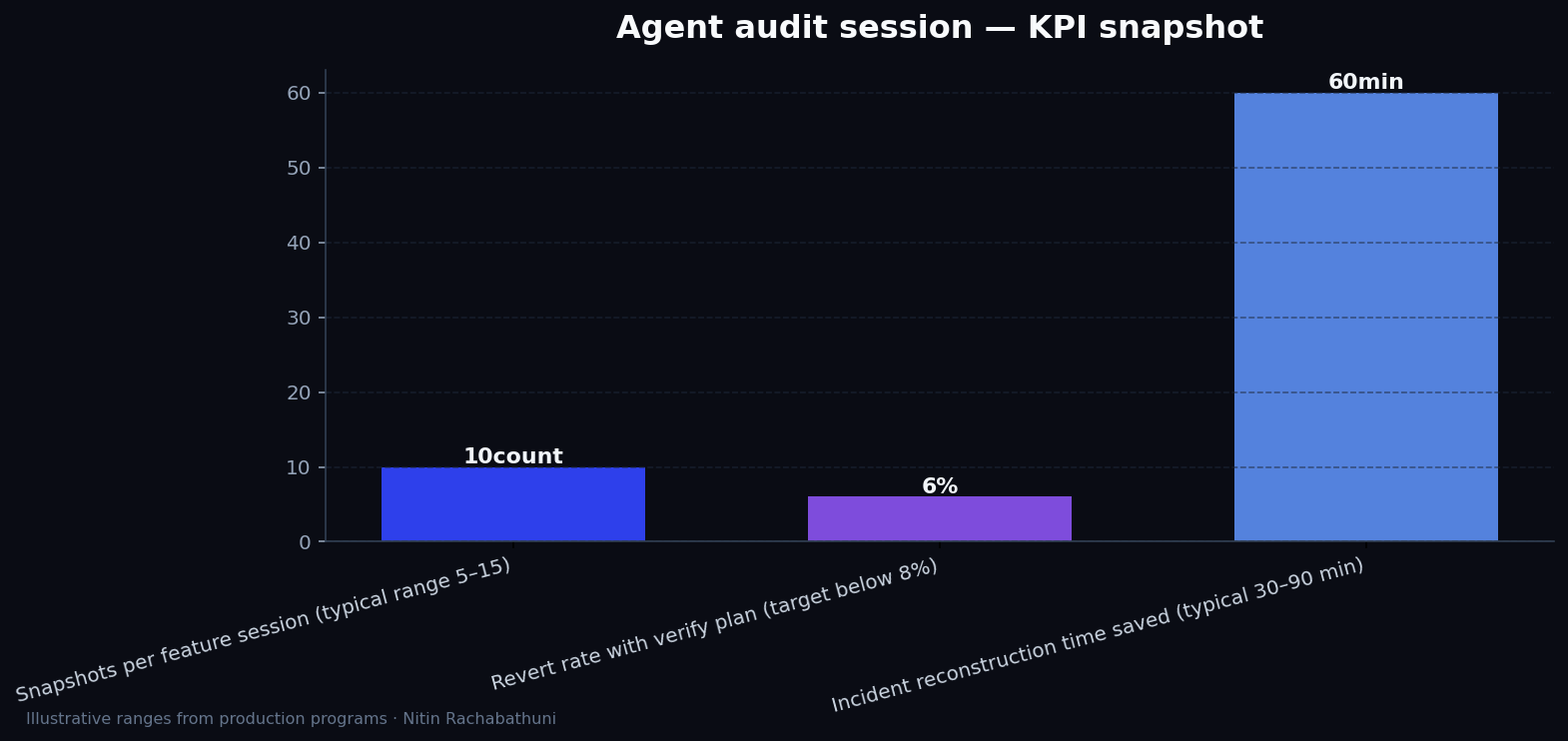
Illustrative agent-session KPI ranges from teams using local audit trails—validate against your own snapshot and revert metrics before setting governance SLIs.
Architecture flow

Source: GitHub opengraph
Approach comparison
| Approach | Signal | Risk | Best for |
|---|---|---|---|
| Git diff only | Universal, familiar | No agent intent or per-action rollback | Single-file edits |
| Ponytrail snapshots | Intent + verify + granular revert | Local .pony-trail/ state to manage | Multi-file agent sessions |
| End-of-session agent summary | Fast to read | Too coarse after long sessions | Demos only |
Code sketches
/* Inspect and revert a Ponytrail snapshot */
# View session tree with rollback hints
npx ponytrail history --details

# Preview revert
npx ponytrail revert skill-install-20260622064256Z-99fa03fd --dry-run

# Apply after review
npx ponytrail revert skill-install-20260622064256Z-99fa03fd
Official references
Related on this site
Article slug: auditing-ai-coding-agent-edits-ponytrail · Engineering notes by Nitin Rachabathuni — MVP in 2 days specialist.

Juiceit style straight through document processing
AI Agents
Shopify Acquires Tailwind CSS: The Strategic Shift from Independent Tooling to Core Infrastructure
leadership
Tailwind CSS Joins Shopify: A Masterclass in Strategic Infrastructure Pivot
tech
The Illusion of Quality: Why AI Agents Fail at Test Verification
tech
Beyond the Vector Database: Why Git-Native Memory is the Future for AI Coding Agents
leadership
Agentic Context Management: Solving the Memory vs. Cost Architecture Problem
tech