The Efficiency Paradox: Why Your Team Doesn't Need a 10B Parameter Model to Win
In the current era of Generative AI, there is a prevailing narrative that "bigger is better." We see headlines about massive parameter counts—models with hundreds of billions or even trillions of parameters—and it creates a psychological gravity. For engineering leaders, this often leads to a default posture: if we want the best results, we must use the biggest model available.
However, the release of Moebius serves as a profound case study in why this "bigger is better" philosophy can lead to significant technical debt and operational inefficiency. Moebius is an image inpainting model with only 0.2 billion parameters that manages to deliver performance comparable to (and in some cases superior to) models with over 10 billion parameters.
This isn't just a win for the research community; it’s a critical lesson in engineering leadership and MVP (Minimum Viable Product) methodology. It challenges us to ask: Are we solving the problem, or are we just building the biggest possible machine to solve it?
The Cost of "Generalist" Bloat
When you deploy a massive general-purpose model for a specific task—like image inpainting—you are paying a "complexity tax." These large models are designed to be jacks-of-all-trades. They need to understand everything from poetic nuances and coding logic to nuanced visual textures across thousands of different categories.
Because they must be capable of doing everything, their inference costs, latency profiles, and hardware requirements scale exponentially. When your specific business requirement is simply "fill in the missing part of this portrait," using a model that can also write Python scripts or compose sonnets is an architectural over-reach.
Moebius proves that by narrowing the scope, we can achieve higher fidelity. By focusing exclusively on the mechanics of inpainting, Moebius utilizes less than 2% of the parameters of its larger counterparts while outperforming them on specific benchmarks like portrait and natural scenes. From a leadership perspective, this is the difference between building a Swiss Army knife when you only need a high-quality scalpel.
Engineering Leadership: Choosing Precision Over Scale
As leaders, our role is to protect the team from unnecessary complexity. When we choose a "bloated" model because it's the industry standard, we are often inheriting problems that don't affect the end-user but significantly impact the engineering overhead.
Consider these three pillars of responsible AI leadership:
- Requirement Mapping: Before selecting a model, define the "must-haves." If your users need high-quality image inpainting, do they actually care if the underlying model is capable of text generation? If not, why are we paying for that capability in our compute budget?
- Latency and Cost Optimization: A 0.2B parameter model can be served much faster and on cheaper hardware than a 10B+ model. For an MVP or a production-scale feature, this translates directly to better margins and a smoother user experience.
- The "Good Enough" Principle (with a Twist): In engineering, "good enough" doesn't mean low quality; it means the highest possible quality achievable within the necessary constraints. Moebius provides higher quality in its niche than some larger models do generally. That is the definition of an optimized solution.
Avoiding the Over-Engineering Trap
One of the most common mistakes I see in AI project management is the "Gold-Plated Solution." This happens when a team spends weeks trying to integrate and optimize a massive model because they fear that a smaller one won't be "powerful" enough.
In reality, the risk isn't that the small model isn't powerful; it's that the large model is too heavy to move quickly. When you use a massive generalist model:
- Debugging becomes harder: The failure modes of huge models are often opaque and difficult to isolate.
- Deployment cycles slow down: You may need specialized infrastructure just to host the "general" capabilities your app doesn't even use.
- Iteration slows: It is much easier to fine-tune or swap out a 0.2B model when requirements shift than it is to re-engineer a massive pipeline.
If you are struggling to decide which path to take for your next AI feature, I can help you cut through the noise and identify the most efficient architecture for your specific goals. Contact me here to discuss how we can build a leaner, more effective MVP.
Practical Takeaways for Your Next Sprint
If you are leading a team currently grappling with model selection, I recommend implementing these three "sanity checks" before the next sprint planning:
- Identify the Core Task: Write down exactly what the user sees. If it’s an image edit, look at specialized models first. Only move to generalist models if your requirements are truly multi-modal and broad.
- Audit the Dependency Path: Don't just follow the "hype" of a model that is trending on social media. Look at the benchmarks for your specific use case. If Moebius beats Flux in portraiture, why would you choose the larger one?
- Run a "Failure Mode" Tabletop: Ask your team: "If this model fails or becomes too expensive to run tomorrow, how quickly can we swap it out?" A smaller, specialized model is much easier to replace or pivot than a massive integrated system.
The goal isn't just to build something that works; it's to build the most efficient version of something that works. Moebius is proof that in the world of AI, precision often beats power.
FAQ
Why should we choose a 0.2B model over a 10B+ model? A smaller model like Moebius offers significantly lower latency and lower inference costs while providing superior results for specific tasks like image inpainting. By choosing the right size, you reduce technical debt and simplify your deployment pipeline.
What is "over-engineering" in generative AI selection? Over-engineering occurs when a team selects a massive, multi-purpose model to solve a narrow problem. This leads to unnecessary costs and complexity without providing any additional value to the end user.
Does Moebius actually perform better than larger models like Flux for specific tasks? Yes, in benchmarks involving portraiture and natural scenes, Moebius outperformed Flux.1-fill-dev, demonstrating that specialized training can yield higher quality results with a fraction of the parameters.
Authoritative references
Consult Next.js documentation, MDN Web Docs, web.dev, Next.js documentation, OWASP Cheat Sheets alongside the official references block below. Cross-check guidance with your compliance, security, and SRE stakeholders before setting SLOs.
Metrics snapshot
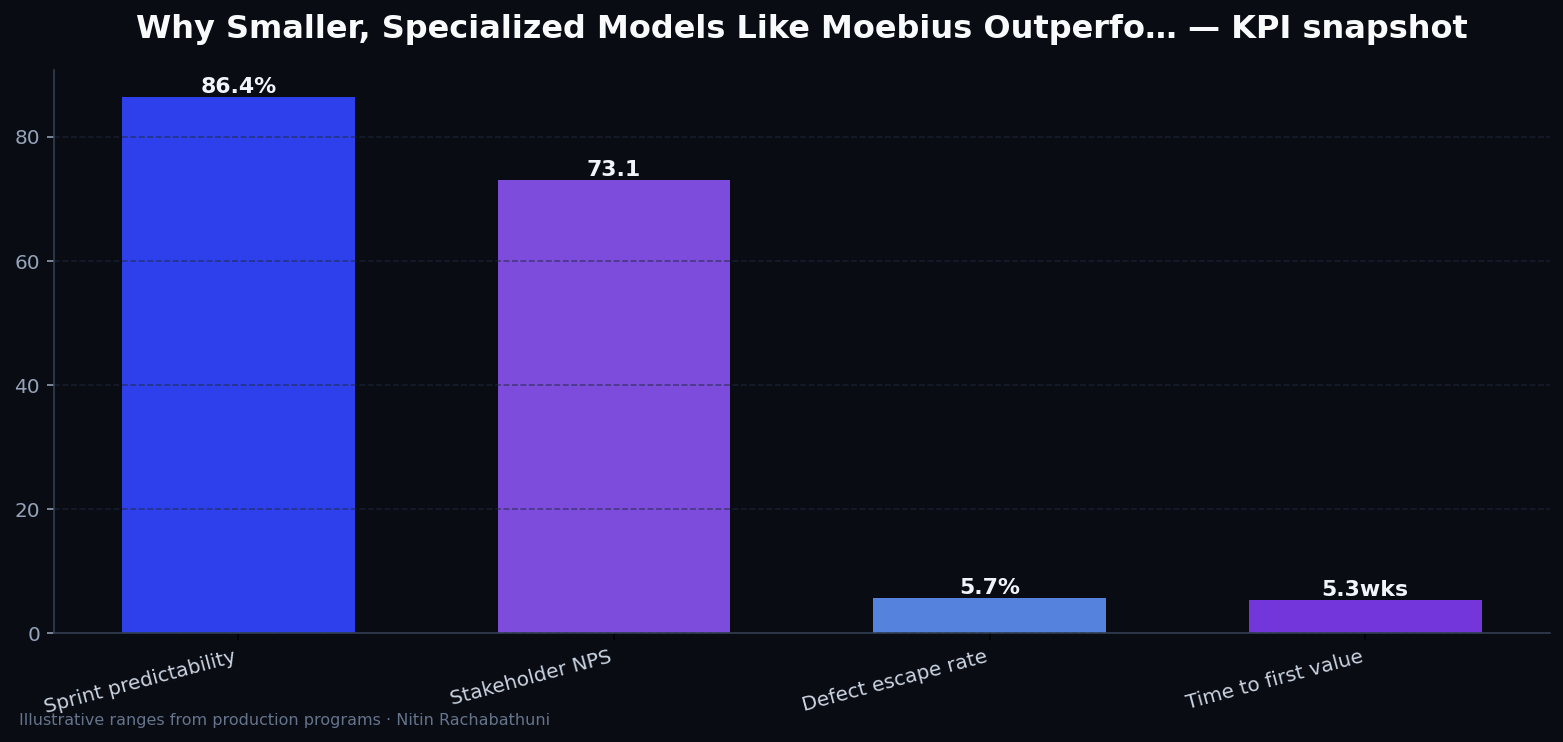
Illustrative consulting KPI ranges observed on programs like “Why Smaller, Specialized Models Like Moebius Outperfo…” — validate against your own telemetry before setting SLOs. Methodology: production-like staging traces + weekly review with product and ops.
Architecture flow

Code sketches
/* Integration sketch */
// Why Smaller, Specialized Models Like Moebius Outperfo…
export async function rolloutMoebiusSmallModelEfficiencyVsLargeGeneralists() {
  const checks = ["telemetry", "auth", "rollback"];
  return { ok: true, checks };
}
Official references
Related on this site
Article slug: moebius-small-model-efficiency-vs-large-generalists · Engineering notes by Nitin Rachabathuni — MVP in 2 days specialist.