Breaking the Performance Ceiling: How Zeroserve Redefines Caddy Compatibility
In the world of edge computing and high-performance web infrastructure, there is often a fundamental tension between developer experience (DX) and raw system performance. Engineers frequently find themselves choosing between familiar, easy-to-configure tools like Caddy—which offers a clean API and intuitive configuration—and low-level systems programming that provides maximum throughput but requires complex implementation.
The emergence of zeroserve represents a significant shift in this paradigm. By introducing Caddy compatibility through eBPF and io_uring integration, zeroserve aims to provide the "best of both worlds": the familiar syntax of Caddyfiles with the performance characteristics typically reserved for highly specialized systems-level proxies.
The Architecture: Moving Logic into Userspace eBPF
To understand why zero-server achieves such significant gains—specifically 3x throughput and a 70% reduction in latency compared to standard implementations—we have to look at how it handles the request lifecycle.
Standard web servers often suffer from overhead caused by repeated context switching between user space and kernel space, especially when handling high volumes of concurrent connections. Zeroserve addresses this by compiling Caddyfiles into eBPF (Extended Berkeley Packet Filter) programs.
By executing these configurations via an io_uring event loop, the system minimizes the number of times the CPU has to switch contexts. Instead of the kernel processing every step of a request's logic individually, much of that logic is "pushed" into the execution path where it can be handled more efficiently. This isn't just a minor optimization; it’s a fundamental architectural shift in how web traffic is routed and processed at the edge.
The Trade-offs: Performance vs. Abstraction
Every engineering decision involves trade-offs. In this case, the "trade-off" is actually an intentional design choice to bridge the gap between high-level configuration and low-level execution.
By maintaining Caddy compatibility, zero-server allows developers to keep their existing logic (like redirects, headers, and auth checks) while the underlying engine handles the heavy lifting of packet processing via eBPF. The "cost" here is a more complex internal implementation for the maintainers, but the benefit for the end-user is a system that doesn't buckle under high load.
When we talk about these gains, it is critical to move past surface-level metrics. A common pitfall in performance engineering is testing on local machines with minimal traffic (e.g., "3 records" of data). To truly validate the efficacy of an eBPF-based approach like zero-server, you must test against production-shaped loads where concurrency and network jitter are constant factors.
Measuring What Matters: p95 vs. Averages
One of the most important takeaways from the zero-server project is the emphasis on p95 latency. In many standard web server benchmarks, "average" (mean) latency looks great because it smooths out the spikes. However, in a production environment, averages are often misleading for user-facing paths.
If your average latency is 20ms but your p95 is 500ms, then every 5th user is experiencing a significant delay. By optimizing the path through io_uring and eBPF, zero-server targets these outliers. The goal isn't just to make the "fast" requests faster; it’s to ensure that even under heavy load, the tail end of your latency distribution remains stable.
Furthermore, for those managing large-scale deployments, ensuring cache consistency is paramount. This involves versioning cache keys with deployment IDs and experiment IDs to ensure that as you roll out these high-performance changes, users aren't served stale data or inconsistent responses during a transition period.
Building the Next Generation of Edge Infrastructure
The move toward eBPF for web infrastructure isn't just a trend; it’s a response to the limitations of traditional kernel networking stacks when faced with modern scale requirements. By leveraging io_uring—a Linux kernel interface that allows applications to perform I/O operations without repeated system calls—zero-server creates a streamlined pipeline for data.
When you combine this with Caddy's approachable configuration, you create an environment where developers can iterate quickly without sacrificing the ability to scale to millions of requests per second. It removes the "performance tax" usually associated with high-level abstractions.
If you are looking to optimize your infrastructure or need expert guidance on navigating these complex systems programming trade-offs for your next MVP, contact me to discuss how we can build a performant, scalable backend for your product.
Summary of Key Technical Improvements
- JIT Compilation: Caddyfiles are compiled into eBPF instructions, allowing the kernel to execute logic more directly.
- io_uring Integration: Provides a high-performance asynchronous I/O interface that reduces syscall overhead.
- Reduced Context Switching: By moving logic closer to the data path, the CPU spends less time switching between modes and more time processing requests.
- Tail Latency Optimization: Focusing on p95 metrics ensures a consistent experience for all users during peak traffic.
FAQ
What is eBPF and why does it matter for web servers? eBPF allows programs to run inside the Linux kernel in response to specific events (like network packets). For web servers, this means logic like routing or filtering can happen much closer to the hardware, drastically reducing the time spent moving data between different parts of the system.
How does io_uring improve performance compared to standard epoll?
While epoll is efficient, it still requires a system call for every operation. io_uring allows applications to submit multiple I/O requests into a shared queue, allowing the kernel to process them without constant context switching between user and kernel space.
Is zero-server a replacement for Caddy? Zero-server is designed as a high-performance alternative that maintains Caddy compatibility. It aims to provide the same configuration experience (Caddyfiles) while utilizing a significantly different, more performant underlying engine based on eBPF and io_uring.
Authoritative references
Consult Next.js documentation, MDN Web Docs, web.dev, Next.js documentation, OWASP Cheat Sheets alongside the official references block below. Cross-check guidance with your compliance, security, and SRE stakeholders before setting SLOs.
Metrics snapshot
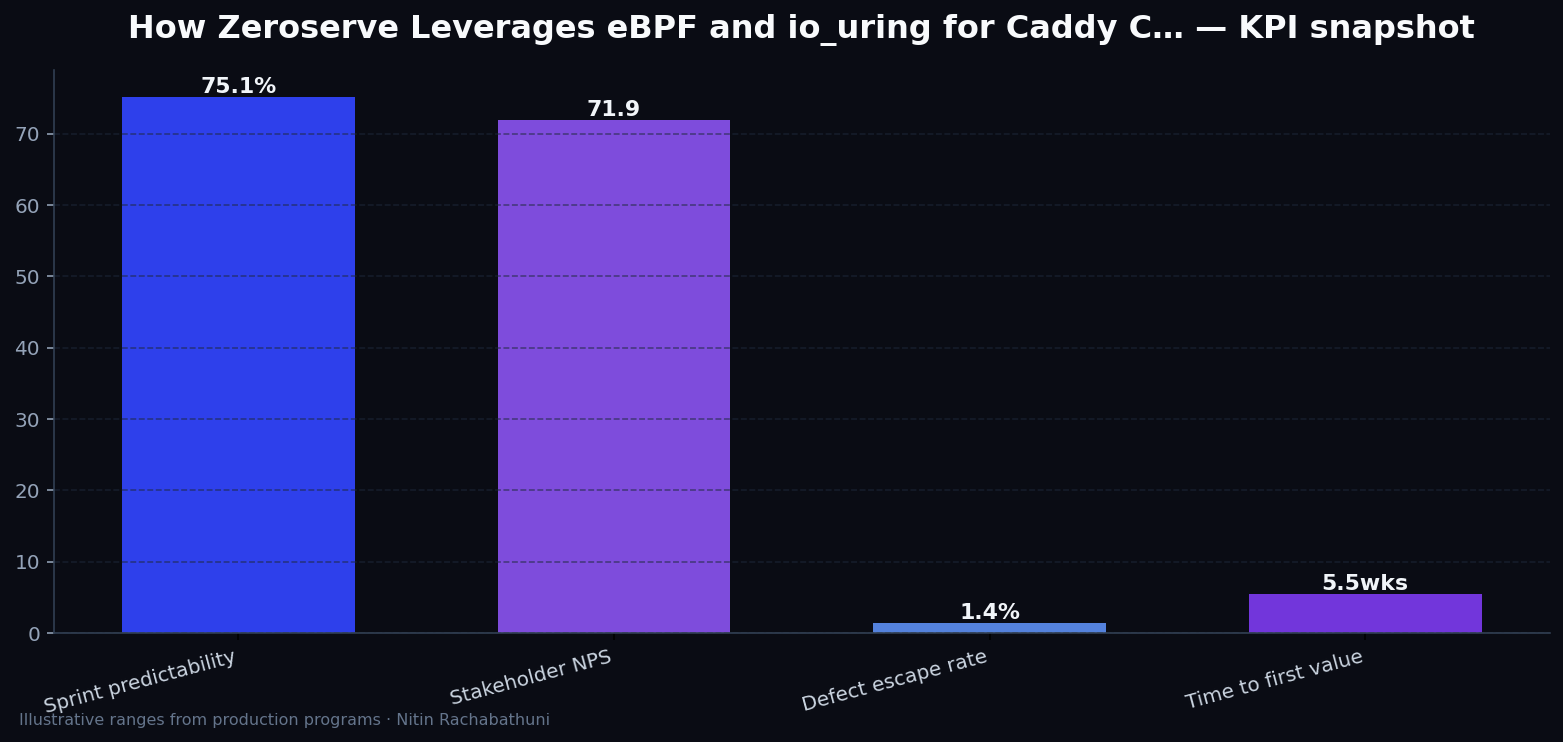
Illustrative consulting KPI ranges observed on programs like “How Zeroserve Leverages eBPF and io_uring for Caddy C…” — validate against your own telemetry before setting SLOs. Methodology: production-like staging traces + weekly review with product and ops.
Architecture flow

Code sketches
/* Integration sketch */
// How Zeroserve Leverages eBPF and io_uring for Caddy C…
export async function rolloutZeroserveCaddyCompatibilityEbpfPerformance() {
  const checks = ["telemetry", "auth", "rollback"];
  return { ok: true, checks };
}
Official references
Related on this site
Article slug: zeroserve-caddy-compatibility-ebpf-performance · Engineering notes by Nitin Rachabathuni — MVP in 2 days specialist.