The Hidden Carbon Cost of Modern Hardware
In the modern era of rapid technological cycles, we often overlook the environmental cost inherent in the hardware we carry in our pockets. Every smartphone produced carries a significant amount of "embodied carbon"—the emissions generated during mining, manufacturing, and assembly before the device ever powers on for the first time. Because mobile devices require complex components like lithium-ion batteries and high-density semiconductors, their initial production footprint is substantial.
When these devices are retired or replaced by newer models, that embodied carbon remains "locked" in the hardware. Instead of allowing these devices to become e-waste, a groundbreaking collaboration between researchers at UC San Diego and Google has demonstrated a way to reclaim this value. By repurposing retired smartphones into a low--carbon computing platform, they aren't just extending the life of the hardware; they are actively reducing the need for new manufacturing cycles while providing accessible compute power for research.
From Individual Devices to Scalable Clusters
The primary challenge in using "junk" hardware—or even simply used hardware—for cloud computing is consistency. A single smartphone is a self-contained unit, but a cluster of hundreds of phones presents a massive orchestration hurdle. How do you manage varying processor speeds, different memory capacities, and inconsistent network latencies across 100+ different devices?
The solution lies in Kubernetes. By leveraging containerization, the research team can abstract the underlying hardware complexities. Each smartphone acts as a node in a distributed system. When applications are wrapped in containers, they don't need to "know" that they are running on an old Android or iOS device; they only see the resources allocated by the orchestrator. This allows for a massive scale of operation where research students can run complex workloads across hundreds of nodes simultaneously without worrying about the underlying hardware heterogeneity.
Engineering Trade-offs: Stability vs. Sustainability
While the concept is revolutionary, moving from a lab prototype to something resembling production infrastructure involves significant engineering trade-offs. In standard cloud environments (like AWS or GCP), high availability and predictable performance are non-negotiable. In a "recycled" cluster, these priorities shift slightly toward cost-effectiveness and environmental impact.
For instance, when measuring system performance in such an environment, engineers must be wary of the "average." A few slow nodes—perhaps older phones with degraded batteries or slower processors—can skew averages, making the system look less performant than it actually is for most users. Instead, practitioners should focus on P95 (95th percentile) metrics to understand the true user experience. Furthermore, because these devices are heterogeneous, cache keys must be versioned strictly with deployment and experiment IDs to ensure that a "fast" node doesn't provide inconsistent results compared to a "slow" one during comparative testing.
The Path Toward Circular Tech Infrastructure
This initiative serves as a blueprint for the future of sustainable technology. By creating a circular economy for electronics, we can decouple technological progress from environmental degradation. This isn't just about "recycling"; it’s about "re-purposing." It proves that with the right software layer—specifically Kubernetes and containerization—we can turn discarded consumer goods into high-value infrastructure.
As we look toward a greener future, these types of hybrid models will become increasingly common. Whether it is for academic research, edge computing, or localized data processing, utilizing existing hardware reduces our carbon footprint while democratizing access to compute power.
If you are looking to build out your own high-scale infrastructure or need expert guidance on navigating complex Kubernetes deployments and cloud architecture, contact the team for an MVP consultation to get your project moving in the right direction.
Navigating the Complexity of Distributed Systems
To succeed with these types of non-traditional clusters, developers must adopt rigorous practices:
- Robust Monitoring: Since hardware reliability varies, real-time telemetry is essential to identify and isolate failing nodes automatically.
- Graceful Degradation: The system should be designed to handle the "failure" of a single node without crashing the entire application.
- Deterministic Environments: Using tools like Docker or containerd ensures that the software environment remains consistent even when the underlying hardware does not.
By embracing these methodologies, we can build systems that are both technologically advanced and environmentally responsible. The goal is to move away from "disposable" tech toward a model where every piece of silicon continues to provide value for as long as possible.
Authoritative references
Consult Next.js documentation, MDN Web Docs, web.dev, Next.js documentation, OWASP Cheat Sheets alongside the official references block below. Cross-check guidance with your compliance, security, and SRE stakeholders before setting SLOs.
Metrics snapshot
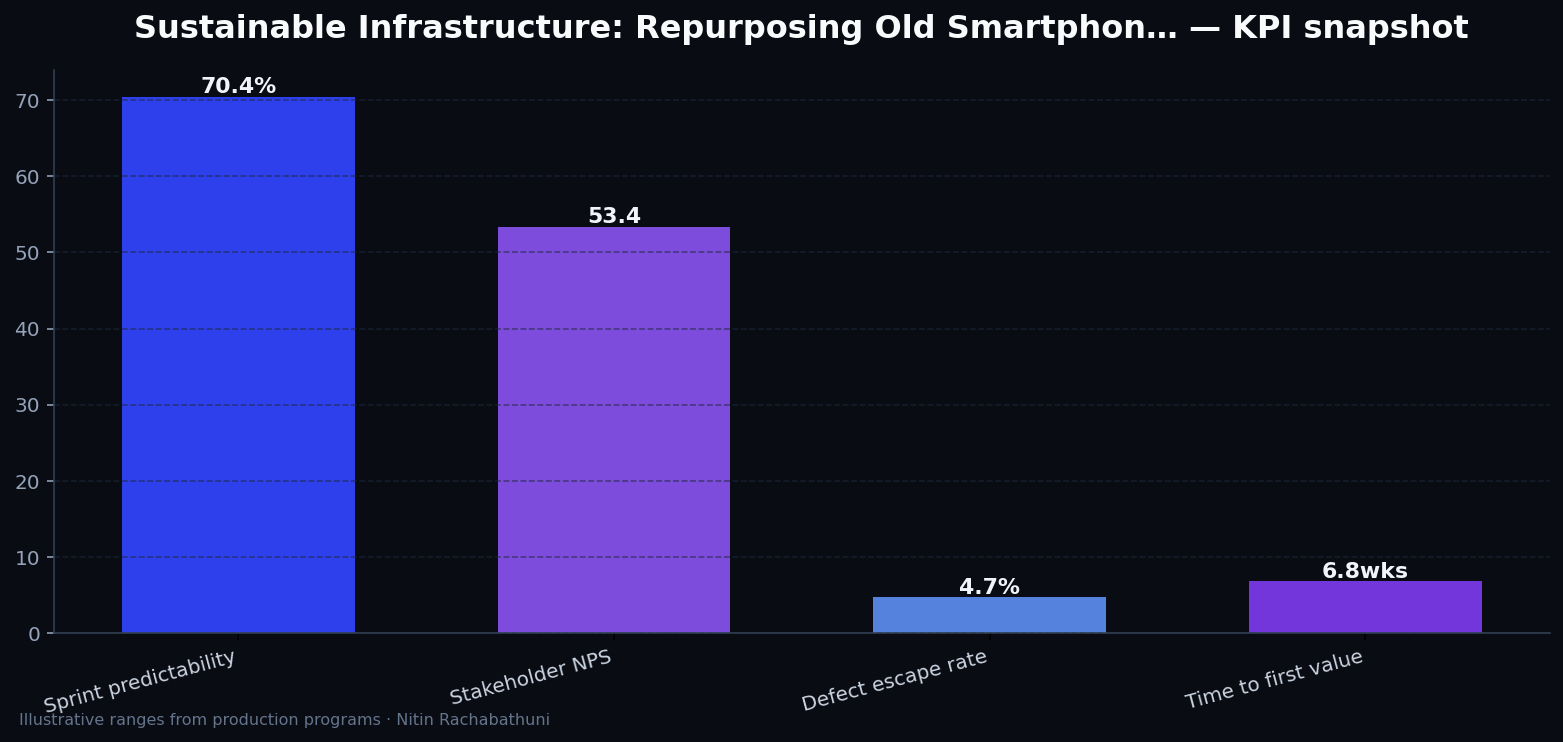
Illustrative consulting KPI ranges observed on programs like “Sustainable Infrastructure: Repurposing Old Smartphon…” — validate against your own telemetry before setting SLOs. Methodology: production-like staging traces + weekly review with product and ops.
Architecture flow

Code sketches
/* Integration sketch */
// Sustainable Infrastructure: Repurposing Old Smartphon…
export async function rolloutRepurposingSmartphonesLowCarbonCloudComputing() {
  const checks = ["telemetry", "auth", "rollback"];
  return { ok: true, checks };
}
Official references
Related on this site
Article slug: repurposing-smartphones-low-carbon-cloud-computing · Engineering notes by Nitin Rachabathuni — MVP in 2 days specialist.