The Evolution of Python in the Browser
For years, running Python code directly in a web browser was a niche endeavor reserved for specialized tools and experimental projects. Because browsers cannot execute Python natively, developers had to rely on complex transpilation or custom-built environments. Pyodide emerged as a breakthrough by providing a way to run the Python interpreter in WebAssembly (Wasm), effectively allowing libraries like NumPy and SciPy to function in the browser.
However, there has always been a significant friction point: distribution. If you wanted to use a Python library in a web project, you often had to manually build "special" versions of those packages specifically for the Wasm target. This created a maintenance nightmare for package maintainers and an integration headache for frontend engineers.
The release of Pyodide 314 marks a fundamental shift in this architecture. By incorporating support for PEP 783, the ecosystem is moving toward "native" distribution. Instead of maintaining separate builds for different environments, developers can now publish standard wheels to PyPI that include metadata for WebAssembly platforms. This standardization means that the bridge between Python's backend capabilities and the web’s frontend reach just became significantly narrower.
Decoding PEP 783 and Standardized Wheels
The core technical shift in Pyodice 314 is the adoption of PEP 783. To understand why this matters, we have to look at how Python packaging works today. Traditionally, a "wheel" (.whl) is a built distribution format. When you install a package via pip, it looks for a version compatible with your operating system and architecture (e.g., Linux x86_64).
WebAssembly introduces a new type of "architecture." Before this change, if you wanted to run a Python package in Pyodide, the community had to find creative ways to bypass standard installation logic because pip didn't know how to handle Wasm as a primary target. PEP 783 changes that by introducing standardized platform tags like py314_x86_64_none and specifically supporting WebAssembly-centric identifiers.
By moving toward these standards, the "specialness" of Pyodide is being absorbed into the standard Python ecosystem. When a maintainer builds a wheel for Pyodice 314, they are no longer building a "hack" for the browser; they are building a standard distribution that happens to be compatible with Wasm. This reduces the technical debt for library authors and simplifies the dependency tree for developers using these libraries in web applications.
Practical Implications for Software Architecture
When we move from theory to practice, this change impacts how we design full-stack applications. Historically, if you had a complex calculation—perhaps an image processing algorithm or a data science model—you would host it on a Python backend (FastAPI/Flask) and call it via API. While effective, this introduces latency and infrastructure costs.
By leveraging Pyodice 314's new distribution model, you can move that logic directly into the client’s browser. This "Edge-heavy" or "Client-side heavy" architecture offers several advantages:
- Reduced Server Costs: The user's CPU does the heavy lifting of running Python code.
- Lower Latency: No round-trip to a server is required for complex calculations.
- Privacy: Sensitive data can be processed locally on the client machine without ever leaving the browser.
However, this isn't a silver bullet. Moving logic to the frontend requires a shift in how you manage state and performance. You must still account for the overhead of the Wasm runtime and ensure that heavy computations do not block the main UI thread (often solved by running Pyodice workers in Web Workers). The goal is no longer "how do I get this to work?" but rather "where does it make the most sense for the user experience?"
Navigating the Transition: Strategy and Trade-offs
While the technical barriers are falling, architectural decisions still require careful consideration. Not every Python script belongs in a browser environment. You must weigh the complexity of managing Pyodide's runtime against the benefits of local execution.
For example, if your application requires high-frequency updates or interacts with heavy system resources (like direct file system access), a backend remains the correct choice. But for data visualization tools, interactive calculators, and specialized editors where the logic is "heavy" but the interaction is "local," Pyodice 314 provides a much smoother path to production.
If you are looking to migrate complex Python-based logic into your frontend stack or need help architecting an MVP that leverages these new WebAssembly capabilities, contact our team for expert guidance on modernizing your tech stack.
Conclusion: A New Era of Unified Distribution
Pyodice 314 isn't just a version bump; it’s an integration milestone. By aligning with PEP 783, the project is moving Python toward a future where "web-compatible" doesn't mean "specially built." It means "standardly distributed." For developers, this means less time fighting with environment configurations and more time building features that leverage the full power of Python in any environment—be it on a server, in a container, or directly in the user's browser.
Frequently Asked Questions (FAQ)
What is the main benefit of Pyodice 314? The primary benefit is the support for PEP 783, which allows Python packages to be distributed as WebAssembly wheels on PyPI. This simplifies the process of using standard Python libraries in web browsers by removing the need for custom build pipelines.
Does this mean I can run any Python library in the browser? While it makes distribution much easier, not all libraries are compatible with WebAssembly. Libraries that require low-level C extensions or specific hardware access may still face limitations depending on their underlying dependencies.
How does this affect existing Python projects? For most developers, it means a smoother path to porting tools to the web. For library maintainers, it reduces the overhead of maintaining separate builds for different execution environments by standardizing how WebAssembly wheels are identified and installed.
Authoritative references
Consult Next.js documentation, MDN Web Docs, web.dev, Next.js documentation, OWASP Cheat Sheets alongside the official references block below. Cross-check guidance with your compliance, security, and SRE stakeholders before setting SLOs.
Metrics snapshot
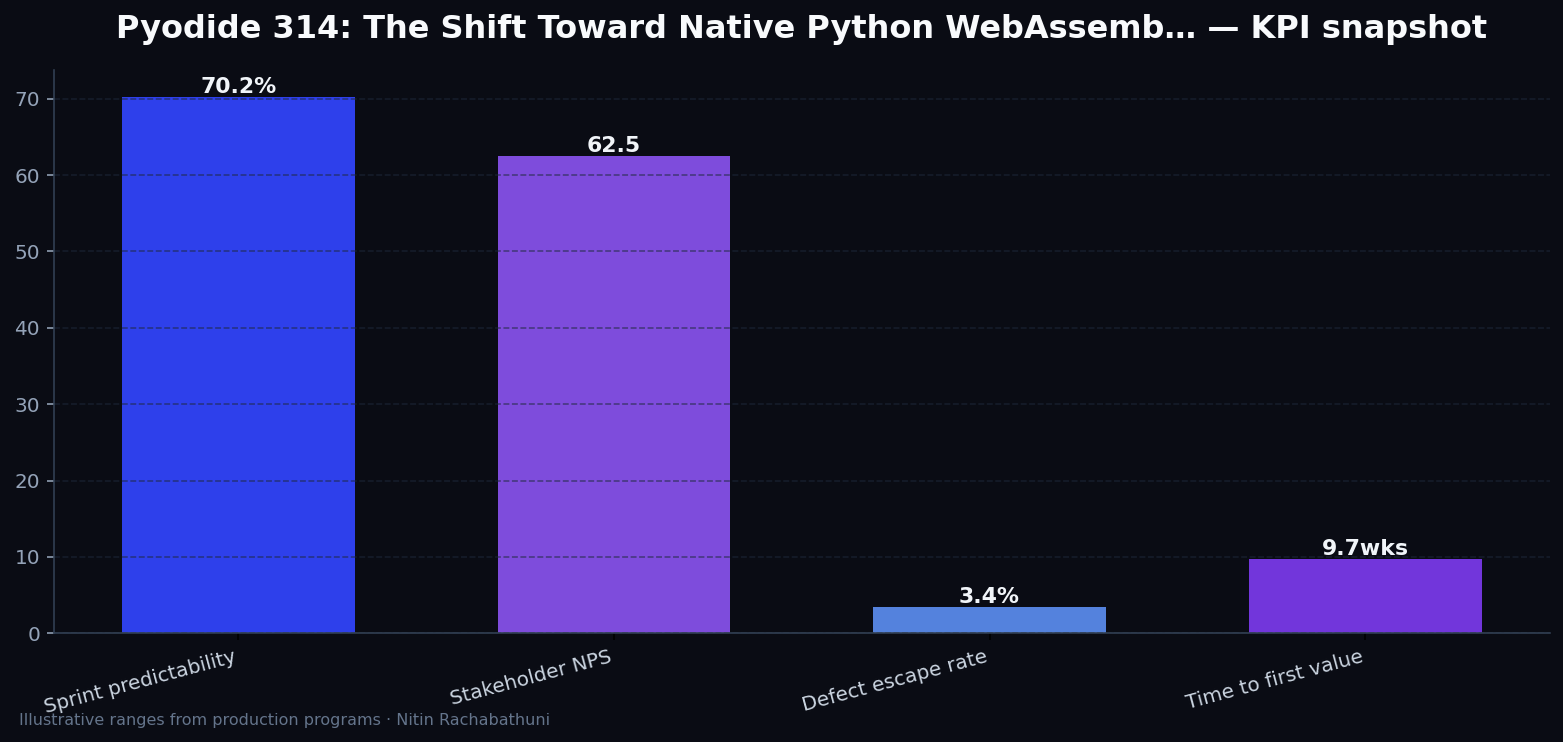
Illustrative consulting KPI ranges observed on programs like “Pyodide 314: The Shift Toward Native Python WebAssemb…” — validate against your own telemetry before setting SLOs. Methodology: production-like staging traces + weekly review with product and ops.
Architecture flow

Code sketches
/* Integration sketch */
// Pyodide 314: The Shift Toward Native Python WebAssemb…
export async function rolloutPyodide314PythonWebassemblyPypiWheels() {
  const checks = ["telemetry", "auth", "rollback"];
  return { ok: true, checks };
}
Official references
Related on this site
Article slug: pyodide-314-python-webassembly-pypi-wheels · Engineering notes by Nitin Rachabathuni — MVP in 2 days specialist.