The Scale of the Shadow: 10,000 Trojan Repositories
The modern software development lifecycle is built on a foundation of trust. We rely on open-source communities to provide the building blocks for everything from web frameworks to niche utility libraries. However, recent research has uncovered a sobering reality: this infrastructure of trust is being weaponized at scale.
Researchers identified over 10,000 GitHub repositories actively distributing Trojan malware. This isn't an isolated incident involving a few "bad actors" making sloppy mistakes; it is a systematic exploitation of the platform’s architecture. By using popular tags and specific commit patterns, these malicious actors managed to bypass automated detection systems for months at a time.
For engineering teams, this means that the "public repository" label no longer equates to a "safe" status. The sheer volume—over 10,000 instances—indicates that attackers are utilizing automation to flood the ecosystem with poisoned code. When you pull a package or copy-paste a script from an obscure repo to solve a minor bug, you aren't just importing functionality; you might be inviting a persistent threat into your production environment.
The Mechanics of Evasion: Why Automation Isn't Enough
One of the most concerning aspects of this discovery is how these repositories evaded detection for extended periods. Automated security tools often look for known signatures or highly anomalous behavior. Sophisticated attackers bypass these by blending in with standard developer workflows.
They use common naming conventions (typosquatting) and "warm up" their accounts to appear legitimate before injecting malicious payloads into the codebase. Because many developers rely on automated indexing and search results, a well-positioned Trojan can reach thousands of users before a manual audit or a security researcher flags it.
This creates a massive surface area risk. When your team integrates a third-party dependency without verifying source integrity, you are essentially outsourcing your security posture to an unknown entity. In the "move fast and break things" era of software engineering, the speed of integration often outpaces the rigor of verification, leaving doors wide open for Trojan malware to establish persistence in your network.
Moving Beyond Awareness: Implementing a Defensible Strategy
Knowing that GitHub is being used as a distribution hub for trojans is only the first step. The real challenge lies in shifting from "awareness" to "active defense." To mitigate these risks, engineering teams must adopt a zero-trust approach toward third-party code.
1. Assume Compromise and Limit Blast Radius Treat every external dependency as potentially compromised. This means implementing strict network policies (egress filtering) so that even if a Trojan is executed, it cannot "call home" or exfiltrate data to an unauthorized IP address. Furthermore, rotate secrets frequently and ensure that your production environment doesn't have broad permissions that a rogue script could exploit.
2. Audit the Path, Not Just the Headline When a security advisory is released for a known package, many teams only patch the specific version mentioned in the headline. However, you must audit the entire dependency path. A Trojan might not be in your direct dependency but buried three levels deep in a sub-dependency that hasn't been updated or audited.
3. Establish a "Quick Fix" Policy The most common entry point for malware is the "quick fix"—a script copied from an obscure repository to solve a minor bug immediately. Organizations should implement a policy where any code not originating from internal repositories or highly-vetted, industry-standard libraries must undergo a peer review and automated scan before it can be merged into the main branch.
Building Resilience in Your Development Pipeline
Securing your software supply chain is an ongoing process of hardening. It requires moving away from "one-off" fixes toward systemic changes in how you manage dependencies.
- Implement SBOMs: Maintain a Software Bill of Materials to know exactly what components are running in your stack at any given time.
- Pin Your Versions: Never use "latest" tags for production builds. Pin specific versions or hashes to ensure that an upstream compromise doesn't automatically propagate into your build pipeline.
- Conduct Tabletop Exercises: Ask the team: "What happens if this Trojan hits us on Friday at 6 PM?" Mapping out the response plan—from isolation to incident response—ensures that you aren't reacting blindly when a breach occurs.
If you are looking to harden your internal development processes or need expert guidance on building more resilient, secure software architectures for your MVP, contact me to discuss how we can streamline your engineering roadmap without compromising on security.
Conclusion
The discovery of 10,000 Trojan repositories highlights a critical reality in modern DevSecOps: the tools that make development faster also provide attackers with more opportunities. By moving toward a model of verified integrity and proactive auditing, you can enjoy the benefits of open-source collaboration while insulating your infrastructure from the risks of malicious actors hiding in plain sight.
Authoritative references
Consult Next.js documentation, MDN Web Docs, web.dev, Next.js documentation, OWASP Cheat Sheets alongside the official references block below. Cross-check guidance with your compliance, security, and SRE stakeholders before setting SLOs.
Metrics snapshot
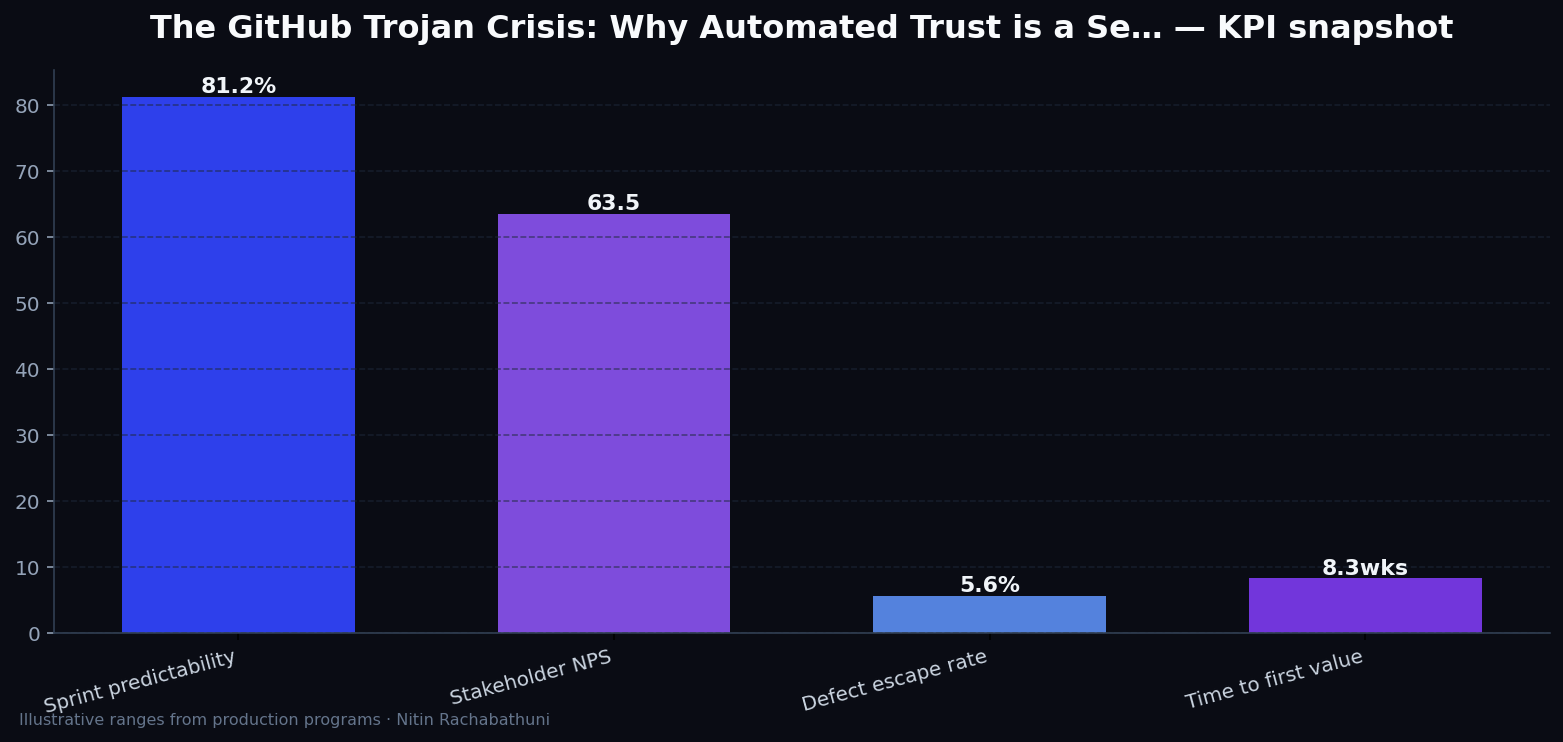
Illustrative consulting KPI ranges observed on programs like “The GitHub Trojan Crisis: Why Automated Trust is a Se…” — validate against your own telemetry before setting SLOs. Methodology: production-like staging traces + weekly review with product and ops.
Architecture flow

Code sketches
/* Integration sketch */
// The GitHub Trojan Crisis: Why Automated Trust is a Se…
export async function rolloutGithubTrojanMalwareRepositoriesSecurityRisk() {
  const checks = ["telemetry", "auth", "rollback"];
  return { ok: true, checks };
}
Official references
Related on this site
Article slug: github-trojan-malware-repositories-security-risk · Engineering notes by Nitin Rachabathuni — MVP in 2 days specialist.