Engineering leadership lens — Nitin Rachabathuni connects industry news to production patterns: tradeoffs, observability, and how senior teams evaluate tools before they commit. The notes below translate hype into decision-grade detail. For a direct conversation on scope—audit, implementation, or advisory—use WhatsApp, email, phone, or LinkedIn below. Flexible hourly terms; available across time zones and countries.
The Breaking Point: When Licensing Costs Outweigh Infrastructure Stability
The recent news regarding Tesco’s decision to migrate 40,000 server workloads away from VMware is more than just a corporate pivot; it is a landmark case study in the dangers of vendor lock-in. Following Broadcom's acquisition of VMware, the licensing landscape shifted dramatically, with some organizations facing price hikes as high as 175%. For a massive retailer like Tesco, these aren't just line items on a spreadsheet—they represent a fundamental shift in the cost-to-value ratio of their core infrastructure.
When a primary technology provider changes its business model so aggressively that it creates "punitive" pricing, organizations are forced into a difficult position. They must choose between paying a premium for a platform they already own or undertaking the Herculean task of migrating thousands of workloads to a new environment. Tesco’s move highlights a critical reality in modern IT: when your infrastructure is built on proprietary layers that are no longer "fair game," you aren't just buying software; you are inheriting the risk of whoever owns that software next.
The decision to migrate 40,000 workloads isn't made lightly. It involves assessing not just the immediate cost of migration, but the long-term viability of the new target platform. For many IT leaders, this situation serves as a wake-up call regarding "gravity." If your data and applications are so deeply entwined with a specific vendor’s ecosystem that moving them would be impossible, you are effectively held hostage by their roadmap.
The Hidden Friction: Technical Debt and Compatibility Hurdles
While the headline of the story focuses on Broadcom's pricing, the underlying technical challenge is far more complex. Moving 40,000 workloads isn't a "lift and shift" operation that can be completed over a weekend. It involves deep architectural considerations regarding how these systems interact with existing tools.
One of the primary pain points identified in this scenario is compatibility with backup and disaster recovery (DR) solutions like Veeam or Zerto. When you move workloads from one hypervisor or environment to another, your entire safety net must be re-evaluated. If a migration target isn't natively supported by your existing DR tools, you face an immediate "technical debt" spike: you have to build custom integrations or purchase new software just to maintain the same level of uptime you had before.
Furthermore, there is the issue of application dependencies. Many legacy systems are built with specific assumptions about the underlying hardware and virtualization layers. Breaking those links can cause silent failures—errors that don't appear during testing but manifest in production when a specific network protocol or storage driver behaves slightly differently than it did on VMware. This "friction" is what makes large-scale migrations so risky; every move introduces the potential for instability in systems that are critical to daily operations.
Navigating the Transition: Strategy Over Speed
When faced with an inevitable migration, the goal should be a controlled transition rather than a frantic escape. Organizations must prioritize their workloads based on criticality. Not all 40,000 servers need to move at once. A tiered approach allows teams to stabilize "Tier 1" applications (those essential for customer-facing services) before moving internal back-office systems.
A successful migration strategy involves three core pillars:
- Audit and Inventory: You cannot move what you don't understand. Every workload must be mapped, including its dependencies, storage requirements, and security protocols.
- Validation of the Target Environment: Before moving a single byte, the target infrastructure must be proven to support the necessary tools (like Veeam) and meet performance benchmarks.
- Incremental Migration: By moving workloads in batches, teams can identify and resolve bugs in the migration pipeline without taking down the entire enterprise's operations.
If your organization is currently grappling with these complexities—whether it’s navigating a forced migration due to vendor changes or trying to balance the costs of "staying put" against the technical debt of moving—it helps to have an expert perspective on the architecture. If you need help identifying the best path forward for your infrastructure, contact our team for MVP assistance in navigating these complex transitions.
Security Implications and Risk Mitigation
A migration of this scale is also a significant security event. Every time an application moves from one environment to another, the "attack surface" changes. New network paths are created, new credentials may be issued, and different firewall rules must be implemented.
In the wake of Broadcom's acquisition, many firms are looking at their infrastructure not just through a cost lens, but through a security lens. If a vendor’s roadmap becomes unpredictable, does that mean they will continue to provide timely security patches? When the answer is "maybe," the risk profile changes.
To mitigate these risks during a transition, teams should adopt a "Zero Trust" mentality:
- Assume Compromise: During migration, treat every new connection as potentially hostile. Rotate secrets and limit the blast radius of any single credential.
- Patch the Path: Don't just wait for an advisory to tell you what’s broken; proactively audit the paths your data takes during the transition from the old environment to the new one.
- Tabletop Exercises: Run "what if" scenarios. If a migration script fails at 6:00 PM on a Friday, does the team have the tools and knowledge to roll back immediately?
The Tesco case is a stark reminder that in modern IT, infrastructure is not just about functionality; it's about sovereignty. By moving toward more open or manageable environments, organizations can reclaim their ability to plan for the next decade without worrying about whose "deal" they are currently riding on.
FAQ
What makes vendor lock-in so dangerous for large enterprises? Vendor lock-in creates a situation where an organization's core operations become dependent on a single provider's pricing, roadmap, and support. If that provider changes their terms—as seen with Broadcom and VMware—the enterprise may be forced into expensive migrations or higher costs to maintain their existing systems.
How many workloads did Tesco plan to move? Tesco reported moving 40,000 server workloads off the VMware platform following the acquisition by Broadcom and subsequent pricing changes.
What are some common tools used for disaster recovery during migrations? Tools like Veeam and Zerto are commonly used to ensure that even as systems are moved between environments, they remain backed up and can be recovered quickly in the event of a failure.**
Authoritative references
Consult Next.js documentation, MDN Web Docs, web.dev, Next.js documentation, OWASP Cheat Sheets alongside the official references block below. Cross-check guidance with your compliance, security, and SRE stakeholders before setting SLOs.
Metrics snapshot
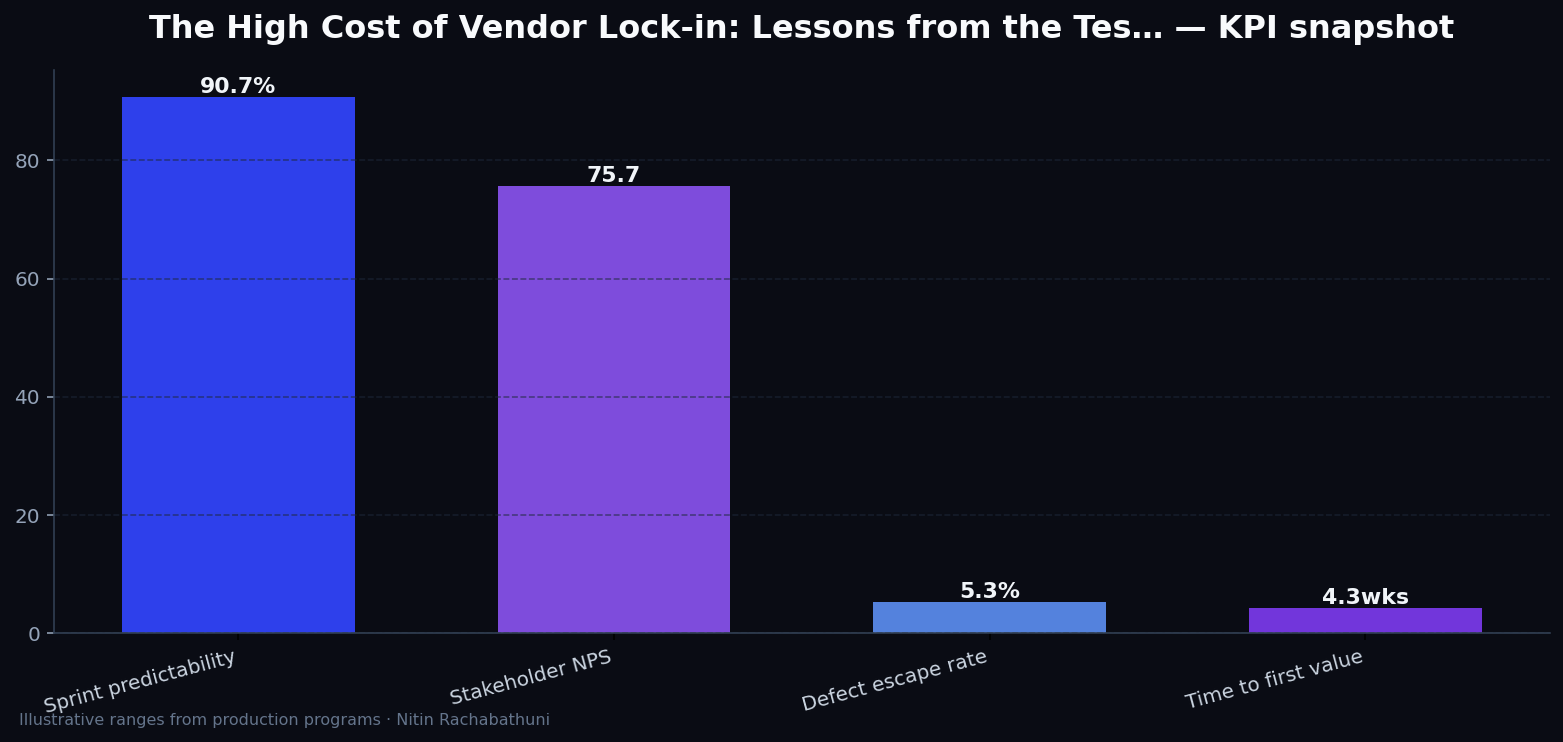
Illustrative consulting KPI ranges observed on programs like “The High Cost of Vendor Lock-in: Lessons from the Tes…” — validate against your own telemetry before setting SLOs. Methodology: production-like staging traces + weekly review with product and ops.
Architecture flow

Code sketches
/* Integration sketch */
// The High Cost of Vendor Lock-in: Lessons from the Tes…
export async function rolloutTescoVmwareBroadcomMigrationRisks() {
  const checks = ["telemetry", "auth", "rollback"];
  return { ok: true, checks };
}
Official references
Related on this site
Article slug: tesco-vmware-broadcom-migration-risks · Engineering notes by Nitin Rachabathuni — MVP in 2 days specialist.