Beyond Character Recognition: Solving the Long-Horizon Parsing Problem in Production
In the early days of Optical Character Recognition (OCR), success was defined by a simple metric: accuracy. If a model could identify that a cluster of pixels represented the letter 'A' or a string of digits formed a price, it was considered a win. However, as we move deeper into the era of Large Language Models (LLMs) and sophisticated Document AI, the bottleneck has shifted significantly.
We are no longer just fighting against poor character recognition; we are fighting against fragmentation. When dealing with complex documents—such as multi-page legal contracts, medical records, or technical manuals—the challenge is maintaining "long-horizon" consistency. This means ensuring that a data point on page one remains contextually linked to its corresponding header on page ten without the system losing the thread during processing.
The Fragmentation Trap in Standard Pipelines
Most production OCR workflows today rely on a "chunk and process" methodology. Because many models have limited context windows or struggle with high-resolution image inputs, developers often slice large documents into smaller segments. While this works for simple invoices, it fails miserably for complex document structures where information is spread across non-contiguous sections.
When you fragment a document, you risk losing the "global" state of the data. A table that spans two pages might have its headers lost in one chunk and its values in another. This creates a massive downstream headache for engineers who then have to write complex post-processing logic to stitch these fragments back together into a coherent JSON object or database entry.
The introduction of Unlimited-OCR (by Baidu) addresses this specific pain point by enabling "one-shot" extraction of extensive content. By building upon established architectures like DeepSeek-OCR and PaddleOCR, it aims to handle large-scale visual data more cohesively. Instead of stitching together a mosaic of broken pieces, the goal is to ingest the document as a unified entity where the model maintains its understanding of the layout across the entire "horizon" of the file.
Engineering Leadership: Moving from Hype to Reliability
As engineering leaders, it is easy to get distracted by the marketing charts of new models. However, when you are moving these systems into production for enterprise clients, "hype" doesn't pass a QA check—reliability does. When evaluating tools like Unlimited-OCR or any other advanced parsing framework, your evaluation should be grounded in three specific engineering disciplines:
1. Benchmark the Specifics
Never rely solely on the launch blog’s benchmark charts. A model might perform exceptionally well on a standard "test set" but fail miserably on your specific proprietary document types (e.g., handwritten notes or non-standard layouts). You must run internal benchmarks on your exact prompt variations and token mixes to understand where the edge cases lie before you commit to a production rollout.
2. Versioning as a First-Class Citizen
One of the most common failures in ML engineering is "silent degradation." This happens when an underlying model update or a slight change in a system prompt alters the output format just enough to break downstream parsers. You must log both the Model ID and the Prompt Version on every single production call. If your parsing accuracy drops by 2% at 3:00 AM, you need to know exactly which version of the logic was running when it happened.
3. The Canary Strategy
Never swap out a core OCR engine across your entire fleet simultaneously. Use canary deployments for low-risk endpoints first. By routing a small percentage of traffic to the new "long-horizon" pipeline, you can monitor for hallucinations or formatting errors in a controlled environment before it impacts your primary user base.
The Strategic Shift: Context is King
The move toward one-shot extraction isn't just about making life easier for developers; it’s about the quality of the data being fed into downstream systems. If an LLM receives a fragmented piece of information, its ability to reason or summarize that information is severely hampered. By providing a "long-horizon" view, we provide the model with the full context it needs to perform complex reasoning accurately.
When you eliminate the need for manual stitching and post-processing logic, you reduce your technical debt significantly. You move from managing a complex web of "glue code" to managing a robust, end-to-end pipeline where the OCR output is high-fidelity and structurally sound from the moment it leaves the vision model.
If you are looking to navigate these complexities in your own production environment or need help architecting an MVP for a complex document processing system, reach out for expert guidance to get started on building a robust architecture that scales.
Conclusion: Building for the Long Term
The transition from "Can we read this text?" to "Do we understand this entire document?" marks the next evolution in Document AI. By adopting frameworks like Unlimited-OCR, teams can move away from the limitations of fragmented processing and toward a more cohesive, one-shot extraction model.
As leaders, our job is to ensure that these advancements are implemented with rigor—through strict versioning, targeted benchmarking, and cautious deployment cycles. The goal isn't just to have the fastest OCR; it’s to have the most reliable data pipeline for your users.
FAQ
What is "long-horizon" parsing in the context of OCR? Long-horizon parsing refers to the ability of a model to maintain structural and contextual consistency across large, multi-page documents. Unlike standard OCR which processes snippets, long-horizon systems understand how data on page 1 relates to information on page 50.
How does Unlimited-OCR differ from traditional OCR pipelines? Traditional pipelines often fragment large documents into smaller chunks for processing, which can break the logical flow. Unlimited-OCR enables one-shot extraction of extensive content by leveraging advanced architectures to handle larger visual data more cohesively.
What are the engineering best practices for deploying OCR models? Engineers should benchmark specific prompts and token mix rather than relying on general launch charts. Additionally, logging model ID + prompt version on every production call and using canary deployments ensures stability when updating production workflows.
Authoritative references
Consult Next.js documentation, MDN Web Docs, web.dev, Next.js documentation, OWASP Cheat Sheets alongside the official references block below. Cross-check guidance with your compliance, security, and SRE stakeholders before setting SLOs.
Metrics snapshot
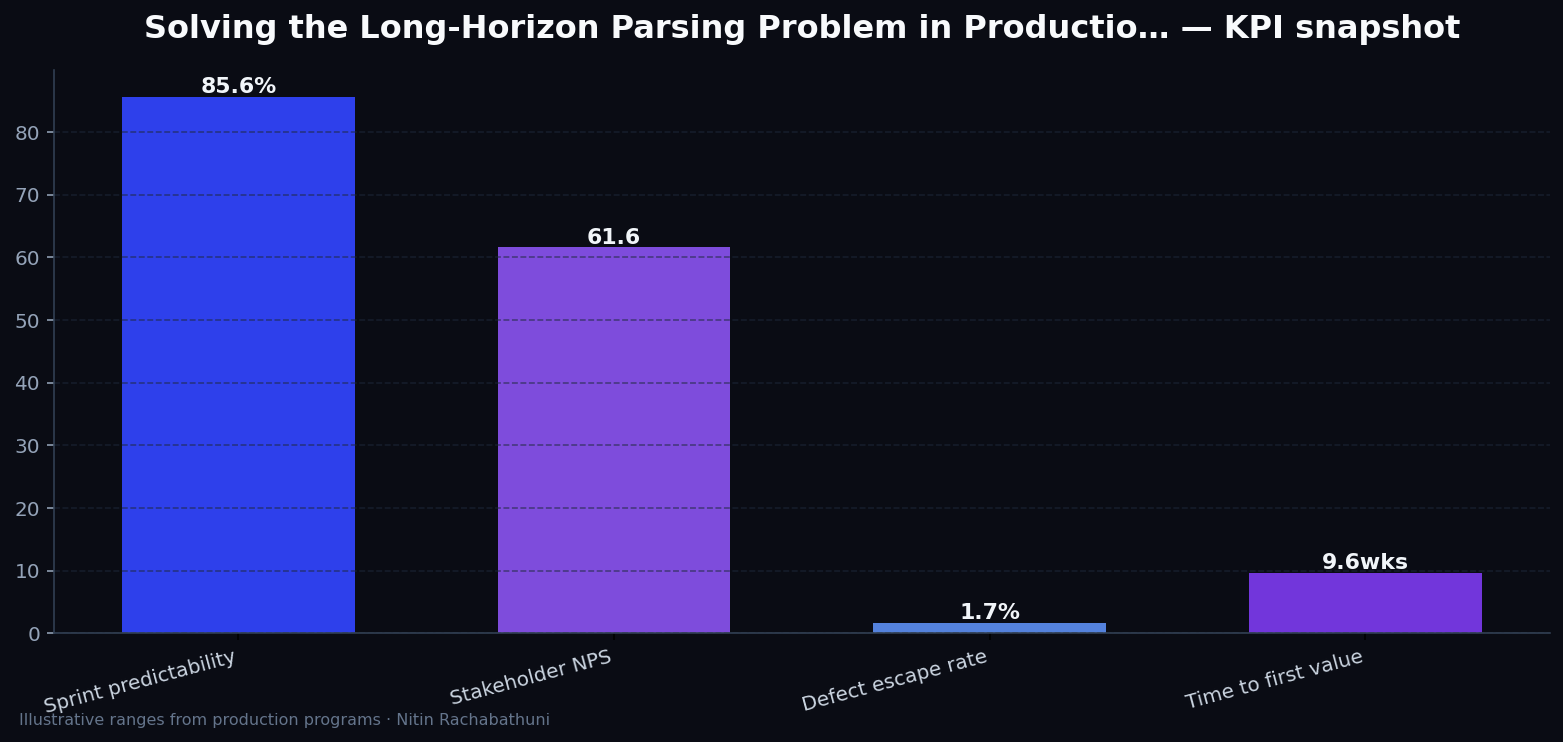
Illustrative consulting KPI ranges observed on programs like “Solving the Long-Horizon Parsing Problem in Productio…” — validate against your own telemetry before setting SLOs. Methodology: production-like staging traces + weekly review with product and ops.
Architecture flow

Code sketches
/* Integration sketch */
// Solving the Long-Horizon Parsing Problem in Productio…
export async function rolloutSolvingLongHorizonParsingOcrLimitations() {
  const checks = ["telemetry", "auth", "rollback"];
  return { ok: true, checks };
}
Official references
Related on this site
Article slug: solving-long-horizon-parsing-ocr-limitations · Engineering notes by Nitin Rachabathuni — MVP in 2 days specialist.