Lisp in the Rust Type System: Exploring DSLs via Advanced Type Engineering
The boundaries between a language's compiler and its type system are often porous. In systems programming, we frequently encounter scenarios where standard abstractions aren't enough to express complex business logic or hardware constraints without introducing significant runtime overhead. This is where "Type-Driven Development" moves from a philosophy into a technical implementation: using the type system itself as an execution engine for domain-specific languages (DSLs).
A recent project, lisp-in-types, demonstrates this concept by hosting a Lisp interpreter entirely within Rust's trait system. While it might seem like a "proof of concept" or academic exercise, it highlights a profound capability of the Rust compiler: its ability to perform complex logic during the compilation phase rather than at runtime.
The Mechanics of Type-Level Execution
To understand how a Lisp interpreter can exist within Rust's types, we have to look at how traits and generics function as a functional programming environment. In many ways, Rust’s trait system is a form of "type-level" logic. When the compiler resolves a generic type or matches a trait implementation, it is essentially executing code—just not in the way a CPU executes instructions at runtime.
In lisp-in-types, this manifests through:
- Recursive Functions: By leveraging recursive traits and associated types, the system can evaluate nested expressions during compilation.
- Lexical Environments: The implementation uses "let" bindings to manage scope, ensuring that variables are resolved correctly within their respective blocks without needing a runtime environment stack.
- Proper Application & Continuations: By mapping Lisp's functional primitives onto Rust’s type-level structures, the project achieves complex control flows like delimited continuations—features usually reserved for high-level functional languages.
The core takeaway here is that if you can express it in a typed function, you can often "execute" it in a type system. This isn't just about running Lisp; it’s about using the Rust compiler as an optimizer and validator for your internal logic before the binary ever touches a CPU.
The Trade-offs: Safety vs. Flexibility
As with any architectural decision, there is no "free lunch." Implementing a DSL through the type system involves significant trade-offs that every systems engineer must weigh before choosing this path over traditional runtime execution.
The Gains:
- Zero-Cost Abstractions: Because the logic is resolved at compile-time, the resulting machine code contains only the final result of the computation. There is no "interpreter" overhead.
- Compile-Time Validation: If your DSL represents a configuration or a hardware protocol, any error in that logic results in a compilation failure rather than a runtime crash.
The Costs:
- Loss of Dynamism: You cannot have an
eval()function. Every symbol must be known to the compiler. This means you cannot easily process raw strings from a config file as "code" without pre-processing them into types. - Macro Dependency: To make the experience usable for humans, these systems often require complex macros to bridge the gap between user input and type definitions.
- Complexity of Error Messages: When a type-level computation fails, the Rust compiler may produce opaque errors that are difficult to debug without deep knowledge of how the trait system is resolving the specific paths.
Is Type-Level DSLs Viable for Internal Tooling?
The real question isn't "Can we do this?" but rather "Should we do this?" For many internal tools, the answer depends on the nature of the data being processed.
If you are building a tool to parse configuration files or define network protocols where the structure is known at build-time, type-level DSLs are an exceptional choice. They allow you to create a "safe" sandbox for developers to write logic that is guaranteed by the compiler's type checker. This reduces the surface area for bugs and eliminates entire classes of runtime errors.
However, if your tool requires high flexibility—such as a plugin system where users can load dynamic scripts or an engine that handles highly unpredictable input data—a type-level approach will likely be too restrictive. In those cases, a standard interpreter (like Rhai or Lua) integrated into Rust is the more pragmatic path.
When building for production systems, we must ask: Who measured this on what workload? While the "zero-cost" nature of type-system execution is mathematically true, the "cost" shifts to developer time and compilation speed. A complex type-level Lisp might increase compile times significantly as the compiler traverses deep trait trees.
If you are looking to architect a high-performance internal tool or need help navigating the complexities of Rust's advanced features to build a robust MVP, contact me for expert guidance. We can work together to determine if your specific use case benefits from type-level engineering or standard system design.
Summary of Technical Constraints
To summarize the technical boundaries observed in lisp-in-types:
- Symbol Resolution: Must be handled via macros; no dynamic symbol lookup.
- No Macro Expansion: The "Lisp" part is executed by the type system, not the macro preprocessor.
- Scope Management: Handled through nested types rather than a runtime stack.
FAQ
Q: Does using a type-level DSL make the final binary larger?
A: Generally, no. Because the "execution" happens during compilation, the compiler only keeps the results of those computations in the final binary. The complexity is paid by the developer and the compiler at build-time, not by the user at runtime.
Q: Why would someone choose this over a standard Rust implementation?
A: You would choose this when you want to enforce constraints that are difficult to express in standard imperative code but easy to define as types. It allows for "correct-by-construction" software where certain invalid states are literally impossible to compile.
Q: Is it harder to maintain a type-level DSL?
A: Yes, it is significantly more complex to debug and maintain than standard Rust. It requires developers who have a deep understanding of the compiler's behavior regarding generics and trait resolution. Use this only when the benefits of safety outweigh the costs of complexity.
Authoritative references
Consult Next.js documentation, MDN Web Docs, web.dev, Next.js documentation, OWASP Cheat Sheets alongside the official references block below. Cross-check guidance with your compliance, security, and SRE stakeholders before setting SLOs.
Metrics snapshot
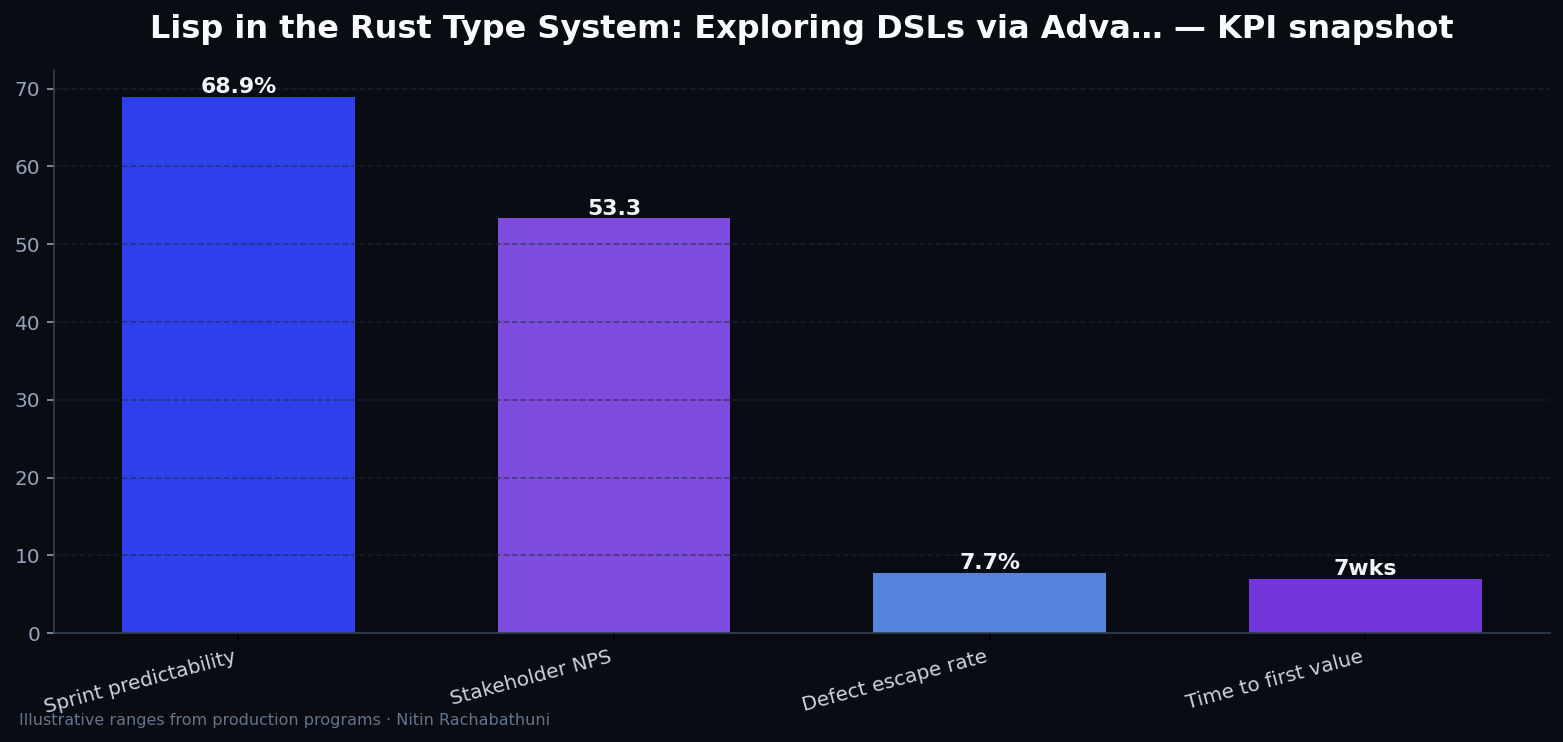
Illustrative consulting KPI ranges observed on programs like “Lisp in the Rust Type System: Exploring DSLs via Adva…” — validate against your own telemetry before setting SLOs. Methodology: production-like staging traces + weekly review with product and ops.
Architecture flow

Code sketches
/* Integration sketch */
// Lisp in the Rust Type System: Exploring DSLs via Adva…
export async function rolloutLispInTheRustTypeSystem() {
  const checks = ["telemetry", "auth", "rollback"];
  return { ok: true, checks };
}
Official references
Related on this site
Article slug: lisp-in-the-rust-type-system · Engineering notes by Nitin Rachabathuni — MVP in 2 days specialist.