The Engineering Reality of Salesforce's $3.6B Acquisition of Fin
The news that Salesforce is moving to acquire Fin (formerly Intercom) for $3.6 billion isn't just a headline about market share; it is a massive engineering puzzle waiting to be solved. While the business logic—consolidating the customer communication stack into one powerhouse ecosystem—is clear, the technical execution required to merge these two distinct platforms is where the real work begins.
When an organization of Salesforce’s scale acquires a high-growth platform like Fin, they aren't just buying code; they are inheriting a culture, a tech stack, and a set of architectural decisions made under different constraints than those that govern the Salesforce core. As engineers, we have to look past the press release and analyze what this means for system reliability, developer experience (DX), and long-term maintainability.
The Challenge of Merging Divergent Architectures
One of the most immediate hurdles in any acquisition of this scale is "architectural friction." Fin was built as a modern communication layer, likely prioritizing high-concurrency messaging and real-time interactions. Salesforce’s ecosystem, while massive, operates on different legacy constraints and integration patterns.
When these two systems begin to share data or authentication flows, the engineering team faces several critical decisions:
- Identity Management: Do we migrate Fin users into a unified Salesforce identity provider (IdP), or do we build a bridge? A bridged solution creates technical debt; a migration is risky but cleaner for long-term security.
- Data Consistency: How are "customer records" defined in both systems? Mapping disparate schemas while ensuring zero downtime during the transition is an immense undertaking that requires rigorous ETL (Extract, Transform, Load) pipelines and careful schema evolution.
- API Standardization: To provide a seamless experience for enterprise clients, both platforms must eventually speak the same language. This often means wrapping legacy endpoints in new wrappers or rewriting core services to adhere to unified API standards.
Preserving Developer Experience (DX) During Integration
A common pitfall in M&A is the degradation of developer experience. When two engineering teams are merged under one roof, the "path of least resistance" for a developer often becomes fragmented. If a developer has to learn two different deployment pipelines, two sets of CI/CD tools, and two distinct ways of handling environment variables just to push a minor update, velocity will crater.
To prevent this, leadership must prioritize a unified internal platform. Instead of forcing Fin engineers to adopt Salesforce's entire legacy workflow overnight—which can lead to talent attrition—the goal should be the creation of an abstraction layer. The objective is for a developer to feel like they are working on one cohesive product, even if the underlying infrastructure remains heterogeneous in the short term.
We must ask: Who measured this integration cost? On what workload? It is easy to claim that "integration will be seamless," but unless there is a clear plan for unifying CI/CD pipelines and internal tooling, the friction will manifest as delayed release cycles and increased bug rates in the first 18 months post-acquisition.
Managing Technical Debt and Product Philosophy
Every acquisition brings with it an inherited backlog of technical debt. Fin likely has "fast" debt—shortcuts taken to achieve rapid market growth. Salesforce operates on "scale" debt—complexities introduced by supporting millions of enterprise customers across diverse industries.
The conflict arises when these two philosophies collide. One team might want to refactor a core module for elegance, while the other needs it to remain stable because it supports thousands of downstream integrations. The engineering leadership must decide where to draw the line:
- Refactor vs. Wrap: Do we rewrite Fin’s components to match Salesforce standards (high effort/high long-term reward) or wrap them in an adapter layer (low effort/higher maintenance)?
- Feature Consolidation: Where do features overlap? If both platforms offer a "chat" widget, which one becomes the standard? Eliminating redundancy is essential for reducing the cognitive load on both internal developers and external customers.
Strategic Planning: The Rollback Plan
In high-stakes integrations like this, every major architectural change should have a documented rollback plan before it hits production. When you are merging two massive systems, "moving fast and breaking things" isn't an option—breaking something means potentially disrupting thousands of enterprise clients who rely on these tools for their daily operations.
Engineers must be skeptical of the "all-in-one" hype. The reality is a multi-year journey of synchronization. Success won't be measured by the day the deal closes, but by the first year when a developer can move between the Fin and Salesforce codebases without feeling like they’ve stepped into a different world.
If you are navigating complex system integrations or looking to streamline your engineering roadmap for an upcoming transition, I can help you navigate these technical trade-offs. Contact me here to discuss how we can build scalable systems that survive the growth of acquisition.
FAQ
What is the primary risk when merging two different tech stacks? The main risks include "integration friction," where differing standards for API design, security protocols, and data schemas create a fragmented experience for both developers and end-users. This often leads to increased technical debt and slower deployment cycles during the transition period.
How does an acquisition like this affect internal engineering culture? Merging cultures can lead to tension regarding "the right way" to build features. Success depends on establishing common goals, such as unified CI/CD pipelines and shared documentation standards, rather than forcing one team's culture onto another immediately.
Why is developer experience (DX) critical during a merger? Poor DX leads to slower feature delivery and higher turnover of high-performing engineers. By providing clear tools and consistent workflows early in the integration process, companies can maintain momentum and retain talent from both legacy organizations.
Authoritative references
Consult Next.js documentation, MDN Web Docs, web.dev, Next.js documentation, OWASP Cheat Sheets alongside the official references block below. Cross-check guidance with your compliance, security, and SRE stakeholders before setting SLOs.
Metrics snapshot
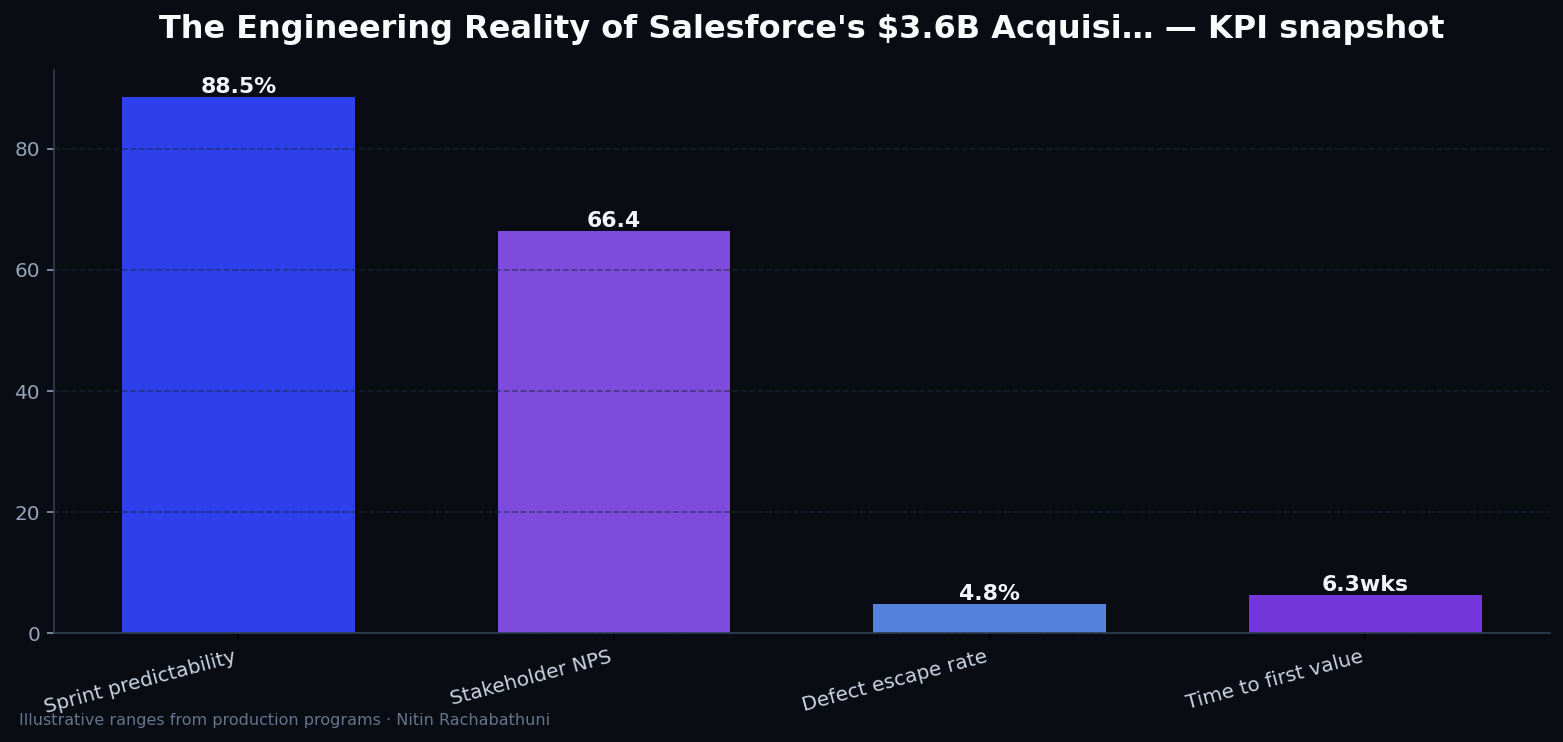
Illustrative consulting KPI ranges observed on programs like “The Engineering Reality of Salesforce's $3.6B Acquisi…” — validate against your own telemetry before setting SLOs. Methodology: production-like staging traces + weekly review with product and ops.
Architecture flow

Code sketches
/* Integration sketch */
// The Engineering Reality of Salesforce's $3.6B Acquisi…
export async function rolloutSalesforceFinAcquisitionEngineeringChallenges() {
  const checks = ["telemetry", "auth", "rollback"];
  return { ok: true, checks };
}
Official references
Related on this site
Article slug: salesforce-fin-acquisition-engineering-challenges · Engineering notes by Nitin Rachabathuni — MVP in 2 days specialist.