The Great Decoupling: Navigating the Choice Between Frontier Models and Local LLMs for Development
The debate within engineering circles has shifted from if we should use Large Language Models (LLMs) to where those models should live. As organizations grapple with data privacy, latency concerns, and the sheer cost of high-token usage, a significant migration toward local inference is occurring.
In recent technical discussions, developers are weighing the "senior" reasoning capabilities of frontier models like Claude 3.5 Sonnet against the autonomy and security of locally hosted models such as Qwen or Llama variants. This isn't just a matter of preference; it’s a strategic decision about where your intellectual property sits and how much control you need over your automated workflows.
The Case for Frontier Models: High-Level Reasoning
There is no denying the "magic" of frontier models. When you are architecting a complex microservices system or debugging a race condition in a multi-threaded environment, the reasoning capabilities of Claude Opus or GPT-4o are hard to replicate locally. These models act as senior architects—they can synthesize vast amounts of context and provide nuanced suggestions on design patterns that might not be immediately obvious.
However, these benefits come with caveats:
- Data Exposure: Every prompt sent to a cloud provider is technically "out" of your immediate control. For companies dealing with PII (Personally Identifiable Information) or proprietary trade secrets, this creates a significant compliance hurdle.
- Cost Scaling: While the cost per token has dropped significantly, high-frequency automated tasks—such as generating unit tests for every commit or real-time documentation updates—can become prohibitively expensive when scaled across an entire engineering team.
- Dependency: You are at the mercy of the provider's uptime and their "model drift" policies.
The Rise of Local Inference: Autonomy and Speed
On the other side of the fence, local models (often running on-premise or in private clouds) offer a different value proposition. Models like Qwen have shown remarkable proficiency in specific coding tasks, such as writing boilerplate for Django, configuring Kubernetes manifests, or generating repetitive SQL queries.
The advantages of going "local" are practical:
- Data Sovereignty: By running models on your own hardware (or private VPC), you ensure that no proprietary code ever leaves your perimeter. This is the gold standard for security-conscious industries like fintech and healthcare.
- Deterministic Workflows: Because you control the environment, you can pin specific versions of a model to ensure that your automated pipelines don't break when a provider updates their weights.
- Cost Efficiency: Once the hardware is provisioned, the marginal cost of running an inference task drops significantly compared to per-token API pricing.
Finding the Hybrid Equilibrium
The most sophisticated engineering teams are moving toward a hybrid model. They aren't replacing Claude with Qwen entirely; they are delegating tasks based on complexity and risk profile.
Use Frontier Models for:
- Initial system architecture design.
- Complex debugging of non-obvious logic errors.
- Refactoring large blocks of legacy code where context is vast.
Use Local Models for:
- Unit test generation and boilerplate creation.
- Automated documentation updates.
- Internal scripts and "low-stakes" coding tasks.
- Processing data that contains sensitive information.
Implementation Best Practices for the Modern Stack
If you are moving toward a hybrid or local-first approach, do not simply swap an API key and hope for the best. You need a rigorous deployment strategy to ensure reliability:
- Benchmark Your Specific Use Case: Don't rely on general benchmarks (like MMLU). Run your specific prompts through both models and measure accuracy, latency, and cost over 500 iterations.
- Version Control Everything: Log the model ID and the exact prompt version for every production call. This allows you to trace back why a piece of code was generated in a certain way if an issue arises later.
- Canary Deployments: When introducing a new local model into your CI/CD pipeline, roll it out to low-risk endpoints first. Ensure the "hallucination rate" is within acceptable limits before letting it touch core production logic.
If you are looking to build a robust, scalable AI integration for your engineering team and need help navigating these architectural complexities, contact us for MVP development help to streamline your implementation.
Conclusion: Choosing the Right Tool for the Job
The choice between local LLMs and frontier models isn't binary; it’s a spectrum of trade-offs. While Claude provides the "senior" reasoning needed for high-level architecture, locally hosted models provide the privacy, speed, and cost-efficiency required for daily, repetitive development tasks. By understanding where each model excels, you can build a more secure, efficient, and scalable engineering workflow.
FAQ
When should I choose a local LLM over a frontier model like Claude?
Choose a local LLM when data privacy is paramount or when you need to perform repetitive coding tasks without incurring high API costs. Frontier models remain superior for complex architectural reasoning and multi-step problem solving.
Are current local models capable of handling production-grade code?
Yes, modern open-weight models can handle specific tasks like Django integrations or Kubernetes configurations effectively. However, they may require more precise prompting and "guardrails" compared to their larger cloud counterparts.
How do I ensure safety when deploying LLMs in a production environment?
You should log model IDs and prompt versions for every call, perform canary testing on low-risk endpoints, and benchmark your specific token mix rather than relying solely on general leaderboard scores.
Authoritative references
Consult Next.js documentation, MDN Web Docs, web.dev, Next.js documentation, OWASP Cheat Sheets alongside the official references block below. Cross-check guidance with your compliance, security, and SRE stakeholders before setting SLOs.
Metrics snapshot
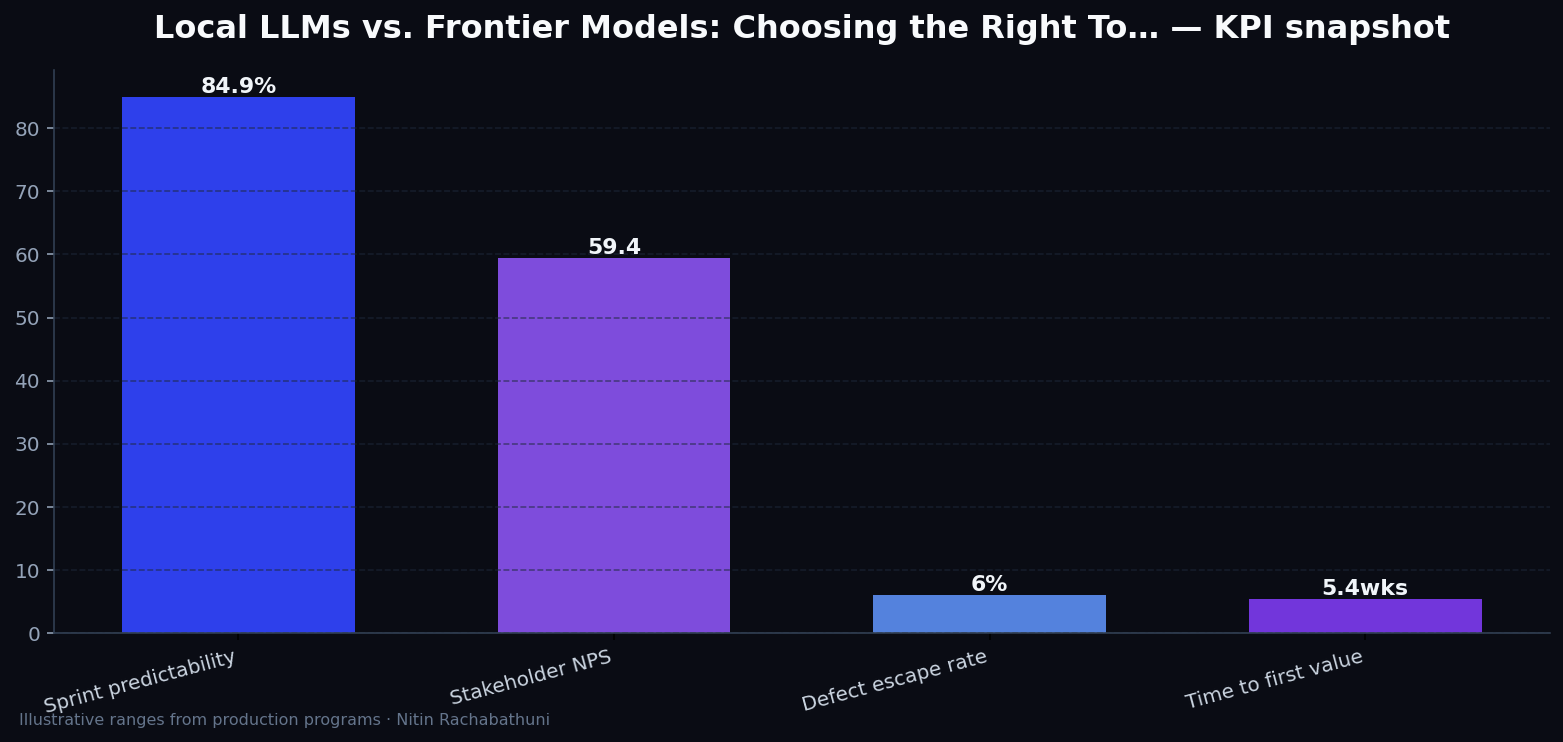
Illustrative consulting KPI ranges observed on programs like “Local LLMs vs. Frontier Models: Choosing the Right To…” — validate against your own telemetry before setting SLOs. Methodology: production-like staging traces + weekly review with product and ops.
Architecture flow

Code sketches
/* Integration sketch */
// Local LLMs vs. Frontier Models: Choosing the Right To…
export async function rolloutLocalLlmsVsFrontierModelsCodingWorkflow() {
  const checks = ["telemetry", "auth", "rollback"];
  return { ok: true, checks };
}
Official references
Related on this site
Article slug: local-llms-vs-frontier-models-coding-workflow · Engineering notes by Nitin Rachabathuni — MVP in 2 days specialist.