The Architect's Dilemma: Choosing the Right Foundation for Rust GUIs
As systems programmers move toward more interactive applications, the question of how to build user interfaces (UIs) in Rust has become a central architectural debate. Unlike web development, where the browser handles much of the heavy lifting, or mobile development with established frameworks, Rust UI development forces engineers to confront the raw reality of rendering pipelines and state management early on.
The core tension lies in a fundamental engineering trade-off: Stability vs. Innovation.
When you choose a path for your UI stack, you aren't just picking a library; you are choosing how much "technical debt" you are willing to manage versus how much "innovation overhead" you can tolerate. In the Rust ecosystem, this manifests as the choice between established bindings (like GTK or Qt) and emerging, pure-Rust frameworks (like Slint or others).
From a leadership perspective, this decision isn't just about what is "coolest"—it’s about risk management. You must decide if your product requires the reliability of a decades-old C++ engine wrapped in Rust, or if you want to be on the bleeding edge of a native Rust implementation that offers tighter integration with modern GPU pipelines.
The Case for Stability: Leveraging Proven Bindings (GTK/Qt)
For many enterprise applications, "boring" is a feature. Using bindings for established libraries like GTK or Qt provides an immediate advantage in terms of widget maturity. These frameworks have spent decades refining how buttons behave, how accessibility layers work, and how complex layouts are rendered across different operating systems.
When you use these bindings, the Rust layer acts as a safe wrapper around highly optimized C++ code. The benefits include:
- Feature Completeness: You don't have to reinvent the wheel for common components like date pickers or complex tables.
- Cross-Platform Consistency: These libraries have already solved the "it looks different on Linux vs. Windows" problem through extensive testing.
- Predictability: The bugs in these systems are well-documented, and the solutions are often already known.
However, there is a cost. Because these are bindings, you are occasionally fighting against the limitations of the underlying C++ architecture to make it feel "Rusty." You may encounter complexities in memory management across the FFI (Foreign Function Interface) boundary or find that certain modern styling techniques are harder to implement because they weren't envisioned when the original C++ library was conceived.
The Case for Innovation: Native Rust Frameworks (Slint, etc.)
On the other side of the spectrum are native Rust frameworks. These projects aim to build UI components directly in Rust, often leveraging modern graphics APIs like Vulkan or Metal through abstraction layers.
The advantages here are significant for high-performance applications:
- True Ownership: By avoiding the FFI boundary where possible, these frameworks can leverage Rust's type system more effectively, leading to safer state management.
- Modern Rendering: These tools often integrate more cleanly with modern GPU pipelines, allowing for smoother animations and complex visual effects that are difficult to achieve in older C++ wrappers.
- Developer Experience (DX): Because they are built specifically for Rust, the API surfaces feel more natural to a Rust developer, leading to cleaner codebases and easier refactoring.
The trade-off here is maturity. You may find yourself building components that "should" have been there, or you might encounter bugs in the rendering engine that haven't been caught by thousands of users yet. This path requires a team that is comfortable with active participation in the community and the ability to navigate evolving APIs.
Engineering Leadership: Moving Beyond "Localhost" Thinking
When leading a team through these choices, it is vital to move away from "happy path" development. It is easy to build a prototype on your local machine where everything works perfectly because you are only handling small amounts of data and simple UI states.
To ensure production readiness, leadership must insist on several key metrics:
- Real-World Load: Does the UI remain responsive when processing thousands of updates per second? A "smooth" UI at 30 frames per second with a tiny dataset is not the same as a fluid experience under heavy load.
- Tail Latency (p95): In user interface design, averages are deceptive. If your average frame time is 16ms but every 20th frame takes 100ms, the user will perceive "jank." You must measure and optimize for the 95th percentile of performance to ensure a consistent experience.
- Observability: Ensure that state transitions are logged and traceable. In complex UIs, it is often hard to tell if a bug is in the business logic or the rendering layer.
If you are building an MVP (Minimum Viable Product) and need help navigating these architectural complexities—specifically in choosing between stability-first and performance-first paths—you can reach out for expert guidance here.
Conclusion: Making the Informed Choice
There is no "correct" answer, only a choice that aligns with your product's goals. If you are building a mission-critical enterprise tool where reliability is non-negotiable, the established bindings offer a safer harbor. If you are building a high-performance creative tool or an innovative consumer application where unique aesthetics and fluid motion are paramount, the native Rust path offers a more fertile ground for innovation.
Ultimately, your choice should be dictated by your timeline, your team's expertise with FFI vs. pure Rust, and the specific performance requirements of your end users. Build for the scale you expect to hit in production, not just the features you need to show at the next demo.
FAQ
What is the primary difference between using GTK/Qt bindings and a native Rust UI framework?
GTK and Qt provide mature, battle-tested C++ infrastructure that offers stability but may have larger binaries and more complex FFI boundaries. Native Rust frameworks offer tighter integration with modern rendering engines and better "Rustiness" at the cost of less maturity in their component libraries.
Why is 'p95' latency more important than average performance in UI development?
Average frame times can hide intermittent stutters (jakes) that ruin the user experience. Focusing on p95 ensures that 95% of interactions are smooth, which is critical for maintaining a high-quality feel in interactive applications.
Is Rust currently production-ready for complex desktop GUI applications?
Yes, but "readiness" depends on your requirements. If you need immediate stability and standard widgets, C++ bindings are the safer choice; if you want a bespoke, high-performance experience with modern rendering, native Rust frameworks are evolving rapidly and are becoming more viable daily.
Authoritative references
Consult Next.js documentation, MDN Web Docs, web.dev, Next.js documentation, OWASP Cheat Sheets alongside the official references block below. Cross-check guidance with your compliance, security, and SRE stakeholders before setting SLOs.
Metrics snapshot
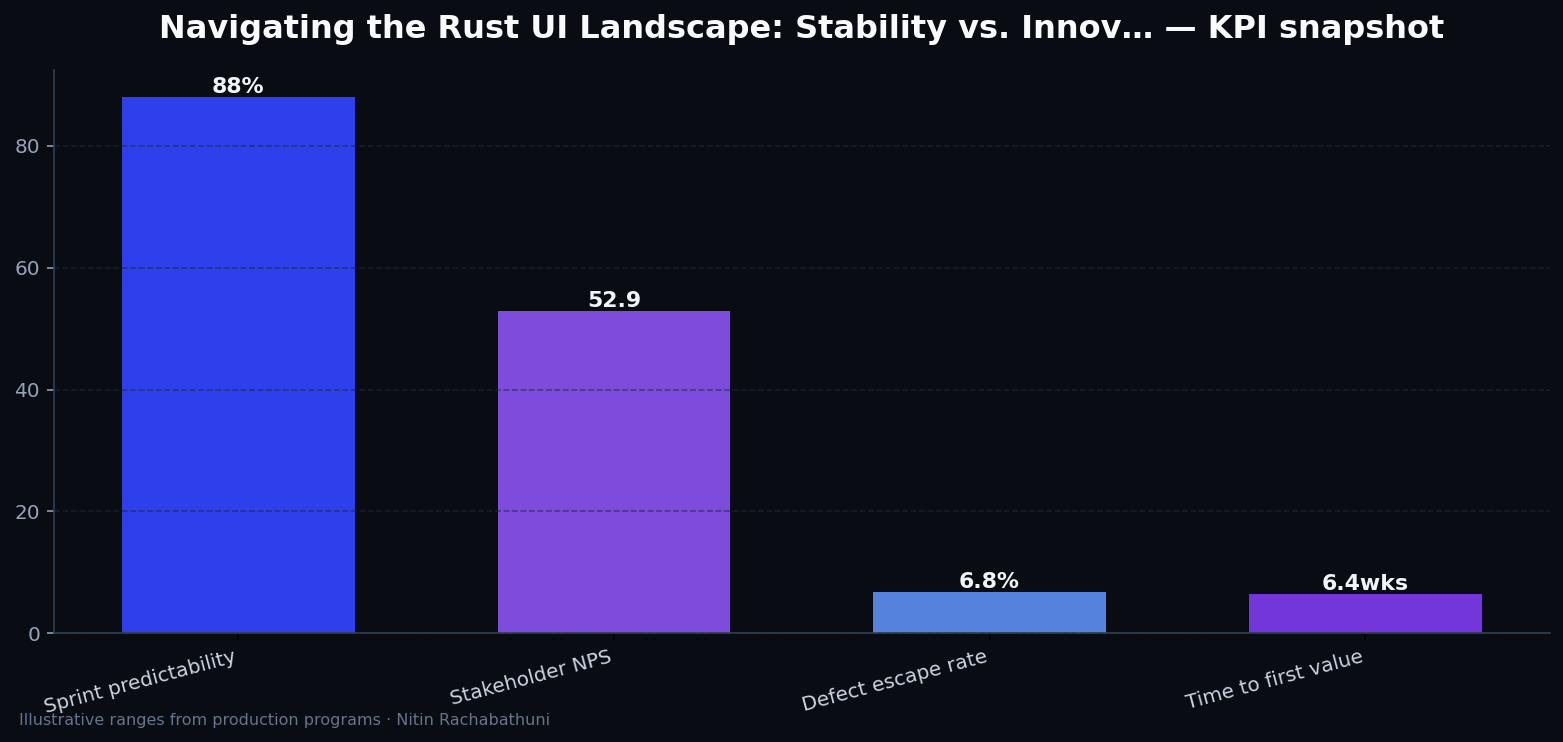
Illustrative consulting KPI ranges observed on programs like “Navigating the Rust UI Landscape: Stability vs. Innov…” — validate against your own telemetry before setting SLOs. Methodology: production-like staging traces + weekly review with product and ops.
Architecture flow

Code sketches
/* Integration sketch */
// Navigating the Rust UI Landscape: Stability vs. Innov…
export async function rolloutRustUiEcosystemStabilityVsInnovation() {
  const checks = ["telemetry", "auth", "rollback"];
  return { ok: true, checks };
}
Official references
Related on this site
Article slug: rust-ui-ecosystem-stability-vs-innovation · Engineering notes by Nitin Rachabathuni — MVP in 2 days specialist.