The Evolution of the AI Sidekick to a First-Class Teammate
For the past two years, the tech industry has been saturated with "AI-powered" project management tools. However, if we look closely at the architecture of these products, most are simply traditional CRUD applications with an LLM wrapper. In these systems, AI functions as a peripheral—a chatbot you ping to summarize a ticket or a button that generates a few lines of boilerplate code. The human workflow remains unchanged; the AI is just a faster way to type.
The emergence of Paca signals a fundamental shift in this paradigm. Instead of treating AI as an external consultant, Paca treats AI agents as first-class scrum teammates. This isn't just a marketing pivot; it’s a structural change in how project management software handles collaboration. In the Paca model, an agent occupies its own "seat" at the table. It doesn't just sit on a sidebar waiting for a prompt; it inhabits the same board and sprint cycles as human engineers.
When an AI is integrated this deeply, the workflow changes from Human → Tool → Output to Human + Agent $\rightarrow$ Shared Goal. These agents participate in real-time updates, move tickets across columns based on progress, and collaborate on complex technical documentation like Behavior Driven Development (BDD) specs or system design documents. By moving the AI into the core of the workflow, Paca aims to reduce the "context switching" tax that engineers pay when they have to jump between a project management tool and an LLM interface.
The Architecture of Trust: Data Sovereignty and Self-Hosting
One of the most critical engineering decisions in any modern devtool is where the data lives. As organizations move toward integrating AI into their core workflows, the "black box" nature of cloud-based AI providers becomes a significant hurdle for security and compliance teams. If an agent is involved in drafting system designs or handling sensitive customer requirements, that data cannot simply live on a third-party server without strict controls.
Paca addresses this by leaning toward self-hosted infrastructure. This choice reflects a pragmatic understanding of the current enterprise landscape: to get full "agentic" capabilities, you must own your data model. By prioritizing a self-hosted path, Paca ensures that the organization maintains sovereignty over its intellectual property.
This move is essential for high-stakes engineering environments. When an agent is part of the team, it needs access to historical context—past tickets, architectural decisions, and internal documentation. If that data is siloed or shared with a third party's training model, the risk profile changes. By opting for a structure where you own the infrastructure, Paca allows teams to build deep, persistent relationships between their agents and their specific project knowledge base without compromising security.
Practical Implementation: Moving from Hype to Engineering Reality
While the concept of "AI teammates" sounds like futuristic sci-fi, implementing it successfully requires rigorous engineering discipline. As we move toward these collaborative models, developers must move away from "magic prompt" thinking and toward robust systems engineering.
If you are building or integrating with agentic workflows like those found in Paca, there are three non-negotiable practices to ensure stability:
- Deterministic Logging: You cannot manage what you cannot measure. Every production call must log the specific model ID and the version of the prompt used. If an AI teammate suddenly starts hallucinating a system design, you need to know if it was due to a change in the underlying model or a regression in your prompt logic.
- Token Management: Don't just look at the "launch blog" charts for cost-effectiveness. You must benchmark your specific use cases—calculating the exact token mix for recurring tasks like ticket summarization versus complex BDD generation. This allows for better budgeting and performance tuning.
- Canary Deployments: Never roll out a new agent behavior to the entire fleet at once. Use canary releases on low-risk endpoints (like internal documentation updates) before allowing an AI teammate to automate high-stakes actions like moving tickets in a production sprint or updating deployment scripts.
The Future of Project Management is Collaborative
The shift toward platforms like Paca suggests that the next generation of devtools will not be "AI-powered" tools, but rather "Multi-Agent Systems" (MAS) where humans and AI work in parallel. In this model, the human's role shifts from performing repetitive administrative tasks to orchestrating the flow of information between various agents and other human teammates.
When an agent can update a task status because it recognized a completed logic block in a pull request, or when an agent can flag a potential architectural bottleneck during the planning phase, the velocity of the team increases exponentially. We are moving toward a world where "Project Management" is less about tracking what humans did and more about managing the collaborative output of a hybrid workforce.
Building these systems requires a nuanced understanding of both software engineering principles and AI capabilities. If you are looking to build an MVP that leverages these advanced collaboration models or need guidance on structuring your product's technical roadmap, I can help you navigate the complexities of modern devtool architecture. Contact me here to discuss how we can turn complex requirements into a scalable reality.
FAQ
What is a "first-class" AI teammate in project management? A first-class agent is one that is integrated directly into the workflow rather than being an external tool. It participates in active tasks like updating ticket statuses, drafting technical specs, and participating in sprint planning alongside human team members.
Why does Paca emphasize self-hosted infrastructure for AI features? Self-hosting allows organizations to maintain full ownership of their data models and intellectual property. This is crucial when integrating AI into sensitive areas like system design or proprietary codebases where third-party cloud risks are unacceptable.
How do these tools improve the developer experience (DX)? By treating AI as a teammate, developers spend less time on manual administrative tasks—like updating tickets or writing repetitive documentation—and more time on high-level problem solving and core engineering work.
Authoritative references
Consult Next.js documentation, MDN Web Docs, web.dev, Next.js documentation, OWASP Cheat Sheets alongside the official references block below. Cross-check guidance with your compliance, security, and SRE stakeholders before setting SLOs.
Metrics snapshot
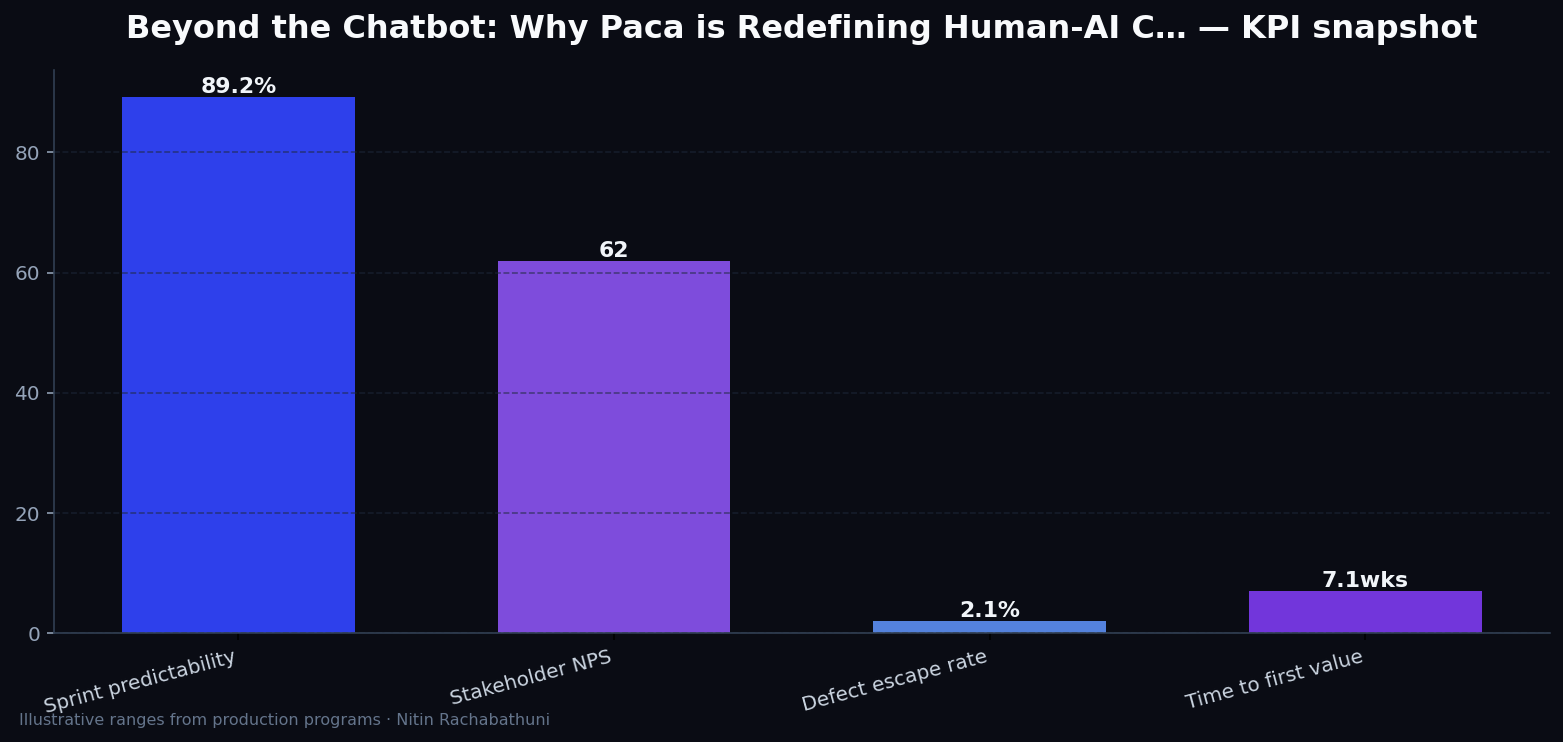
Illustrative consulting KPI ranges observed on programs like “Beyond the Chatbot: Why Paca is Redefining Human-AI C…” — validate against your own telemetry before setting SLOs. Methodology: production-like staging traces + weekly review with product and ops.
Architecture flow

Code sketches
/* Integration sketch */
// Beyond the Chatbot: Why Paca is Redefining Human-AI C…
export async function rolloutPacaJiraAlternativeHumanAiCollaboration() {
  const checks = ["telemetry", "auth", "rollback"];
  return { ok: true, checks };
}
Official references
Related on this site
Article slug: paca-jira-alternative-human-ai-collaboration · Engineering notes by Nitin Rachabathuni — MVP in 2 days specialist.