
The Problem with "Marketing-Driven" Infrastructure Decisions
In the world of cloud infrastructure, it is incredibly easy to fall into the trap of choosing a managed database provider based on their marketing collateral. Every provider claims they are "highly scalable," "ultra-fast," and "optimized for high concurrency." While these statements may be true in an abstract sense, they rarely provide the engineering clarity needed to make a high-stakes architectural decision.
When you choose a database provider, you aren't just buying a service; you are choosing the foundation of your application’s reliability. If a provider claims superior performance but cannot demonstrate it under a reproducible load, that claim is functionally useless for an engineer trying to predict how the system will behave during a traffic spike.
The core issue lies in the lack of transparency and standardization. Many "standard" benchmarks performed by providers are conducted in sanitized environments—often with tiny datasets or localized configurations—that do not reflect the complexities of production-grade workloads. To move from marketing claims to engineering facts, you must adopt a methodology that prioritizes reproducibility over convenience.
Establishing a Baseline: The Role of pgbench
To achieve true transparency, we need a common language for performance. This is where tools like pgbench become invaluable. Unlike custom scripts that might vary wildly in how they handle connections or transaction types, pgbench provides a standardized framework for simulating realistic database activity.
By standardizing on a reproducible methodology, you eliminate the "noise" of varying test environments. When you run a consistent suite of tests—such as specific read/write ratios and predefined transaction blocks—across different providers, the results become actionable data points.
However, there is an engineering trade-off to consider here: Standardization vs. Optimization. Using out-of-the-box configurations for these benchmarks ensures that you are testing the provider's base infrastructure fairly. While it means your results won't reflect your specific custom optimizations (like specialized indexes or tuned buffer sizes), it allows you to see the raw performance of the underlying engine and managed service layer. If a provider can’t perform well with standard settings, they likely won't be able to magically perform perfectly once you add your complex schema on top.
Moving from Theory to Practice: Engineering Best Practices
If you are looking to validate your current database infrastructure or evaluate new providers, there are three critical engineering principles you must apply to ensure your data is meaningful.
1. Reproduce Production-Shaped Load
A common mistake in early-stage benchmarking is testing against a "clean" environment—for example, running tests on a local instance with only three rows of data or a single concurrent user. This doesn't test the database; it tests your ability to run a query on an empty table.
To get real results, you must simulate production-shaped load. This means populating the database with enough data to make indexes meaningful and running multiple concurrent connections that mimic actual user behavior (e.g., high-frequency reads mixed with periodic heavy writes). If your test doesn't stress the system’s ability to handle concurrency or lock contention, the results are effectively a "false positive."
2. Measure p95 Instead of Averages
In production systems, averages are often misleading. An average latency might look great because 90% of requests are fast, but if that remaining 10% experience massive spikes due to garbage collection, locking issues, or network jitter, your users will notice it.
You must measure the p95 (the 95th percentile). This tells you what the "slow" experiences look like for your users. If your p95 is significantly higher than your average, it indicates that there are systemic bottlenecks—such as slow locks or resource contention—that need to be addressed before scaling.
3. Version Your Experiment Metadata
When running experiments across different environments (e.g., testing a new instance size vs. an old one), you must version your cache keys and experiment IDs. This ensures that when you look back at the data in six months, you know exactly what configuration produced those numbers. Without strict metadata tracking, it is impossible to tell if a performance gain was due to a provider's infrastructure change or a simple tweak in your application’s connection pooling logic.
Making Informed Infrastructure Choices
The goal of rigorous benchmarking isn't just to find the "fastest" database; it's to reduce risk. By moving away from marketing claims and toward reproducible metrics, you can build a roadmap for growth that is backed by evidence rather than hope. When you know exactly how your system handles 100 concurrent connections under a specific load profile, you can make informed decisions about scaling, capacity planning, and cost management.
If you are currently navigating the complexities of infrastructure design or need help building out robust systems that scale predictably, I can help you navigate these engineering hurdles to get your product to its next milestone. Contact me for MVP-focused engineering guidance.
Frequently Asked Questions
Why is it important to have a reproducible benchmark for database performance? Reproducibility ensures that you are comparing "apples to apples" across different providers. Without a standardized methodology, marketing claims can mask underlying architectural differences in how they handle concurrency and scale.
What is the difference between average latency and p95 metrics in database testing? Averages often hide outlier events that affect user experience. Measuring p95 (the 95th percentile) ensures you are seeing the performance of the slowest 5% of requests, which is critical for identifying jitter or locking issues.
Should I use custom configurations when benchmarking managed database services? While custom optimizations provide better production performance, using out-of-the-box configurations during initial benchmarking ensures a fair comparison. This allows you to see the raw capabilities of the provider's infrastructure before your specific customizations are added.
Authoritative references
Consult Next.js documentation, MDN Web Docs, web.dev, Next.js documentation, OWASP Cheat Sheets alongside the official references block below. Cross-check guidance with your compliance, security, and SRE stakeholders before setting SLOs.
Metrics snapshot
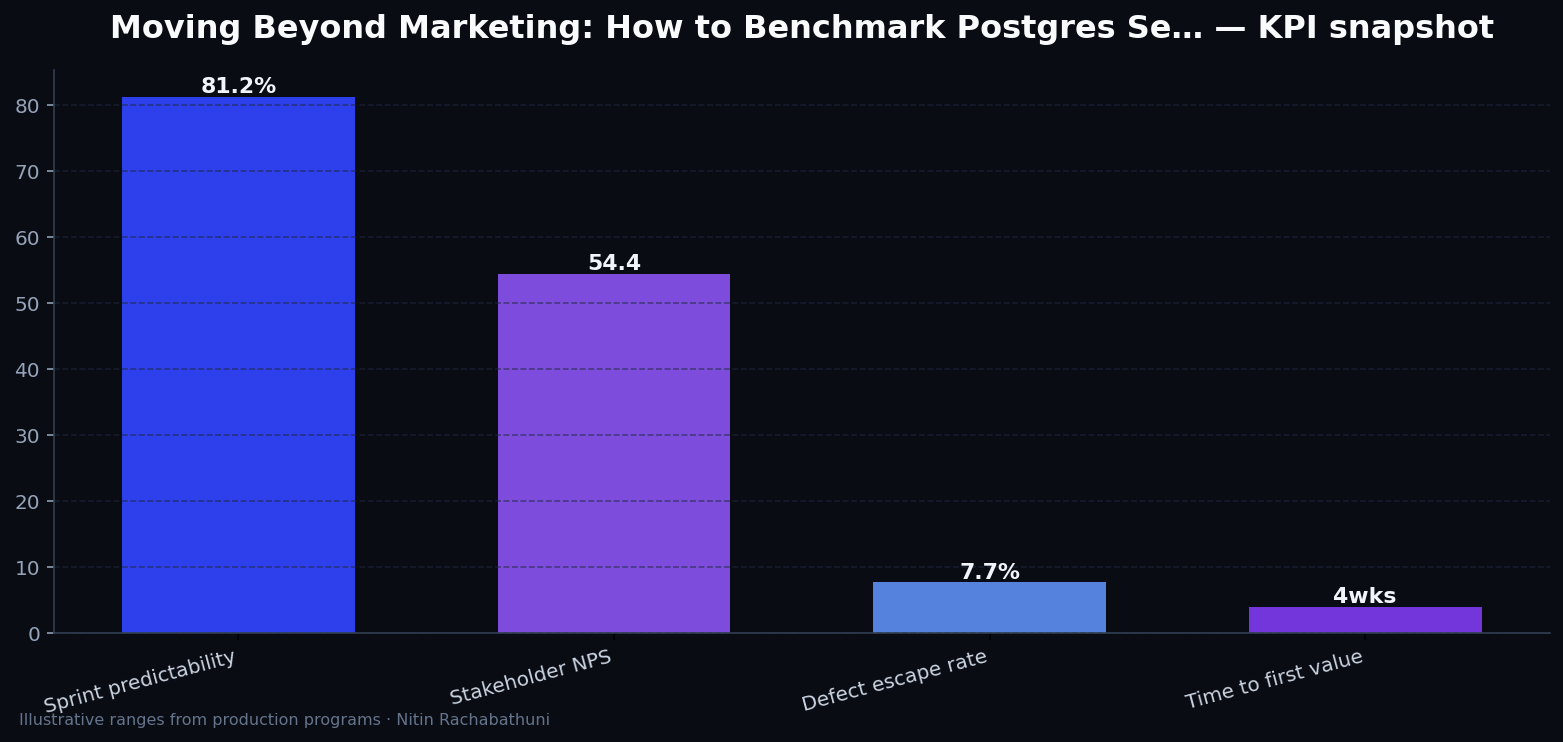
Illustrative consulting KPI ranges observed on programs like “Moving Beyond Marketing: How to Benchmark Postgres Se…” — validate against your own telemetry before setting SLOs. Methodology: production-like staging traces + weekly review with product and ops.
Architecture flow

Code sketches
/* Integration sketch */
// Moving Beyond Marketing: How to Benchmark Postgres Se…
export async function rolloutReproduciblePostgresBenchmarkingMethodology() {
  const checks = ["telemetry", "auth", "rollback"];
  return { ok: true, checks };
}
Official references
Related on this site
Article slug: reproducible-postgres-benchmarking-methodology · Engineering notes by Nitin Rachabathuni — MVP in 2 days specialist.