From Demo to Deployment: The Engineering Reality of Reliable Agentic Systems
In the current landscape of Generative AI, there is a massive chasm between a "cool demo" and a production-grade system. We have all seen the viral videos of LLMs performing complex tasks—coding entire apps, planning travel itineraries, or navigating complex corporate data. However, as many engineering teams are discovering, moving these capabilities into a stable, enterprise-ready environment requires a fundamental shift in mindset: from focusing on raw generation to building structured reliability.
The transition involves moving beyond simple prompt engineering and entering the realm of systems engineering. When we talk about "Agentic AI," we aren't just talking about smarter prompts; we are talking about autonomous loops where models use tools, manage state, and interact with other agents to complete a goal. As complexity increases, so does the surface area for failure.
The Complexity Trade-off in Multi-Agent Orchestration
One of the most significant hurdles in building agentic systems is managing the trade-off between capability and reliability. In many use cases—such as those seen in highly regulated industries like pharmaceuticals (as highlighted in recent case studies)—the problem isn't just "finding information." It’s about navigating complex data silos and executing multi-step workflows where accuracy is non-negotiable.
To solve these problems, engineers often turn to multi-agent orchestration. Instead of one massive prompt trying to do everything, you break the task into smaller sub-tasks handled by specialized agents (e.g., a "researcher" agent, a "writer" agent, and a "fact-checker" agent).
While this modular approach makes the system more manageable, it introduces significant complexity:
- State Management: Each step in a multi-agent chain must maintain context without drifting into hallucination.
- Error Propagation: If Agent A produces a slightly flawed output, and that output is fed to Agent B, the error can compound exponentially.
- Non-deterministic Branching: When an agent decides to take a specific path based on its reasoning, developers must account for every possible branch in the logic tree.
Implementing "Process Reflection" for Reliability
To combat the risks of multi-learning and non-determinism, production systems must implement rigorous "process reflection." This means that instead of just taking the final output from an agent at the end of a chain, you insert validation checkpoints at every transition point.
Think of it as unit testing for LLM logic. Before Agent B receives data from Agent A, a verification step (which could be another smaller model call or a deterministic script) checks if the input meets specific criteria. If the output is malformed or logically inconsistent, the system can trigger a retry loop or flag the error for human intervention before it reaches the end-user.
This layer of "reflection" ensures that even if an agentic workflow hits a non-deterministic branch, the system has guardrails to keep it within the bounds of expected behavior. It transforms a fragile chain into a resilient pipeline.
Performance Realities and LLMOps Best Practices
When moving toward production, your evaluation metrics must shift from "vibes" to hard data. Many teams fall into the trap of believing their own marketing materials or high-level benchmark charts. In reality, reliability is found in the weeds of telemetry.
To build a truly reliable system, consider these three engineering pillars:
1. Granular Logging and Versioning: Every production call should be logged with its specific model ID and prompt version. Because LLM providers update models frequently (and even minor updates can change output behavior), you must know exactly what "engine" produced a specific result to debug regressions effectively.
2. Benchmarking the Mix: Don't just benchmark your final output; benchmark your token mix across different stages of the pipeline. This helps identify which part of the agentic chain is consuming excessive costs or experiencing high latency, allowing you to optimize smaller models for simpler sub-tasks while reserving larger models for complex reasoning.
3. Canary Deployments: Never roll out a new prompt version or an updated agent logic to your entire user base at once. Use canary deployments on low-risk endpoints. This allows you to observe how the model handles real-world edge cases in a controlled environment before it becomes the default for all users.
Building Your Path to Production
Building reliable AI isn't just about choosing the right model; it’s about building the infrastructure that supports that model. From state management and multi-agent orchestration to robust logging and canary testing, every step is a move toward creating a system that can survive the transition from a lab experiment to a core business tool.
If you are looking to bridge the gap between an initial AI prototype and a production-ready MVP, I can help navigate these technical complexities. Let's build something reliable together: Contact me for MVP development help.
FAQ
What is "process reflection" in agentic workflows? Process reflection involves validating the output of an LLM at every step within a multi-step chain rather than only checking the final result. This allows the system to catch and correct errors early, preventing them from compounding as they pass through different agents.
How do you handle non-deterministic branches in AI systems? Non-deterministic branches occur when an agent's reasoning leads it down a path that varies between runs. To manage this, developers implement strict state management and "guardrail" checks at each branch point to ensure the output remains within acceptable parameters regardless of the specific logic path taken.
Why is logging prompt versions so important for LLMOps? LLM providers frequently update their models, which can subtly change how a model interprets a prompt. By logging the exact version of both the model and the prompt used for every production call, engineers can quickly identify if a drop in quality is due to an internal provider change or a flaw in the logic.
Authoritative references
Consult LangGraph.js, MDN Web Docs, web.dev, Next.js documentation, OWASP Cheat Sheets alongside the official references block below. Cross-check guidance with your compliance, security, and SRE stakeholders before setting SLOs.
Metrics snapshot
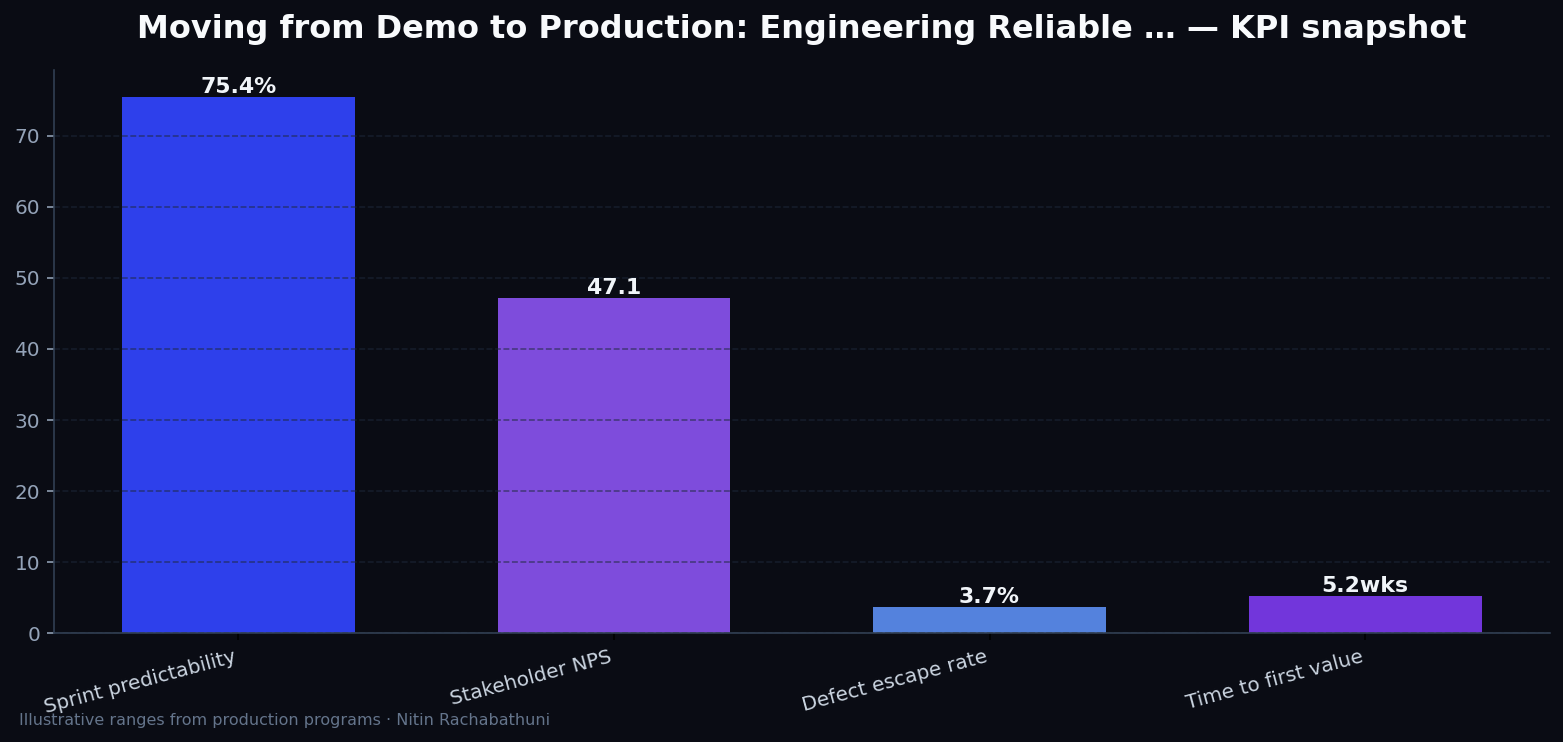
Illustrative consulting KPI ranges observed on programs like “Moving from Demo to Production: Engineering Reliable …” — validate against your own telemetry before setting SLOs. Methodology: production-like staging traces + weekly review with product and ops.
Architecture flow

Code sketches
/* Integration sketch */
// Moving from Demo to Production: Engineering Reliable …
export async function rolloutBuildingReliableAgenticAiSystemsProduction() {
  const checks = ["telemetry", "auth", "rollback"];
  return { ok: true, checks };
}
Official references
Related on this site
Related case study
Juiceit.ai — AI platform — document intelligence, agent workflows, enterprise automation.
Article slug: building-reliable-agentic-ai-systems-production · Engineering notes by Nitin Rachabathuni — MVP in 2 days specialist.
Juiceit style straight through document processing
AI Agents
Shopify Acquires Tailwind CSS: The Strategic Shift from Independent Tooling to Core Infrastructure
leadership
Tailwind CSS Joins Shopify: A Masterclass in Strategic Infrastructure Pivot
tech
The Illusion of Quality: Why AI Agents Fail at Test Verification
tech
Beyond the Vector Database: Why Git-Native Memory is the Future for AI Coding Agents
leadership
Agentic Context Management: Solving the Memory vs. Cost Architecture Problem
tech