
The Illusion of Permission-Based Privacy
In the world of mobile engineering, we often treat "Permissions" as the primary gatekeeper for user privacy. When a user sees a popup asking to access their location or microphone, we feel we have fulfilled our ethical and technical obligations. However, there is a significant distinction between authorized data access and available system information.
The emergence of tools like Loupe highlights a critical nuance in the iOS ecosystem: the "fingerprinting" surface. Even if an app never asks for your location or contacts, it can still build a highly specific profile of your device by querying public APIs that do not require explicit consent. These are often referred to as passive data points—bits of information like battery status, time zone, screen dimensions, and system language.
While any single piece of this data is benign, the aggregation of these signals creates a unique "fingerprint." For example, while thousands of people might have 40% battery life at 2:00 PM on a Tuesday, only a handful will have that exact percentage combined with a specific screen resolution, a niche system font set, and a particular network signal strength. By correlating these values, third-party trackers can identify a unique device across different sessions or even across different apps.
The Mechanics of Side-Channel Data Leakage
To understand why this is a risk for product leaders and engineers alike, we have to look at how "side-channel" techniques work. These are methods where information is leaked through unintended paths—not because the system failed, but because the data was technically available in a public API.
For instance, an app might check if certain custom URL schemes are registered or probe for specific keychain persistence. While these actions aren't "hacking" in the traditional sense, they provide high-entropy signals that can be used to distinguish one device from millions of others. In many cases, this happens because developers prioritize functionality (e.g., making sure a deep link works) without auditing how much information that check reveals about the underlying system state.
From a technical risk assessment standpoint, these vulnerabilities are often overlooked during standard QA cycles. Because the data is "public," it doesn't trigger security flags in automated scanners. However, for privacy-conscious users and regulated industries (like FinTech or Healthcare), this level of exposure can be a significant liability. If your application’s SDK includes third-party analytics tools, you may unknowingly be exporting these fingerprints to external servers every time the app initializes.
Engineering Responsibility: Balancing Utility and Privacy
As leaders in mobile development, we must move toward a "Privacy by Design" framework. This means moving beyond just checking boxes on an App Store compliance list and actually auditing what your product exposes to the world.
When evaluating third-party SDKs or building new features, ask these three questions:
- Is this data point necessary for functionality? If you only need to know if a user is in their home region, do you need to query every available system setting?
- Can the signal be anonymized? Can we bucket certain values (e.g., rounding battery percentage or generalizing screen resolutions) to reduce the uniqueness of the fingerprint?
- What are the downstream implications? If a tracker can identify a user's device without their consent, does that violate your internal privacy policy or regional regulations like GDPR/CCPA?
The Loupe project is particularly interesting because it was built largely using AI-assisted coding tools. This serves as a reminder of how rapidly developers can now build complex diagnostic utilities to audit these very issues. It underscores the need for engineers to be more proactive in identifying security gaps before they become systemic problems.
Moving Toward Proactive Auditing
The goal isn't to stop collecting data entirely—most apps require some level of system information to function correctly. The goal is to minimize the "surface area" available for exploitation by malicious actors or invasive trackers.
By auditing your app’s fingerprinting profile, you can provide a more transparent experience for your users and build deeper trust in your brand. Instead of relying on the OS to protect everything, we must assume that if an API is public, it can be used as a signal.
If you are looking to harden your mobile product's security posture or need expert guidance on navigating complex technical risks during the development lifecycle, I can help you navigate these hurdles from the ground up. Contact me for MVP-focused engineering leadership to ensure your next launch is both high-performing and privacy-hardened.
Summary of Technical Risks
- Passive Data Aggregation: Combining non-sensitive data (battery, time zone) into a unique identifier.
- Side-Channel Probing: Using URL schemes or system checks to bypass standard permission barriers.
- SDK Leakage: Third-party libraries often collect more "fingerprint" data than the primary app developer realizes.
Authoritative references
Consult Next.js documentation, MDN Web Docs, web.dev, Next.js documentation, OWASP Cheat Sheets alongside the official references block below. Cross-check guidance with your compliance, security, and SRE stakeholders before setting SLOs.
Metrics snapshot
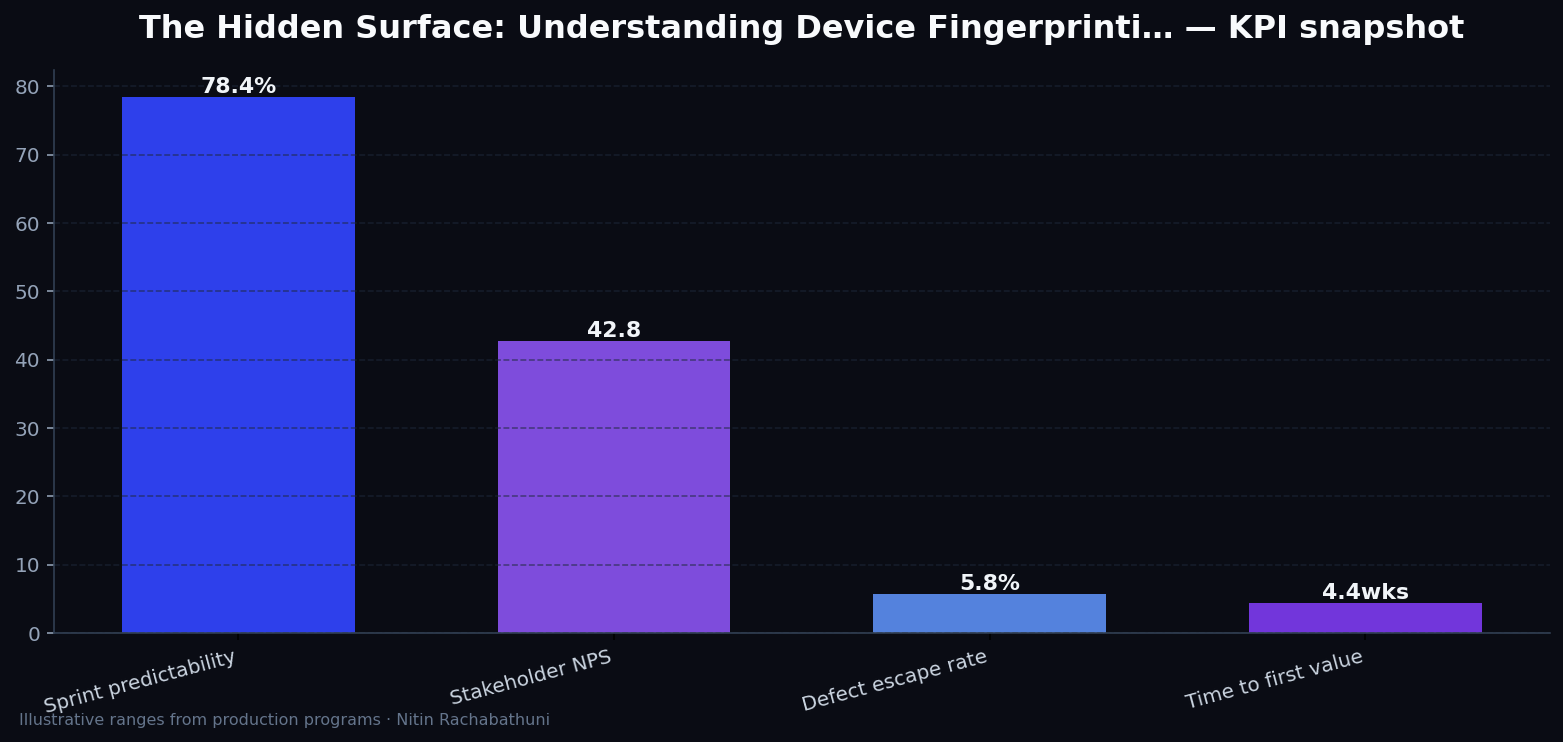
Illustrative consulting KPI ranges observed on programs like “The Hidden Surface: Understanding Device Fingerprinti…” — validate against your own telemetry before setting SLOs. Methodology: production-like staging traces + weekly review with product and ops.
Architecture flow

Code sketches
/* Integration sketch */
// The Hidden Surface: Understanding Device Fingerprinti…
export async function rolloutIosDeviceFingerprintingSecurityRisks() {
  const checks = ["telemetry", "auth", "rollback"];
  return { ok: true, checks };
}
Official references
Related on this site
Article slug: ios-device-fingerprinting-security-risks · Engineering notes by Nitin Rachabathuni — MVP in 2 days specialist.