The Erosion of Foundation: When Innovation Outpaces Stability
In the high-stakes world of Big Tech, there is a recurring tension between "moving fast" and "building right." For years, Meta’s engineering culture was synonymous with building massive, resilient infrastructure capable of supporting billions of users. However, as the industry pivots toward an AI-first mandate, that balance is shifting dangerously.
The core issue isn't just about a change in product focus; it is about the fundamental erosion of the "engineering" in software engineering. When leadership decides to prioritize immediate trend alignment—specifically the rapid deployment of LLMs and generative features—at the expense of foundational infrastructure, they aren't just changing their roadmap. They are potentially dismantling the very systems that ensure security, scalability, and trust.
When core engineering teams are treated as "cost centers" rather than value-drivers, the quality of the underlying code begins to degrade. Instead of optimizing database queries or refining network protocols, engineers may find themselves diverted toward data labeling or building thin wrappers for third-party models. While these tasks serve the current AI hype cycle, they do nothing to strengthen the core platform's integrity.
The Hidden Costs of "Short-Term" Wins
The danger of prioritizing immediate results over long-term stability is that technical debt doesn't disappear; it accrues interest. When a company pivots so aggressively toward AI integration that infrastructure teams are cannibalized, several systemic risks emerge:
- Security Vulnerabilities: If the engineers responsible for hardening systems are moved to "feature" teams, the surface area for cyberattacks expands. Security cannot be an afterthought in an AI-driven architecture.
- Scalability Bottlenecks: Rapidly deployed features often lack the optimization required to handle massive scale. Without a robust infrastructure base, these features will eventually hit performance ceilings that are expensive and difficult to fix retroactively.
- Talent Attrition: High-performing engineers generally want to work on complex, foundational problems. When they are forced into repetitive tasks or "glue code" roles because the core engineering organization has been hollowed out, top talent often leaves for organizations that prioritize technical excellence.
Leadership must recognize that infrastructure is not a luxury; it is the prerequisite for any successful product launch. By treating the foundation as something to be bypassed in favor of speed, companies risk catastrophic failures in trust and reliability—the two things most difficult to regain once lost.
Strategic Frameworks for Balanced Growth
How do you navigate this transition without sacrificing your core infrastructure? The answer lies in disciplined leadership that treats "innovation" and "stability" as twin pillars rather than competing interests.
To maintain a healthy engineering organization during an AI pivot, leaders should implement the following strategies:
- Assume Compromise: Acknowledge that not every feature can be perfect on day one, but core infrastructure must remain non-negotiable. This means rotating secrets and narrowing the blast radius of new deployments to ensure that even if a "fast" feature fails, it doesn't take down the entire system.
- Patch the Dependency Path: Instead of just chasing headlines, focus on the actual pathways your teams deploy. Ensure that any AI integration is built upon a verified, stable infrastructure layer rather than being "bolted on" to an unstable foundation.
- Conduct Stress Tests (Tabletops): Run regular scenarios like: "What if this new feature hits us at 6 PM on a Friday?" This forces the team to think about failure modes before they happen in production, ensuring that even rapid innovations are built with safety nets.
If you are looking for expert guidance on navigating these complex organizational transitions or need help building a roadmap that balances innovation with architectural integrity, contact me here to discuss how we can build your MVP for growth without sacrificing stability.
Conclusion: Building for the Long Haul
The "move fast" mantra is not inherently bad; it is a necessary component of market competition. However, when "moving fast" means ignoring the structural integrity of your platform, it becomes a liability. The most successful tech leaders will be those who can integrate cutting-edge AI capabilities while simultaneously fortifying the core engineering systems that make those features possible for millions of users.
True leadership in software architecture is about knowing where to take risks and where to build walls. In the age of AI, the wall must remain strong.
Frequently Asked Questions (FAQ)
What are the primary risks of treating core engineering as a cost center? Treating foundational systems as cost centers leads to technical debt, reduced security oversight, and potential system instability. When basic infrastructure is under-resourced, it creates "brittle" environments where even minor updates can cause major outages.
How should leaders balance AI innovation with core infrastructure stability? Leaders should adopt a "defense-in-depth" approach by rotating secrets, narrowing blast radius for new deployments, and maintaining dedicated teams for foundational reliability. Balancing the two requires clear boundaries between experimental features and stable platform services.
What is the impact of rapid engineering pivots on developer morale? Rapid shifts can lead to burnout and frustration when engineers are forced to work on low-leverage tasks like data labeling instead of core architecture. Clear communication regarding the long-term roadmap is essential to retain high-performing talent during transitions.
Authoritative references
Consult Next.js documentation, MDN Web Docs, web.dev, Next.js documentation, OWASP Cheat Sheets alongside the official references block below. Cross-check guidance with your compliance, security, and SRE stakeholders before setting SLOs.
Metrics snapshot
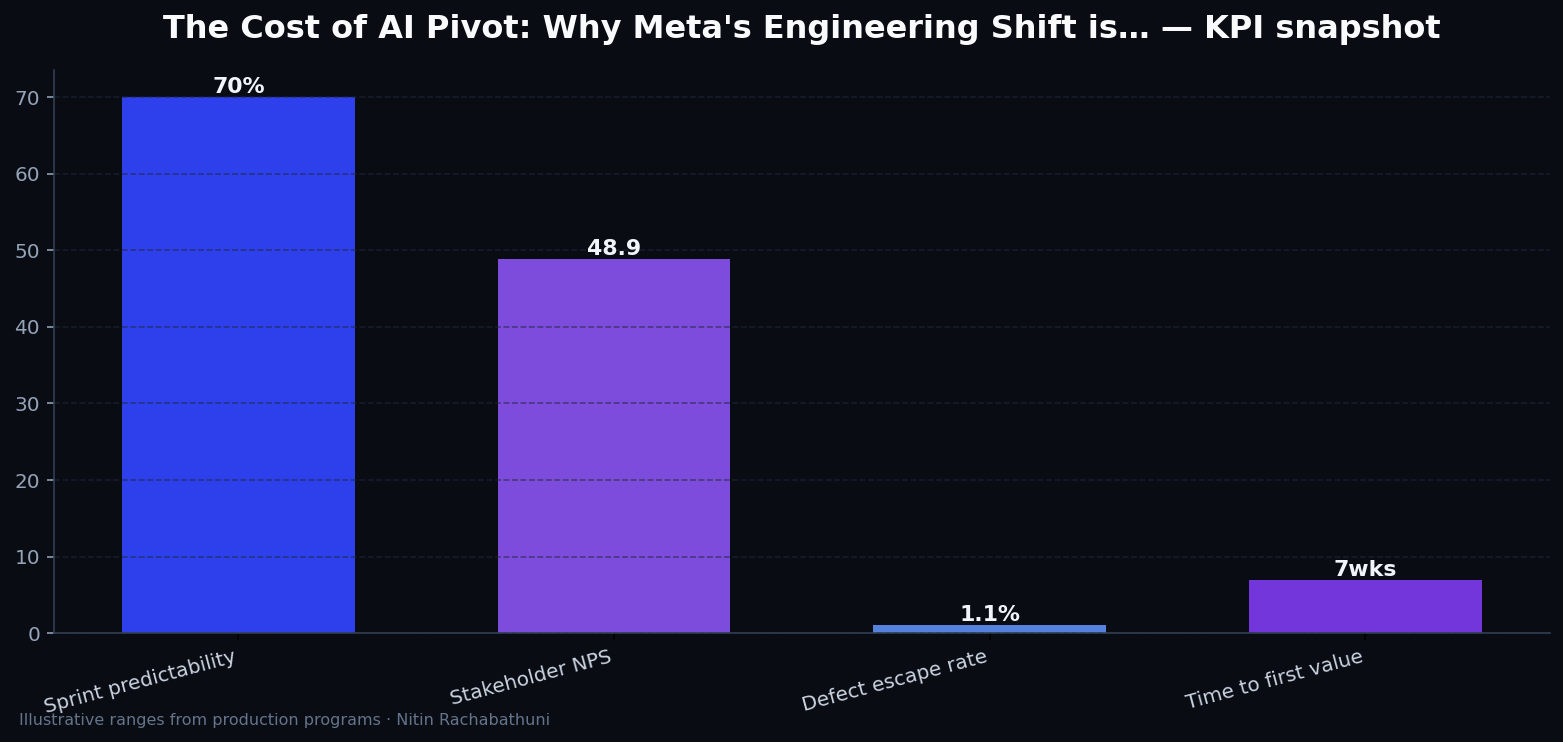
Illustrative consulting KPI ranges observed on programs like “The Cost of AI Pivot: Why Meta's Engineering Shift is…” — validate against your own telemetry before setting SLOs. Methodology: production-like staging traces + weekly review with product and ops.
Architecture flow

Code sketches
/* Integration sketch */
// The Cost of AI Pivot: Why Meta's Engineering Shift is…
export async function rolloutMetaEngineeringCultureAiShiftRisks() {
  const checks = ["telemetry", "auth", "rollback"];
  return { ok: true, checks };
}
Official references
Related on this site
Article slug: meta-engineering-culture-ai-shift-risks · Engineering notes by Nitin Rachabathuni — MVP in 2 days specialist.