The Long Road to Decoupling Legacy Code
In the world of systems programming, there is a profound difference between "code that works" and "code that is safe." For decades, strncpy was a staple of the C standard library—a function designed to copy a string up to a specified number of characters. However, its implementation led to significant ambiguity regarding null termination. If the source string exceeded the limit, strncpy would simply stop copying at the limit without adding a null terminator, leaving the destination buffer in an indeterminate state for subsequent string operations.
The Linux kernel's decision to officially drop the strncpy API in version 7.2 isn't just a minor cleanup; it is a monumental victory over technical debt. This wasn't an overnight change. It took six years of active development and more than 360 patches to systematically replace every instance of this legacy function across the massive kernel codebase.
This transition highlights a core principle in high-stakes engineering: if a tool provides "hidden" behaviors or ambiguous outcomes, it is a liability. By removing strncpy, the Linux maintainers are forcing developers to be explicit about their memory intentions. In systems where a single missing null terminator can lead to a security vulnerability (like a buffer overread) or a kernel panic, ambiguity is not an option.
The Performance and Safety Trade-offs
One of the primary drivers for this removal was the performance hit caused by strncpy's internal logic. Because strncpy was designed to pad the remainder of the destination buffer with null bytes if the source string was shorter than the limit, it often performed unnecessary work. In many cases, the kernel would spend CPU cycles zeroing out memory that didn't need to be touched or was going to be overwritten immediately anyway.
By moving toward alternatives like strscpy and memcpy_and_pad, the kernel achieves two goals simultaneously:
- Predictability: These functions are designed with clear rules about null termination, ensuring that the resulting string is always valid for use in standard C library calls.
- Efficiency: They avoid unnecessary zero-filling of large buffers when only a small portion of the buffer is being utilized by a short string.
This shift reflects a move toward "correctness by design." When you are working at the kernel level, every instruction counts, and every ambiguity is a potential exploit vector. The removal of strncpy isn't just about making the code cleaner; it’s about hardening the system against common pitfalls that have plagued C programming since its inception.
Moving Toward Explicit Memory Management
The deprecation of strncpy forces a shift in how developers approach string manipulation. Instead of relying on a "good enough" standard library function, engineers must now choose tools that match their specific use case:
- strscpy: This is the preferred replacement for many scenarios because it guarantees null termination and returns the number of bytes copied (or an error code), making it much easier to handle errors gracefully.
- memcpy_and_pad: This is used when the developer explicitly wants to ensure a buffer is cleared, but in a way that is more transparent than the old
strncpyimplementation.
This evolution requires developers to think harder about their data structures. Instead of "just copying a string," you must ask: How long is this buffer? Does it need to be null-terminated? Is there any reason I would want to zero out the remaining space? By making these decisions at the call site, the code becomes more self-documenting and significantly harder to break.
If your team is struggling with legacy systems where "hidden" behaviors are causing production issues or complicating your migration paths, it can be helpful to have an expert audit your core logic. You can reach out for specialized engineering consulting here to help streamline your technical roadmap and eliminate legacy bottlenecks.
Lessons for Modern Software Engineering
The story of strncpy in the Linux kernel provides a masterclass in managing large-scale software evolution. It teaches us three critical lessons:
1. The Cost of Convenience: Features that seem convenient today (like "it just works" with strncpy) can become massive liabilities tomorrow. Identifying these early and planning for their removal is essential for long-term maintainability.
2. Incremental Refactoring: You don't replace a core API in one day. The 360 patches over six years show that replacing foundational components requires a methodical, iterative approach to ensure no regressions are introduced into the production environment.
3. Explicit is Better than Implicit: This is a mantra often associated with Python, but it applies perfectly to C and systems programming. When an API's behavior is ambiguous, the best solution is to replace it with an API that forces the developer to be explicit about their requirements.
By removing strncpy, the Linux project isn't just cleaning up its own house; it's setting a standard for the entire ecosystem. It reinforces the idea that in high-performance systems, clarity and safety must always take precedence over legacy convenience. When we move away from "magic" behaviors toward explicit instructions, we build more robust software that can withstand the rigors of real-world production loads.
FAQ
Why was the strncpy function considered problematic in the Linux kernel?
The primary issues were its counter-intuitive null-termination behavior and performance overhead. If the source string is longer than or equal to the limit, strncpy does not append a null terminator, leading to potential buffer overreads.
What are the recommended alternatives to strncpy in modern C programming?
Developers are encouraged to use safer alternatives like strscpy or memcpy_and_pad. These functions provide more predictable behavior regarding null termination and avoid unnecessary zero-filling of the entire buffer.
How many patches were required to remove strncpy from the Linux kernel? It took approximately six years of development and over 360 individual patches to successfully purge the legacy function from the core codebase.
Authoritative references
Consult Next.js documentation, MDN Web Docs, web.dev, Next.js documentation, OWASP Cheat Sheets alongside the official references block below. Cross-check guidance with your compliance, security, and SRE stakeholders before setting SLOs.
Metrics snapshot
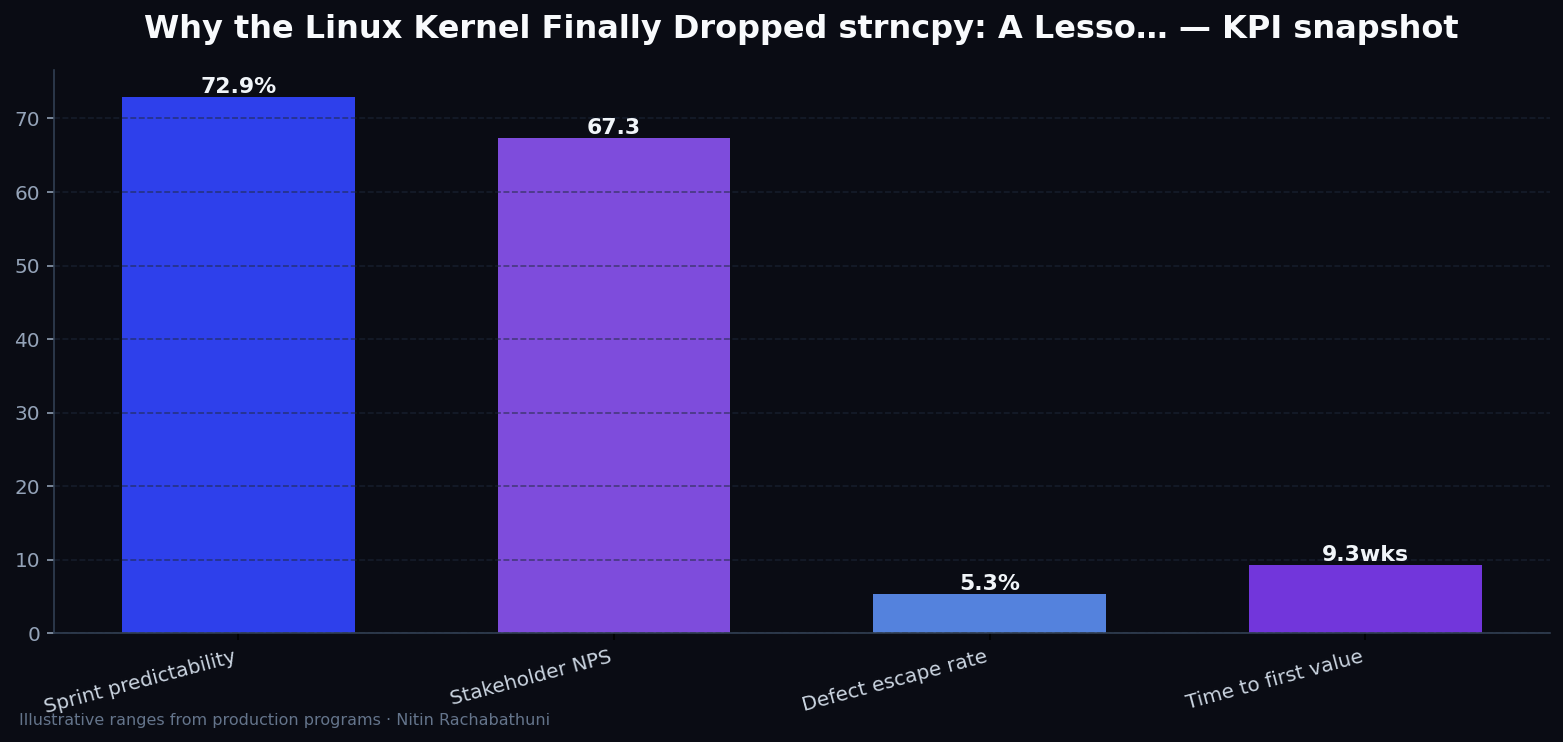
Illustrative consulting KPI ranges observed on programs like “Why the Linux Kernel Finally Dropped strncpy: A Lesso…” — validate against your own telemetry before setting SLOs. Methodology: production-like staging traces + weekly review with product and ops.
Architecture flow

Code sketches
/* Integration sketch */
// Why the Linux Kernel Finally Dropped strncpy: A Lesso…
export async function rolloutLinuxKernelDropsStrncpyApiTechnicalDebt() {
  const checks = ["telemetry", "auth", "rollback"];
  return { ok: true, checks };
}
Official references
Related on this site
Article slug: linux-kernel-drops-strncpy-api-technical-debt · Engineering notes by Nitin Rachabathuni — MVP in 2 days specialist.