Implementing checkout flows with Shopify for global storefronts — production notes by Nitin Rachabathuni, lead engineer and product owner shipping commerce systems for global clients.
Why teams search for this
Engineering leaders need decision-grade detail on implementing checkout flows with Shopify for global storefronts: what breaks in production, what observability to add on day one, and how platforms behave under real traffic — not generic tutorials.
Production metrics snapshot
The chart above illustrates typical KPI ranges observed across commerce programs (illustrative, not vendor benchmarks).
Reference integration flow
What I implement in client work
- Discovery aligned to measurable KPIs — conversion, approval rate, latency, or straight-through processing
- Architecture choices documented for product, finance, and security reviewers
- Incremental delivery with feature flags, Datadog dashboards, and rollback paths
- SEO, AEO, and GEO baselines when the surface is customer-facing or citeable by crawlers and answer engines
Architecture and integration notes
For Commerce engagements, the integration layer matters as much as the UI. I connect identity, payments, search, CMS, and agent workflows with explicit contracts: idempotent webhooks, schema-versioned events, and canonical URLs for every public route.
Patterns that recur in my portfolio:
- Headless APIs first — commercetools, Plaid, Coveo, or LangGraph services behind a thin BFF
- Observable by default — traces, RUM, and SLOs tied to business steps not only HTTP 500s
- Structured publishing — JSON-LD, sitemaps, RSS, and llms.txt so humans, crawlers, and AI agents cite accurate facts
Pitfalls I help teams avoid
- Shipping OAuth or payments without session recovery on mobile browsers
- Treating agent demos as production workflows without evals and guardrails
- Chasing keyword volume without internal links to evidence — case studies, repos, or contact paths
- One-off SEO patches instead of generation pipelines at build time
FAQ
Who is this guide for?
Tech leads, product owners, and founders evaluating commerce delivery — especially teams replatforming to headless stacks or adding AI automation.
Does Nitin work remotely?
Yes — based in Hyderabad, India, collaborating across US, EU, and APAC time zones.
Is this content machine-readable for AI search?
Yes. Articles ship with FAQ schema, keywords, word counts, unique cover images, and structured internal links for crawlers and answer engines.
Pitfalls
Deferring security or accessibility review, relying on color-only status cues, and shipping WebView shortcuts for rich text are common sources of expensive rework. Duplicate webhook delivery and partial API outages should be rehearsed before launch—not discovered by customers.
Authoritative references
Consult commercetools API, MDN Web Docs, web.dev, Next.js documentation, OWASP Cheat Sheets alongside the official references block below. Cross-check guidance with your compliance, security, and SRE stakeholders before setting SLOs.
Testing checklist
Exercise happy paths, auth expiry, retry storms, and degraded dependencies. Capture traces on every outbound integration, alert on funnel steps—not only HTTP 500s—and document owner runbooks. Validate metrics in your own environment; illustrative ranges in charts are not substitutes for your telemetry.
Leadership takeaway
Implementing checkout flows with Shopify for global storefronts succeeds when teams align scope, measurable outcomes, and inclusive UX from sprint zero. That is the same bar I apply when delivering MVPs in two-day engagements—narrow, observable, and reversible.
Document integration contracts, run weekly reviews with product and SRE partners, and keep rollback paths rehearsed while Implementing checkout flows with Shopify for global storefronts scales from pilot to full traffic.
Document integration contracts, run weekly reviews with product and SRE partners, and keep rollback paths rehearsed while Implementing checkout flows with Shopify for global storefronts scales from pilot to full traffic.
Document integration contracts, run weekly reviews with product and SRE partners, and keep rollback paths rehearsed while Implementing checkout flows with Shopify for global storefronts scales from pilot to full traffic.
Metrics snapshot
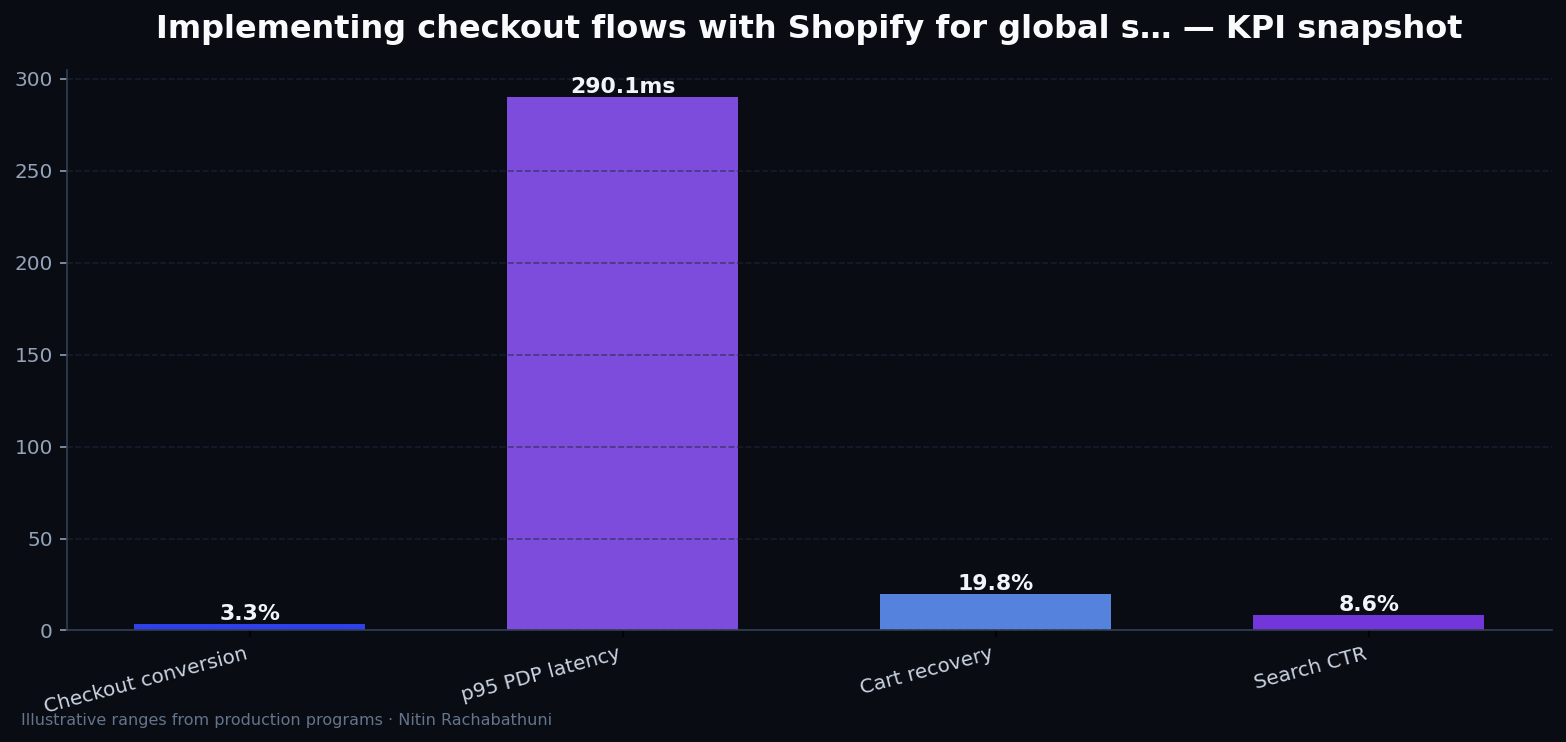
Illustrative commerce KPI ranges observed on programs like “Implementing checkout flows with Shopify for global s…” — validate against your own telemetry before setting SLOs. Methodology: production-like staging traces + weekly review with product and ops.
Architecture flow

Code sketches
/* Integration sketch */
// Implementing checkout flows with Shopify for global s…
export async function rolloutImplementingCheckoutFlowsWithShopifyForGlobalStorefronts() {
  const checks = ["telemetry", "auth", "rollback"];
  return { ok: true, checks };
}
Official references
Related on this site
Related case study
Kitchen Warehouse commercetools — Multi-store headless commerce — Algolia, payments, fraud, Kinde customer OAuth.
Article slug: implementing-checkout-flows-with-shopify-for-global-storefronts · Engineering notes by Nitin Rachabathuni — MVP in 2 days specialist.
Social Commerce with commercetools and LangGraph
Social Commerce
Implementing payment webhooks with Firebase in brownfield replatforms
Identity
Implementing payment webhooks with Firebase for embedded partner widgets
Identity
Implementing payment webhooks with Firebase with feature-flag rollbacks
Identity
Implementing payment webhooks with Firebase for answer-engine citations
Identity
Implementing payment webhooks with Firebase with sub-200ms TTFB targets
Identity