Social commerce is not a chatbot pasted onto a website. It is commerce-native conversations: every message maps to orders, business units, and associates in your commerce backend.
Architecture that scales
- Messaging gateway — WhatsApp Business API (or simulator for demos) with verified webhooks
- Identity layer — phone → commercetools Associate → Business Unit scope
- Intent router — keywords first, LangGraph agents for free-text with tool calls
- CRM inbox — human agents with order context, proposals, audit trail
- Headless storefronts — same commercetools catalog powers D2C and B2B
Why LangGraph on top of commerce APIs
Free-text distributor messages ("where is order RC-10042?" / "approve the change") need stateful reasoning:
- Plan which CT API to call
- Execute with BU-scoped credentials
- Format reply for messaging UI
- Escalate to CRM on low confidence
LangGraph makes this debuggable — each node is testable, unlike one-shot prompts.
Social commerce metrics that matter
- Time-to-status for order inquiries
- Proposal approval rate via messaging
- CRM handle time with linked order context
- D2C conversion unaffected by B2B channel load
Takeaway
Start with structured intents and a shared inbox. Add LangChain/LangGraph when free-text volume justifies it. Keep humans in the loop for money-moving actions.
Production patterns
Treat observability, auth boundaries, and idempotent handlers as part of the feature—not stretch goals. Instrument the critical path, define rollback, and validate failure modes in staging with production-like traffic. Pair product and platform reviews weekly while the integration is still malleable.
Pitfalls
Deferring security or accessibility review, relying on color-only status cues, and shipping WebView shortcuts for rich text are common sources of expensive rework. Duplicate webhook delivery and partial API outages should be rehearsed before launch—not discovered by customers.
Authoritative references
Consult commercetools API, MDN Web Docs, web.dev, Next.js documentation, OWASP Cheat Sheets alongside the official references block below. Cross-check guidance with your compliance, security, and SRE stakeholders before setting SLOs.
Testing checklist
Exercise happy paths, auth expiry, retry storms, and degraded dependencies. Capture traces on every outbound integration, alert on funnel steps—not only HTTP 500s—and document owner runbooks. Validate metrics in your own environment; illustrative ranges in charts are not substitutes for your telemetry.
Leadership takeaway
Social Commerce with commercetools and LangGraph succeeds when teams align scope, measurable outcomes, and inclusive UX from sprint zero. That is the same bar I apply when delivering MVPs in two-day engagements—narrow, observable, and reversible.
Document integration contracts, run weekly reviews with product and SRE partners, and keep rollback paths rehearsed while Social Commerce with commercetools and LangGraph scales from pilot to full traffic.
Document integration contracts, run weekly reviews with product and SRE partners, and keep rollback paths rehearsed while Social Commerce with commercetools and LangGraph scales from pilot to full traffic.
Document integration contracts, run weekly reviews with product and SRE partners, and keep rollback paths rehearsed while Social Commerce with commercetools and LangGraph scales from pilot to full traffic.
Document integration contracts, run weekly reviews with product and SRE partners, and keep rollback paths rehearsed while Social Commerce with commercetools and LangGraph scales from pilot to full traffic.
Document integration contracts, run weekly reviews with product and SRE partners, and keep rollback paths rehearsed while Social Commerce with commercetools and LangGraph scales from pilot to full traffic.
Document integration contracts, run weekly reviews with product and SRE partners, and keep rollback paths rehearsed while Social Commerce with commercetools and LangGraph scales from pilot to full traffic.
Document integration contracts, run weekly reviews with product and SRE partners, and keep rollback paths rehearsed while Social Commerce with commercetools and LangGraph scales from pilot to full traffic.
Metrics snapshot
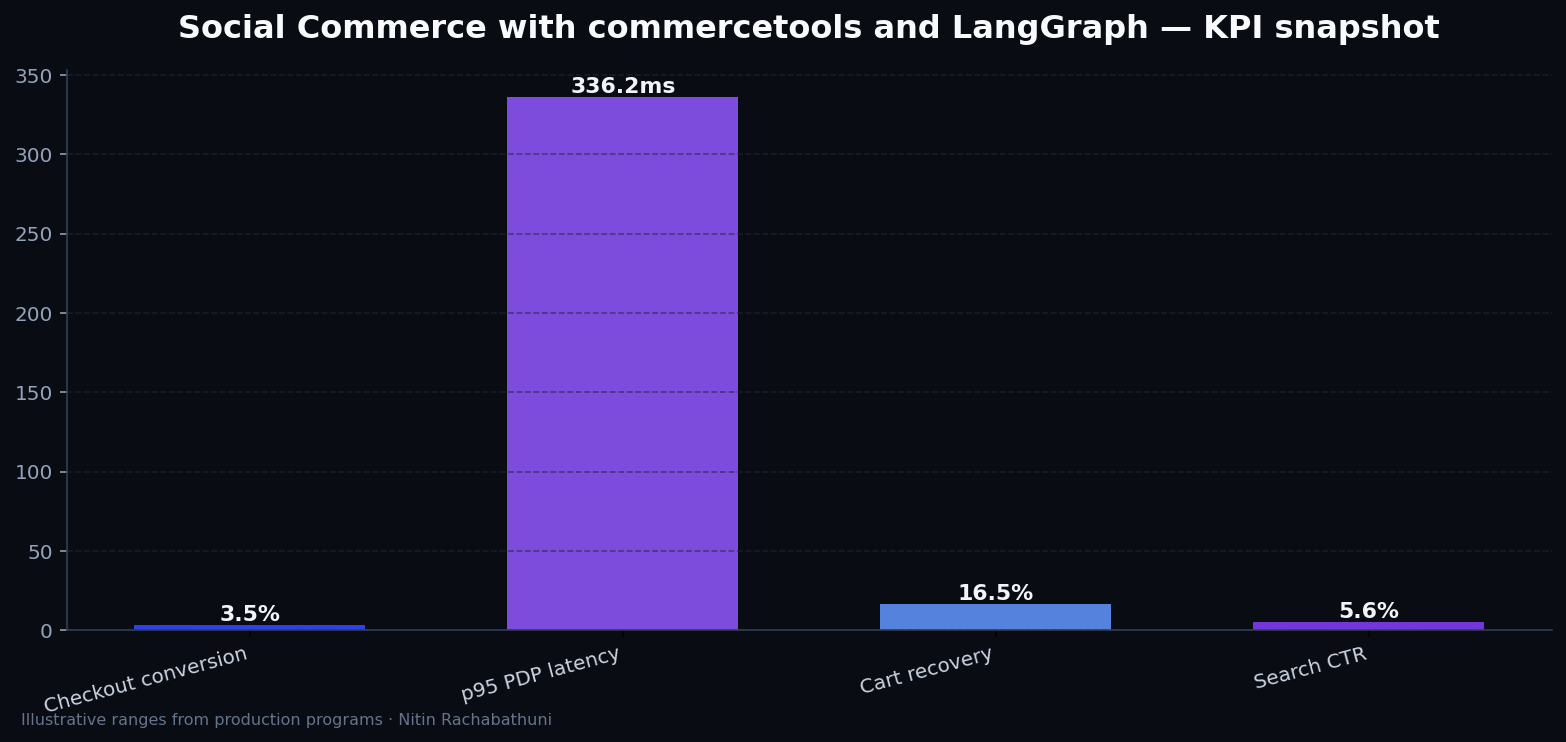
Illustrative commerce KPI ranges observed on programs like “Social Commerce with commercetools and LangGraph” — validate against your own telemetry before setting SLOs. Methodology: production-like staging traces + weekly review with product and ops.
Architecture flow

Code sketches
/* Integration sketch */
// Social Commerce with commercetools and LangGraph
export async function rolloutSocialCommerceLanggraphCommercetools() {
  const checks = ["telemetry", "auth", "rollback"];
  return { ok: true, checks };
}
Official references
Related on this site
Related case study
Kitchen Warehouse commercetools — Multi-store headless commerce — Algolia, payments, fraud, Kinde customer OAuth.
Article slug: social-commerce-langgraph-commercetools · Engineering notes by Nitin Rachabathuni — MVP in 2 days specialist.
Implementing payment webhooks with Firebase in brownfield replatforms
Identity
Implementing payment webhooks with Firebase for embedded partner widgets
Identity
Implementing payment webhooks with Firebase with feature-flag rollbacks
Identity
Implementing payment webhooks with Firebase for answer-engine citations
Identity
Implementing payment webhooks with Firebase with sub-200ms TTFB targets
Identity
Implementing payment webhooks with Firebase for mobile-first buyers
Identity