The Challenge of Scaling Mission-Critical Infrastructure
In the world of global payments, "high availability" is not just a feature; it is a baseline requirement. When a customer swipes a card or initiates a peer-to-peer payment, the system must respond with sub-second latency and near-perfect reliability. However, as systems scale to millions of transactions per second (TPS), traditional high-availability models often hit a ceiling.
In standard distributed architectures, even well-designed microservices can suffer from "cascading failures." A single degraded database instance or a runaway loop in a shared service can propagate across the entire network, taking down an entire region or global platform. For a financial institution like American Express, this level of risk is unacceptable.
To combat this, engineering teams are moving toward cell-based architecture. This design philosophy shifts the focus from "how do we make one big system reliable?" to "how do we ensure that if part of the system fails, it stays contained?" By partitioning the infrastructure into isolated "cells," engineers can effectively cap the blast radius of any single failure.
Defining and Implementing Cell-Based Architecture
At its core, a cell is a modular unit of deployment. Imagine your architecture as a collection of independent silos rather than one massive pool of resources. Each cell contains its own set of compute instances, load balancers, and—most importantly—its own dedicated data stores or partitioned database shards.
When a user interacts with the system, they are routed to a specific cell based on an identifier (such as a Merchant ID, User ID, or geographic region). Because each cell is self-contained:
- Isolation: A bug in the code of Cell A cannot consume resources or corrupt data in Cell B.
- Scalability: To handle more traffic, you don't just make one server bigger; you deploy more cells.
- Predictable Performance: Since each cell serves a limited subset of users, "noisy neighbor" effects are minimized, ensuring consistent latency for everyone.
The transition to this model is not trivial. It requires moving away from shared global resources (like a single massive database cluster) toward partitioned data models. This ensures that even if a specific shard becomes corrupted or overloaded, the impact is confined strictly to the users within that partition.
The Engineering Trade-offs: Complexity vs. Resilience
No architectural choice comes for free. While cell-based architecture provides superior resilience, it introduces significant operational complexity. As highlighted by American Express's engineering approach, you are essentially trading management overhead for a drastically reduced blast radius.
1. Routing Logic and Management: You must implement sophisticated "cell awareness" in your routing layer. The system needs to know exactly which cell a user belongs to and ensure they never "leak" into another cell during the request lifecycle. This requires rigorous configuration management and automated deployment pipelines that can spin up identical cells consistently.
2. Data Consistency: In a multi-cell environment, global data views become harder to maintain. If you need to perform cross-cell analytics or reporting, you must build asynchronous processes to aggregate data from all cells into a central warehouse, as direct cross-cell queries are discouraged to maintain isolation.
3. Deployment Granularity: One of the hidden benefits (and complexities) is deployment. You can roll out new features to one cell at a time (canarying by cell), ensuring that if a bug reaches production, it only affects a small percentage of your user base. However, this means managing multiple versions of infrastructure simultaneously until the rollout is complete.
Strategies for Hardening Mission-Critical Paths
To truly master resilience in payment systems, engineers should focus on three specific strategies derived from high-scale distributed systems:
- Separate Data and Control Planes: Whenever possible, ensure that the "control plane" (the logic used to manage the system) is decoupled from the "data plane" (the path where actual transactions flow). If a management tool crashes or hangs while trying to update a configuration, it should not block the ability of customers to complete their payments.
- Implement Degraded-Read Paths: When central APIs are unavailable or experiencing high latency, systems should have a pre-defined "degraded" mode. For example, if a real-time fraud check service is down, the system might fall back to a cached risk score rather than failing the transaction entirely.
- Run Dependency Failure Game Days: Don't wait for a production outage to see how your system handles a failure. Run "Game Days" where you intentionally take out specific dependencies (like a cache layer or a secondary API) and measure if the system fails gracefully within its assigned cell boundaries.
Building these systems requires a deep understanding of distributed systems theory and practical experience in managing complex infrastructure at scale. If you are looking to build a resilient, production-ready MVP that can handle your growth without crashing under pressure, contact me for expert guidance to help navigate these architectural choices early in your development cycle.
FAQ
What is the "blast radius" in system design? The blast radius refers to the extent of impact caused by a single failure within a distributed system. In cell-based architecture, the goal is to keep this radius small so that an issue in one component only affects a tiny fraction of your total users.
How does cell-based architecture differ from standard microservices? While both use modularity, standard microservices often share common resources like databases or caches. Cell-based architecture takes it a step further by ensuring each "cell" has its own dedicated instances of those shared resources to prevent cross-contamination during failures.
Is cell-based architecture suitable for small startups? It depends on the criticality of your service. For most applications, standard microservices are sufficient. However, if you are handling payments, healthcare data, or any mission-critical infrastructure where a "total outage" is catastrophic, the investment in cell-based architecture is often justified by the level of reliability it provides.
Authoritative references
Consult Next.js documentation, MDN Web Docs, web.dev, Next.js documentation, OWASP Cheat Sheets alongside the official references block below. Cross-check guidance with your compliance, security, and SRE stakeholders before setting SLOs.
Metrics snapshot
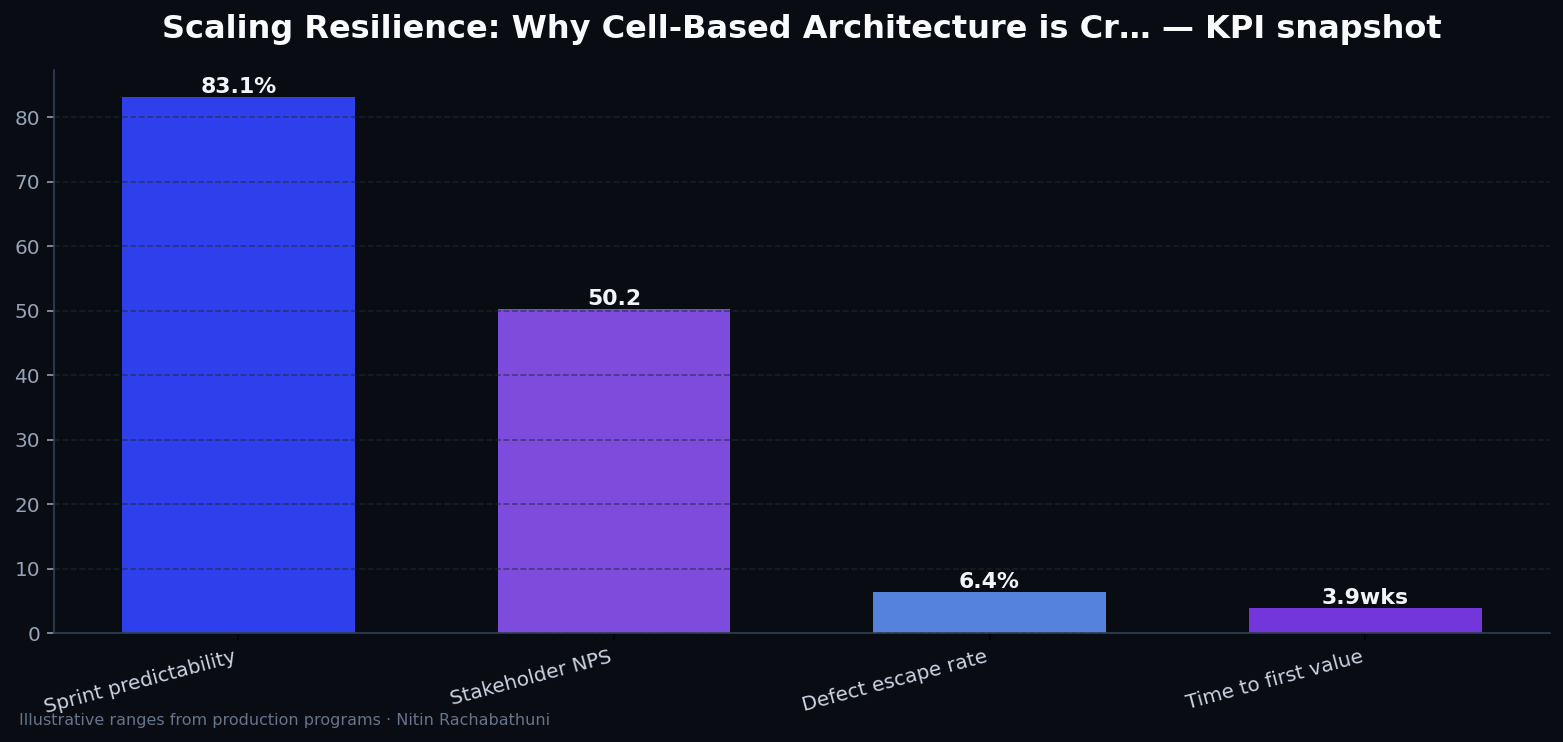
Illustrative consulting KPI ranges observed on programs like “Scaling Resilience: Why Cell-Based Architecture is Cr…” — validate against your own telemetry before setting SLOs. Methodology: production-like staging traces + weekly review with product and ops.
Architecture flow

Code sketches
/* Integration sketch */
// Scaling Resilience: Why Cell-Based Architecture is Cr…
export async function rolloutCellBasedArchitectureResilientPaymentSystems() {
  const checks = ["telemetry", "auth", "rollback"];
  return { ok: true, checks };
}
Official references
Related on this site
Article slug: cell-based-architecture-resilient-payment-systems · Engineering notes by Nitin Rachabathuni — MVP in 2 days specialist.