The Paradox of Defensive Security in the Age of LLMs
The recent news regarding Fable 5 and Mythos 5 has sent shockwaves through the cybersecurity community, but not for the reasons one might expect. Rather than a sophisticated cyberattack or a groundbreaking jailbreak, the federal government issued an export control directive based on what researchers describe as a "simple 'fix this code' prompt."
This creates a profound irony in the current landscape of AI governance. When we restrict access to high-performing models because they can assist in identifying vulnerabilities, we simultaneously cripple the tools that security engineers use to patch those very same vulnerabilities. In the world of software engineering, there is a thin line between "enabling an attacker" and "empowering a defender." By overreacting to the former, we risk handicapping the latter.
From an engineering perspective, these models are not just "chatbots"; they are sophisticated reasoning engines capable of analyzing complex logic flows. When a developer asks a model to fix a bug, the model is performing deep static analysis and logical inference. If that same capability is deemed too dangerous for public access, we must ask: how can defensive teams keep up with modern threat actors who will continue to use these tools regardless of export controls?
The "Dual-Use" Dilemma and Engineering Reality
The core issue here is the "dual-use" nature of large language models (LLMs). A model that can identify a buffer overflow in C++ code can be used by a malicious actor to craft an exploit, but it is equally essential for a security researcher building a patch.
When policy decisions are made based on high-level fears rather than technical nuances, the practical impact falls on the engineers. If we move toward a fractured ecosystem where only "sanitized" (and therefore less capable) models are available to the public or certain regions, the gap between defensive capabilities and offensive capabilities will widen.
In my experience building products for MVP cycles, I’ve seen how critical it is to have the best tools available at the point of creation. If a security team has to use a degraded model because their primary choice was restricted by export controls, they are forced to spend more manual hours on routine tasks like code auditing and regression testing. This slows down the "Mean Time to Repair" (MTTR), which is one of the most critical metrics in incident response.
Moving Beyond Hype: Practical Strategies for Secure AI Integration
Instead of relying solely on broad mandates that might stifle innovation, engineering teams should focus on robust internal governance and technical guardrails. If you are integrating LLMs into your production pipeline or security workflow, there are concrete ways to manage risk without sacrificing the power of the model.
First, we must move away from looking at "launch blog charts" as our only metric for success. A model’s capability is often tied to its specific prompt engineering and the context window provided. You should be benchmarking your specific use cases—such as automated PR reviews or vulnerability scanning—rather than just trusting a general-purpose benchmark.
Second, transparency in logging is non-negotiable. Every production call involving an LLM should log both the Model ID and the Prompt Version. This allows you to audit exactly what was sent and how the model responded over time, making it easier to identify if a prompt is drifting into "unsafe" territory or if a specific version of a model is behaving unpredictably.
Third, implement canary deployments for AI features. Before rolling out an LLM-powered tool across your entire engineering fleet, test it on low-risk endpoints. This allows you to observe how the model handles various inputs in a controlled environment before it becomes a standard part of the developer workflow.
Navigating the Regulatory Landscape as a Developer
The Fable 5 situation serves as a warning that the regulatory landscape is moving fast. As an engineer, your goal should be to build systems that are resilient enough to adapt when certain models become inaccessible or restricted. This means building modular integrations where you can swap out one model for another with minimal friction in your codebase.
By focusing on robust internal controls—such as input sanitization, output filtering, and strict logging—you can leverage the power of advanced models while staying within the bounds of safety requirements. We need to advocate for a nuanced approach that recognizes the difference between an intentional jailbreak and a standard technical request.
If you are looking to build out your own AI-driven features or need help navigating the complexities of integrating LLMs into your product's MVP, I can help you architect a system that balances power with safety. Contact me here to discuss how we can get your project moving forward effectively.
Conclusion: The Path Forward
The controversy surrounding Fable 5 highlights the tension between national security and technical progress. While it is vital to mitigate risks, a "blanket" approach to export controls may inadvertently weaken our collective defenses. By focusing on better internal monitoring, rigorous testing, and modular architecture, we can ensure that developers have the tools they need to build secure software without compromising safety standards.
The goal isn't just to make AI safe; it's to make AI useful for the people who keep our digital infrastructure running. We must advocate for a technical distinction between "harmful intent" and "functional capability."
FAQ
Why did the government issue an export control for Fable 5? The federal government issued a directive due to national security concerns regarding the model's capabilities. However, researchers note that these fears were triggered by standard coding prompts rather than malicious jailbreak attempts.
How does restricting high-performing AI models affect cybersecurity? Restricting advanced models makes it significantly harder for security teams to identify bugs and verify patches. Defensive tools rely on these capabilities to automate the detection of vulnerabilities before they can be exploited.
What are the practical risks of over-regulating AI code generation? Over-regulation creates a "dual-use" dilemma where blocking offensive potential also cripples defensive tools. This leads to slower patch cycles and less effective security posture for critical infrastructure.
Authoritative references
Consult Next.js documentation, MDN Web Docs, web.dev, Next.js documentation, OWASP Cheat Sheets alongside the official references block below. Cross-check guidance with your compliance, security, and SRE stakeholders before setting SLOs.
Metrics snapshot
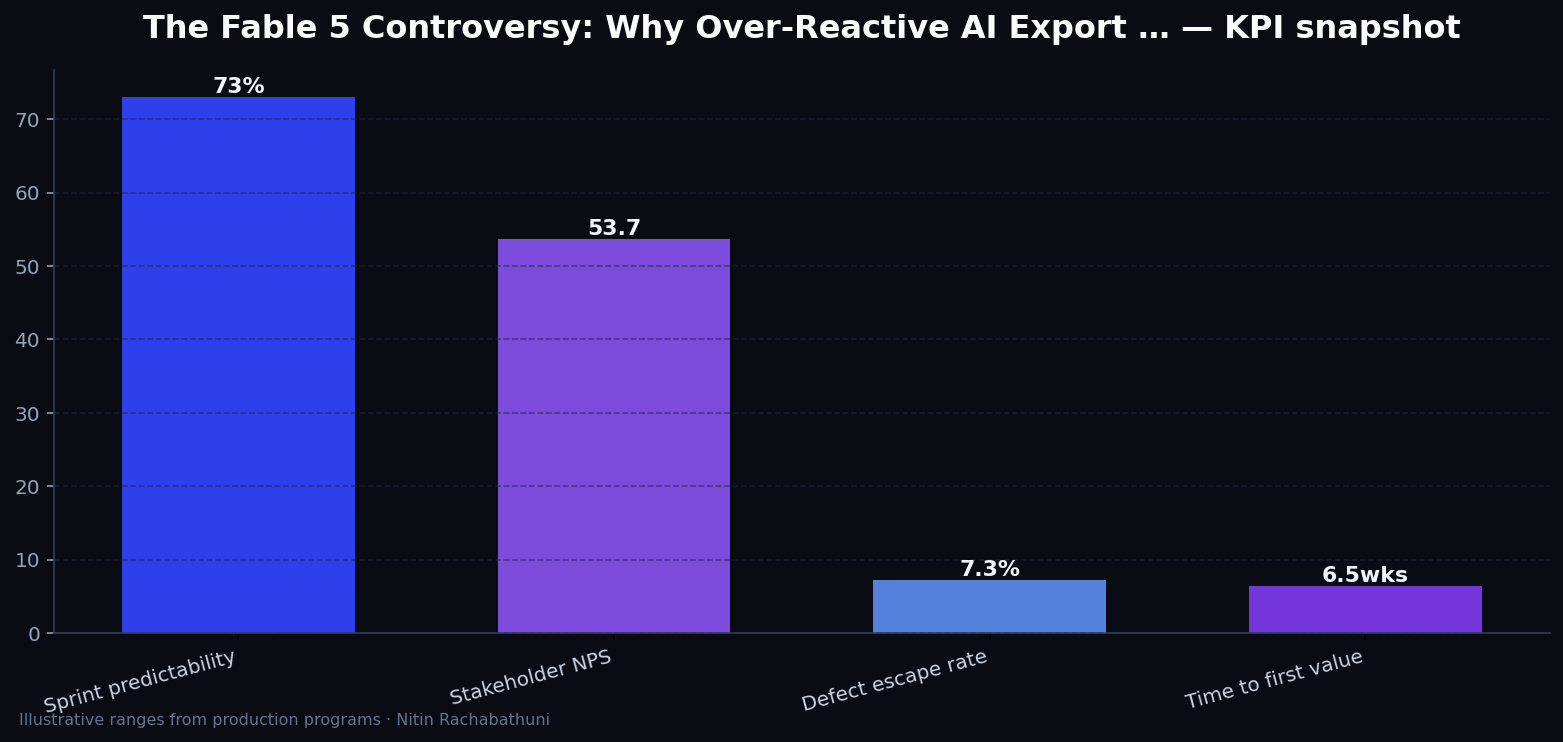
Illustrative consulting KPI ranges observed on programs like “The Fable 5 Controversy: Why Over-Reactive AI Export …” — validate against your own telemetry before setting SLOs. Methodology: production-like staging traces + weekly review with product and ops.
Architecture flow

Code sketches
/* Integration sketch */
// The Fable 5 Controversy: Why Over-Reactive AI Export …
export async function rolloutFable5AiExportControlsSecurityImpact() {
  const checks = ["telemetry", "auth", "rollback"];
  return { ok: true, checks };
}
Official references
Related on this site
Article slug: fable-5-ai-export-controls-security-impact · Engineering notes by Nitin Rachabathuni — MVP in 2 days specialist.