The Distinction Between Public Code and Open Source Excellence
In the modern software landscape, many projects claim to be "open source" simply because their source code is hosted on a public repository. However, as ClickHouse has demonstrated over its ten-year journey in the open-source ecosystem, there is a profound difference between publicly available code and a project that functions as an open-source standard.
True open source maturity isn't just about visibility; it’s about engineering discipline. When a project moves from an internal experimental tool to a community staple, the scrutiny intensifies exponentially. The codebase must transition from "working for our specific use case" to "robust enough for everyone’s production environment." This requires a rigorous commitment to systems design and CI/CD maturity.
For ClickHouse, this meant moving away from the easy path of wrapping existing technologies. Instead, they chose the harder road: building core components from scratch. By doing so, they were able to optimize at the metal—managing how data hits the disk, how memory is allocated in C++, and how queries are parallelized across clusters. This "build-from-scratch" philosophy is what allows a system to achieve high-performance scale rather than hitting the ceiling of an abstracted layer.
The Transition from Internal Tool to Community Standard
One of the most difficult engineering hurdles is identifying when a project is mature enough for public adoption. When a tool lives only within a company, "good enough" might suffice if it solves the immediate internal problem. But once that tool becomes a community standard, every bug becomes a headline and every performance regression impacts thousands of users.
The transition requires three specific shifts in engineering philosophy:
- Transparency as a Feature: A public roadmap isn't just for marketing; it’s a contract with the community. It allows contributors to see where effort is being allocated and ensures that the core team remains focused on architectural stability rather than chasing every minor feature request.
- Production-Grade Code Reviews: In an internal setting, a developer might skip certain edge cases if they know exactly how their specific data will behave. In open source, you must assume the user's data is "messy." This necessitates stricter code reviews that account for diverse workloads and unpredictable inputs.
- Scalability via Architecture: Rather than patching performance issues as they arise, a mature project addresses them through foundational design. ClickHouse’s decade of growth proves that building on solid architectural foundations allows the system to scale without constant "hacks" to keep it running under load.
Engineering for Scale: Beyond Localhost Success
A common trap in software development is the "it works on my machine" fallacy. To move toward a production-grade standard, engineering teams must shift their testing methodologies from local environments with small datasets to high-pressure simulations of real-world traffic.
To achieve this, several technical disciplines become non-negotiable:
Reproducing Production Loads: Testing should never happen on "localhost" with three records or a clean dataset. To truly validate a database system like ClickHouse, you must simulate production-shaped loads—thousands of concurrent queries against billions of rows. This exposes race conditions and locking issues that only appear at scale.
Measuring the Right Metrics (p95 vs. Averages): In user-facing systems, averages are often deceptive. An average latency might look great if 90% of requests are fast, but if the remaining 10% take ten seconds to complete, those users will experience a broken product. Engineering for high performance means measuring at the p95 or even p99 levels. This ensures that the "tail" of your distribution is managed and that the system remains stable under stress.
Robust Configuration Management: As systems grow more complex, managing state becomes harder. A mature engineering practice involves versioning cache keys with deployment IDs and experiment IDs. This prevents a new update from poisoning a cache or causing inconsistent results across different versions of the software running in a distributed environment.
Building for Longevity
The journey of ClickHouse over the last decade highlights that longevity is a byproduct of technical discipline. By choosing to build their own infrastructure rather than layering it on top of existing tools, they gained the ability to innovate at the core level. This gives them the freedom to optimize performance in ways that "wrapper" projects simply cannot achieve.
When you are building for the long haul, every decision—from how a query is parsed to how data is compressed—must be weighed against its impact on the end user's experience and the system’s maintainability. It isn't just about shipping features; it's about crafting an architecture that can withstand the scrutiny of a global community.
If you are looking to move your own internal tools toward production-grade standards or need help navigating the complexities of high-performance systems design, I can help you navigate these engineering trade-offs. Contact me for MVP and system design consulting to turn your "internal tool" into a scalable standard.
Summary of Key Takeaways
- Build vs. Wrap: Building from scratch allows for deeper optimization but requires more upfront engineering effort.
- Reliability over Speed: Moving to community standards requires prioritizing production-grade stability and rigorous CI/CD.
- Data Integrity at Scale: Use p95 metrics and high-volume load testing to ensure the system survives real-world usage.
Authoritative references
Consult Next.js documentation, MDN Web Docs, web.dev, Next.js documentation, OWASP Cheat Sheets alongside the official references block below. Cross-check guidance with your compliance, security, and SRE stakeholders before setting SLOs.
Metrics snapshot
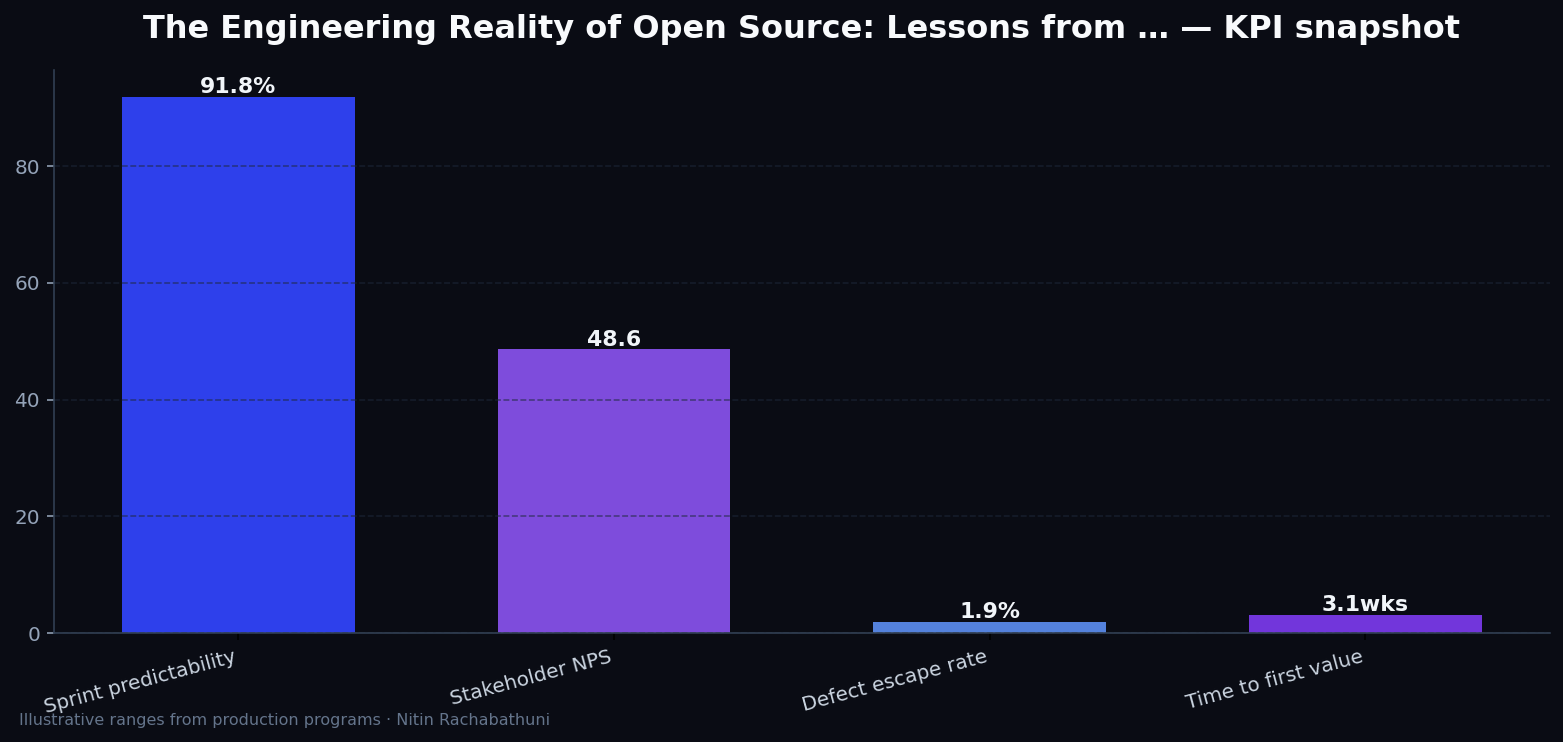
Illustrative consulting KPI ranges observed on programs like “The Engineering Reality of Open Source: Lessons from …” — validate against your own telemetry before setting SLOs. Methodology: production-like staging traces + weekly review with product and ops.
Architecture flow

Code sketches
/* Integration sketch */
// The Engineering Reality of Open Source: Lessons from …
export async function rolloutClickhouseOpenSourceEngineeringLessons() {
  const checks = ["telemetry", "auth", "rollback"];
  return { ok: true, checks };
}
Official references
Related on this site
Article slug: clickhouse-open-source-engineering-lessons · Engineering notes by Nitin Rachabathuni — MVP in 2 days specialist.