Engineering leadership lens — Nitin Rachabathuni connects industry news to production patterns: tradeoffs, observability, and how senior teams evaluate tools before they commit. The notes below translate hype into decision-grade detail. For a direct conversation on scope—audit, implementation, or advisory—use WhatsApp, email, phone, or LinkedIn below. Flexible hourly terms; available across time zones and countries.
The Collision of Legal Guardrails and Proactive Defense
The recent news regarding AMD’s decision to withhold a $10,000 bounty from a security researcher serves as a textbook case study in the friction between corporate legal policy and practical cybersecurity. At its core, the issue wasn't whether the vulnerability existed—AMD acknowledged that it did. Instead, the conflict arose from how the flaw was classified within their internal reward framework.
The researcher identified a critical Remote Code Execution (RCE) vulnerability within an auto-updater for Windows systems. Such flaws are high-priority targets because they allow attackers to execute arbitrary code on a victim's machine, often leading to full system compromise. However, AMD’s legal and policy teams categorized the specific attack vector as a "man-in-the-middle" (MitM) scenario. Because their bug bounty program explicitly excluded MitM attacks from payouts, they were legally unable to fulfill the $10k reward despite the severity of the find.
This situation highlights a growing problem in the InfoSec industry: when legal teams draft policy documents without sufficient input from security engineers, "gray areas" emerge. A vulnerability might be technically complex or nuanced enough that it fits two different categories—one that is high-risk (RCE) and one that is legally excluded (MitM). When these overlap, researchers are often left empty-handed despite providing a massive service to the company’s security posture.
The High Cost of "Policy Gaps" in Bug Bounty Programs
When a major tech giant like AMD refuses to pay for a valid find, it sends a signal to the global research community. Security researchers operate on a mix of passion and professional incentives. When programs are perceived as inconsistent or governed by rigid legal hurdles that don't account for technical reality, high-quality researchers may choose to report their findings elsewhere—or not report them at all.
The 124-day window between the researcher’s disclosure and the final fix also underscores a different kind of risk: the "window of exposure." While the legal team was debating whether the bug met the criteria for a payout, the vulnerability remained live in the wild. In modern cybersecurity, speed is often the only thing standing between a minor incident and a catastrophic breach.
For organizations running these programs, the goal should be to foster a collaborative relationship with "white hat" hackers. If a researcher finds an RCE that impacts core infrastructure, the technical risk of it being exploited by malicious actors far outweighs the administrative headache of navigating a complex payment policy. A rigid stance on MitM exclusions can inadvertently create a "silent" threat environment where researchers find critical flaws but feel discouraged from engaging with the company's official channels because they know the payout will be blocked by fine print.
Building Resilient Infrastructure Beyond Bug Bounties
While bug bounty programs are excellent for finding "low-hanging fruit" and edge cases, they should not be the primary line of defense against critical infrastructure failures. The AMD case shows that even when a program works as intended (from a legal standpoint), it doesn't mean the underlying system is secure.
To move toward an MVP (Minimum Viable Product) approach to security—where you are building for resilience from day one—organizations must look beyond just "catching" bugs and start hardening their deployment pipelines. This means moving away from reactive patching and toward a proactive stance:
- Assume Compromise: Don't wait for a bug bounty report to secure your perimeter. Assume that an attacker is already inside the network and focus on rotating secrets, enforcing multi-factor authentication (MFA), and narrowing the blast radius of every internal service.
- Patch the Path, Not Just the Headline: When a vulnerability like the one in the Windows auto-updater is announced, teams often just check a box saying "we are aware." Instead, engineers should map out exactly where that dependency sits in their production environment and patch it immediately.
- Simulate Reality with Tabletop Exercises: Ask your team: "What happens if this specific vulnerability hits us at 6 PM on a Friday?" Walking through the incident response plan before an actual breach occurs is the difference between a controlled recovery and a chaotic crisis.
If you are looking to streamline your security posture or need help building more resilient systems that don't rely solely on external bug hunters to find critical flaws, contact me for MVP-focused engineering consulting. We focus on building robust infrastructure that minimizes risk from the ground up.
Strategic Takeaways for Security Leaders
The AMD situation is a warning against over-simplifying security policies to satisfy legal requirements at the expense of technical reality. If your organization runs a bug bounty program, it is essential to conduct an audit of your "exclusion" list. Are there any categories that are technically high-risk but legally excluded? If so, you may be creating a blind spot in your defense.
Furthermore, this story highlights the importance of internal security culture. A 124-day turnaround for a fix is significant. It suggests that while the bug was reported, the internal coordination between the reporting team, the engineering team, and the legal team may have been siloed. Breaking down these silos ensures that when a researcher finds something critical, the focus remains on fixing it as fast as possible, regardless of whether the "bounty" criteria are met to the letter of the law.
Ultimately, security is about risk management. The risk of an unpatched RCE in an auto-updater far outweighs the administrative complexity of paying a researcher for their work. By aligning legal policies with technical realities and focusing on robust internal infrastructure, companies can create a much safer environment for both their users and their researchers.
FAQ
Why did AMD refuse to pay the $10k bug bounty? AMD cited specific policy exclusions regarding man-in-the-middle (MitM) attacks. While they acknowledged the vulnerability was real, their internal legal framework prevented payment for flaws categorized under that specific attack vector.
How long did it take AMD to fix the reported security flaw? The report indicates that the critical RCE (Remote Code execution) flaw in the Windows auto-updater took 124 days from initial disclosure for a fix to be implemented.
What does this mean for bug bounty programs in general? It highlights the risk of "policy gaps" where legal constraints can discourage researchers. Organizations must ensure their reward structures align with actual security risks rather than just technical definitions.
Authoritative references
Consult Next.js documentation, MDN Web Docs, web.dev, Next.js documentation, OWASP Cheat Sheets alongside the official references block below. Cross-check guidance with your compliance, security, and SRE stakeholders before setting SLOs.
Metrics snapshot
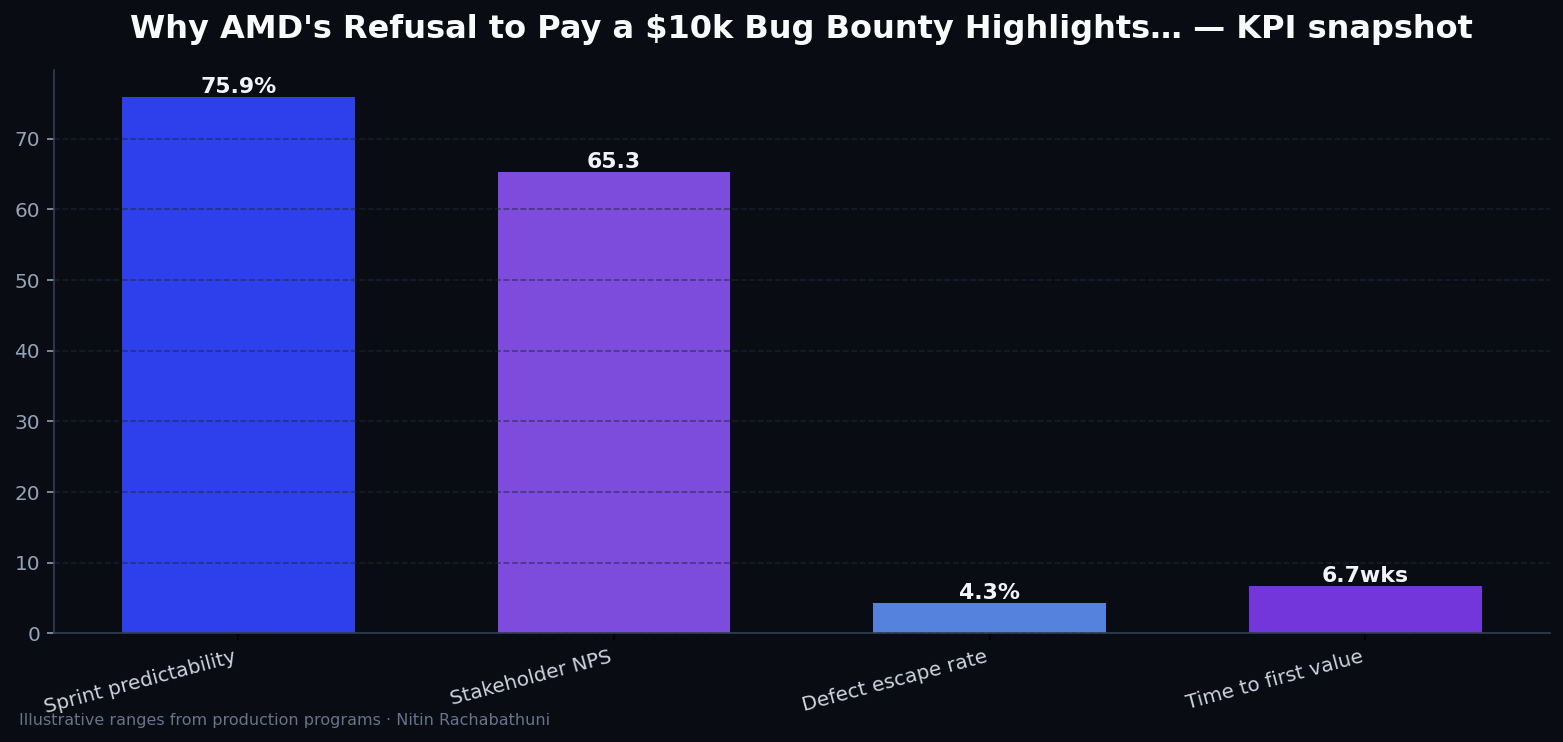
Illustrative consulting KPI ranges observed on programs like “Why AMD's Refusal to Pay a $10k Bug Bounty Highlights…” — validate against your own telemetry before setting SLOs. Methodology: production-like staging traces + weekly review with product and ops.
Architecture flow

Code sketches
/* Integration sketch */
// Why AMD's Refusal to Pay a $10k Bug Bounty Highlights…
export async function rolloutAmdBugBountyPolicyConflictSecurityResearch() {
  const checks = ["telemetry", "auth", "rollback"];
  return { ok: true, checks };
}
Official references
Related on this site
Article slug: amd-bug-bounty-policy-conflict-security-research · Engineering notes by Nitin Rachabathuni — MVP in 2 days specialist.