The Illusion of the Shortcut: Why AI is a Force Multiplier for Technical Debt
The current zeitgeist in software development is dominated by a sense of "magic." With the advent of Large Language Models (LLMs), it feels as though the barrier to entry for creating complex features has vanished. We see people generating entire applications from single prompts and calling it "vibe coding"—a term that captures the essence of building based on general intent rather than granular, disciplined specification.
However, there is a fundamental trap in this narrative. While AI makes it easier to produce code, it does not make it easier to build systems.
In fact, the opposite is true. Because LLMs are non-deterministic systems—meaning they can produce different outputs for similar inputs and may hallucinate logic that looks correct but fails under specific edge cases—the burden on the human engineer actually increases. When you use a tool that generates code at an "average" level of quality instantly, your role shifts from being a writer to being an editor, a validator, and a gatekeeper. If you don't have the discipline to enforce strict types, unit tests, and architectural boundaries, the speed provided by AI will simply allow you to accumulate technical debt faster than ever before.
From Code Generation to System Validation
In traditional software engineering, we spent a lot of time on "boilerplate." We wrote the same getters, setters, and basic API wrappers repeatedly. AI has effectively automated that layer of the stack. But when the boilerplate disappears, what remains is the complexity of integration, state management, and error handling.
When an LLM generates a block of code for you, it doesn't "know" your production environment. It doesn't know your specific latency requirements or how your database handles concurrent locks. If we treat AI output as a finished product rather than raw material, we risk building fragile systems that work 90% of the time but fail catastrophically in the remaining 10%.
To counter this, engineers must lean into higher-level discipline:
- Strict Typing: Using languages or frameworks that enforce types helps catch LLM hallucinations before they reach production.
- Observability: Since AI code can be unpredictable, you need robust logging and tracing to understand why a piece of generated logic failed in the wild.
- Contract Testing: Ensuring that the "glue" between different services remains intact even when the internal implementation of those services is updated by an LLM-assisted workflow.
The Cost of Speed Without Guardrails
The most dangerous moment in any software lifecycle is when speed becomes a substitute for verification. In the "vibe coding" era, it is tempting to skip the documentation or the edge-case analysis because "the AI handled it."
But "handled it" doesn't mean "it's safe." If you don't know exactly what behavior is required from a component, then any code that appears to work is a liability. For example, if an AI generates a function to process payments, and it works for standard amounts but fails on specific currency conversions or timeout scenarios, the speed of its creation becomes irrelevant once the system crashes in production.
To build resilient systems in the age of AI, we must adopt a "trust but verify" mindset:
- Write the Rollback Plan First: Before deploying any major block of AI-generated logic, define exactly how you will revert it if it fails.
- Define Precise Requirements: Instead of asking an LLM to "make a login page," specify the security protocols, the error messages for failed attempts, and the session timeout logic.
- Question the Data: When an AI provides a performance metric or a specific optimization, ask: "Who measured this? On what hardware? Under what load?"
Moving Toward Mature AI Integration
The goal isn't to reject AI tools; it’s to integrate them into a professional engineering workflow that prioritizes stability over "vibes." This means moving away from the idea of "prompting your way" to a finished product and toward using AI as a high-speed drafting tool that must pass through rigorous, human-led validation gates.
By focusing on architecture, system design, and automated testing, we can harness the speed of LLMs without sacrificing the integrity of our software. We need to be the architects who ensure the foundation is solid, even if the bricks were laid by an algorithm.
If you are looking to transition your team from "vibe coding" to a robust, scalable engineering culture that leverages AI responsibly, contact us for MVP help to build out your roadmap and infrastructure.
FAQ
Does AI make it easier to write high-quality code? AI makes it significantly faster to generate code at a "median" level of quality. However, ensuring that the generated code is secure, scalable, and fits specific business logic requires more human oversight and engineering discipline than traditional manual coding.
What is "vibe coding" in the context of AI? Vibe coding refers to a style of development where users rely on LLMs to generate functionality without strictly defining requirements or testing edge cases. While fast, it often leads to brittle systems that fail under non-deterministic conditions.
How can teams balance speed with safety when using AI? Teams should implement rigorous validation layers, such as automated integration tests and strict type checking, before deploying AI-generated code. Establishing a clear "rollback plan" and defining precise requirements before prompting are essential steps.
Authoritative references
Consult Next.js documentation, MDN Web Docs, web.dev, Next.js documentation, OWASP Cheat Sheets alongside the official references block below. Cross-check guidance with your compliance, security, and SRE stakeholders before setting SLOs.
Metrics snapshot
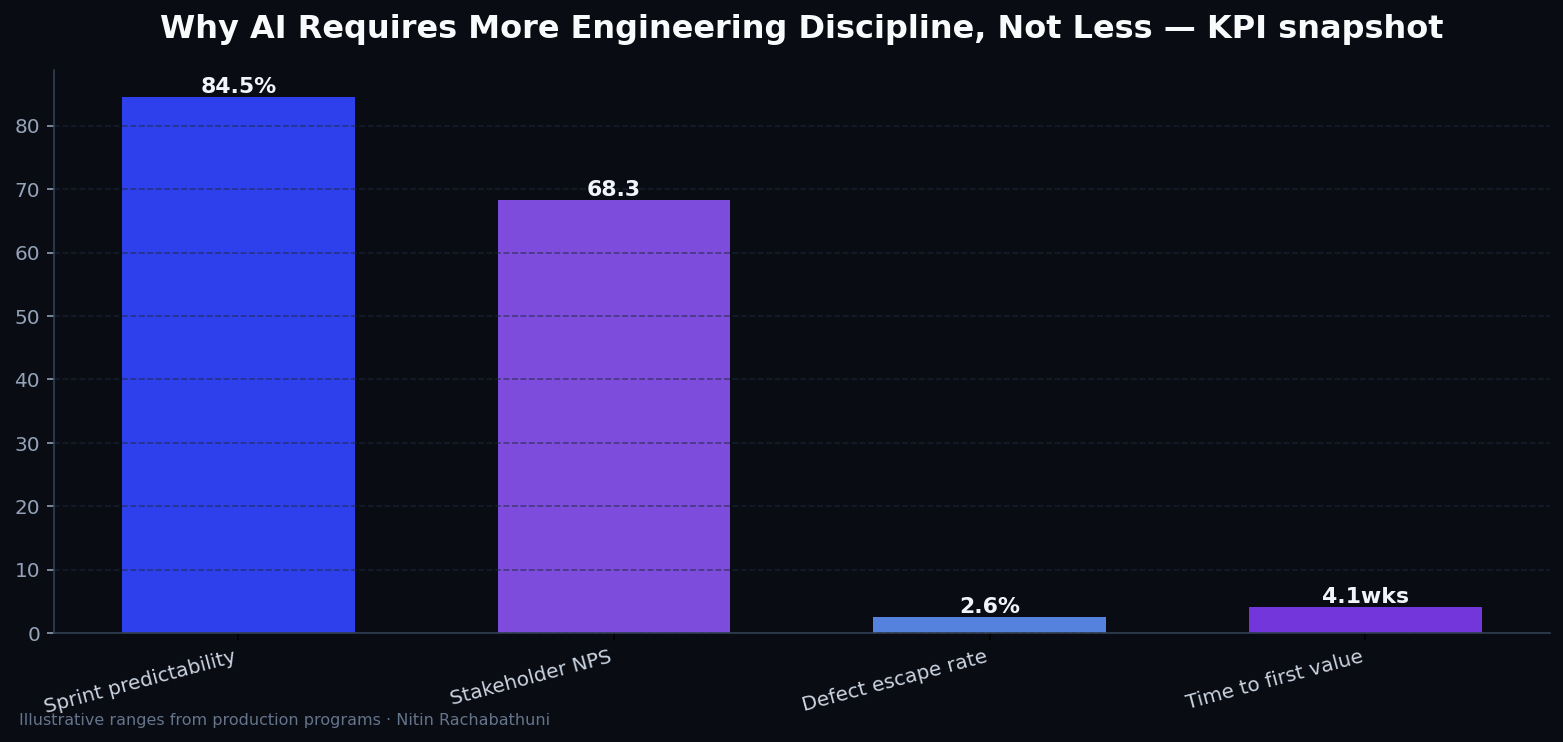
Illustrative consulting KPI ranges observed on programs like “Why AI Requires More Engineering Discipline, Not Less” — validate against your own telemetry before setting SLOs. Methodology: production-like staging traces + weekly review with product and ops.
Architecture flow

Code sketches
/* Integration sketch */
// Why AI Requires More Engineering Discipline, Not Less
export async function rolloutAiEngineeringDisciplineVsVibeCoding() {
  const checks = ["telemetry", "auth", "rollback"];
  return { ok: true, checks };
}
Official references
Related on this site
Article slug: ai-engineering-discipline-vs-vibe-coding · Engineering notes by Nitin Rachabathuni — MVP in 2 days specialist.