Sustainable communities are essential for the well-being of both people and the planet. They are designed to minimize environmental impact, promote social equity, and enhance the overall quality of life. In creating such communities, architecture plays a crucial role.
Architecture is not solely about creating aesthetically pleasing structures; it also has the power to shape our environment in a sustainable manner. From the design phase to construction and beyond, architects have the opportunity to incorporate sustainable principles that can significantly impact the community.
"Good product come from good people, and all problems are solved by good design. Keep doing good design." — Stephen Gardiner
Architects can employ various strategies to foster sustainability. First and foremost, they can prioritize energy efficiency by designing buildings that minimize energy consumption and incorporate renewable energy sources. This includes utilizing natural lighting, employing energy-efficient materials, and implementing efficient insulation systems.
Furthermore, sustainable architecture promotes the use of eco-friendly materials, such as recycled and locally sourced materials, which reduces the carbon footprint associated with construction. By considering the life cycle of materials and designing for disassembly, architects can enable easier recycling and reuse in the future.
Navbar active State
useEffect(() => {
  const activeLink = navRef.current.querySelector(".active");
  if (activeLink) {
    activeLinkRef.current = activeLink;
    setIndicatorPosition({
      left: activeLink.offsetLeft,
      width: activeLink.offsetWidth,
    });
  }
}, [mainMenu]);
Additionally, architects can design spaces that encourage community engagement and social interaction. By incorporating public gathering areas, green spaces, and pedestrian-friendly infrastructure, they create opportunities for residents to connect, fostering a sense of community.
In conclusion, sustainable communities are not merely a product of chance; they are a result of thoughtful and intentional architectural design. Architects have the power to shape our built environment in a way that promotes sustainability, energy efficiency, and community well-being. By embracing sustainable principles and incorporating them into their designs, architects contribute significantly to the creation of sustainable communities.
Markdown syntax guide
Headers
This is a Heading h1
This is a Heading h2
This is a Heading h6
Emphasis
This text will be italic
This will also be italic
This text will be bold
This will also be bold
You can combine them
Lists
Unordered
- Item 1
- Item 2
- Item 2a
- Item 2b
Ordered
- Item 1
- Item 2
- Item 3
- Item 3a
- Item 3b
Images

Links
You may be visiting a Next.JS theme.
Blockquotes
Markdown is a lightweight markup language with plain-text-formatting syntax, created in 2004 by John Gruber with Aaron Swartz.
Tables
| Left columns | Right columns |
|---|---|
| left foo | right foo |
| left bar | right bar |
| left baz | right baz |
Blocks of code
let message = 'Hello world';
alert(message);
Inline code
This web site is using markedjs/marked.

Using Fonts in Next.js (Google Fonts, Local Fonts, Tailwind CSS)
Authoritative references
Consult Next.js documentation, MDN Web Docs, web.dev, Next.js documentation, OWASP Cheat Sheets alongside the official references block below. Cross-check guidance with your compliance, security, and SRE stakeholders before setting SLOs.
Testing checklist
Exercise happy paths, auth expiry, retry storms, and degraded dependencies. Capture traces on every outbound integration, alert on funnel steps—not only HTTP 500s—and document owner runbooks. Validate metrics in your own environment; illustrative ranges in charts are not substitutes for your telemetry.
Leadership takeaway
The Role of a Developer in Creating Communities succeeds when teams align scope, measurable outcomes, and inclusive UX from sprint zero. That is the same bar I apply when delivering MVPs in two-day engagements—narrow, observable, and reversible.
Metrics snapshot
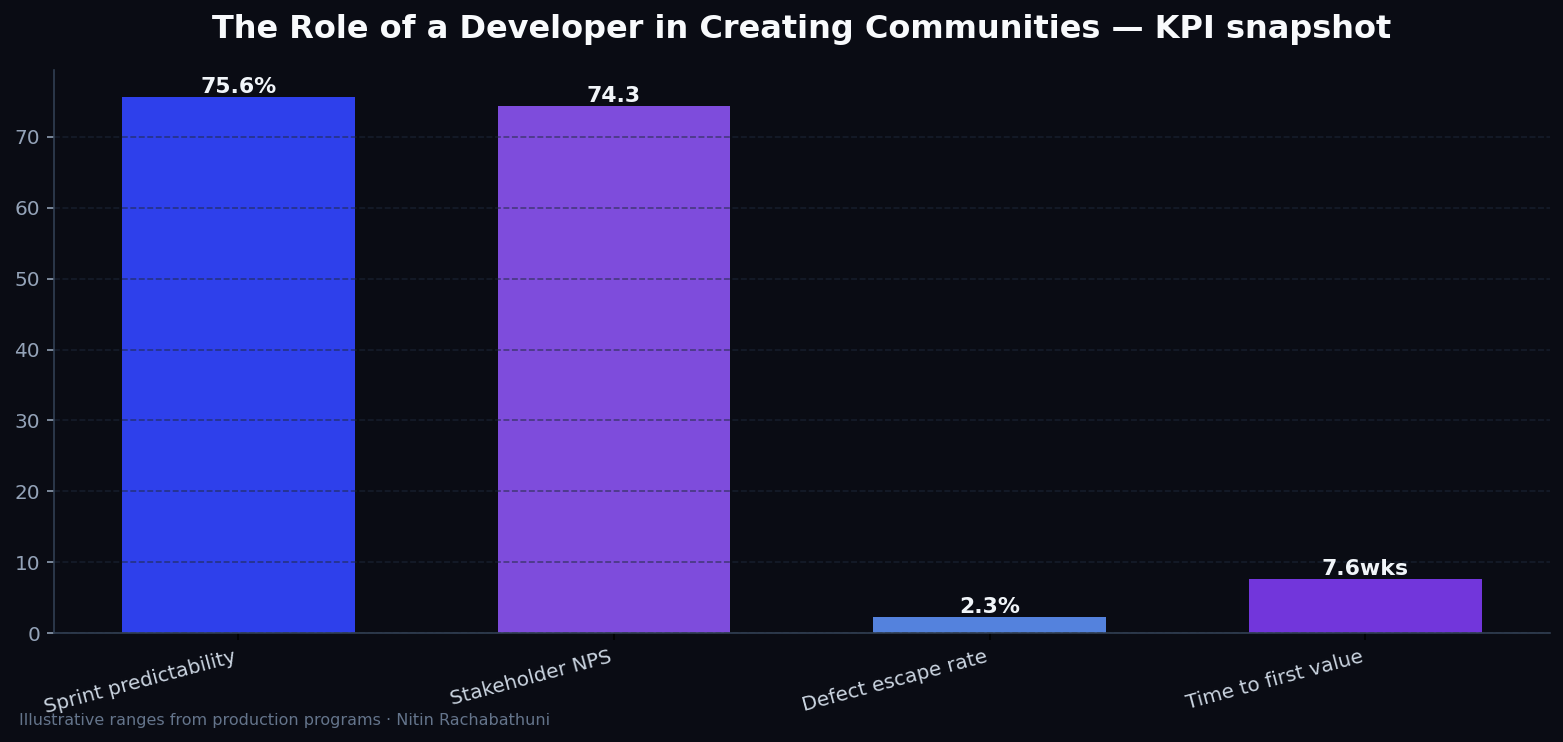
Illustrative consulting KPI ranges observed on programs like “The Role of a Developer in Creating Communities” — validate against your own telemetry before setting SLOs. Methodology: production-like staging traces + weekly review with product and ops.
Architecture flow

Code sketches
/* Integration sketch */
// The Role of a Developer in Creating Communities
export async function rolloutTheRoleOfADeveloperInCreatingCommunities() {
  const checks = ["telemetry", "auth", "rollback"];
  return { ok: true, checks };
}
Official references
Related on this site
Article slug: the-role-of-a-developer-in-creating-communities · Engineering notes by Nitin Rachabathuni — MVP in 2 days specialist.