The Friction Between Human Design and Machine Execution
For the last two decades, Git has been the undisputed standard for version control. It was designed with human cognitive patterns in mind: we want to see visual diffs, understand branch names, and navigate a history that makes sense to our eyes. However, as we move into an era where AI agents are increasingly tasked with performing complex engineering tasks—such as refactoring codebases, managing deployments, and fixing bugs autonomously—we are discovering a fundamental mismatch in tooling.
The problem isn't that Git is "bad" software; it’s that it was designed for humans who can interpret nuance, context, and visual cues. When an LLM interacts with standard Git commands, it often encounters ambiguities. A non-standard exit code or a slightly inconsistent output format from a CLI tool can cause an agent to hallucinate its current state. If an agent is trying to merge a branch but the terminal output doesn't perfectly align with what the model expects for a "success" state, the automation loop breaks.
This is where Oak enters the conversation. Oak isn't just another Git client; it is a reimagining of version control specifically for non-human actors. By moving toward an "agent-native" architecture, Oak aims to eliminate the noise that causes LLMs to fail during complex state transitions. It prioritizes machine-readable outputs and stable environments where the path from point A to point B is mathematically clear rather than contextually implied.
Why Agent-Native Infrastructure Matters
When we build systems for AI agents, our engineering requirements shift significantly compared to standard product development. We have to move away from "convenience" features that humans love but machines struggle with. For example, a human might find it easy to navigate a messy directory structure because they can see the files; an agent needs a deterministic path.
Oak addresses this by implementing:
- Stable Exit Codes: Ensuring that every operation returns a predictable signal so the agent knows exactly whether to proceed or retry.
- JSON Outputs: By providing structured data, Oak allows agents to parse state information directly without needing to "guess" what a string of text means.
- Reduced Ambiguity: By stripping away the layers of human-centric UI/UX from the CLI layer, it creates a streamlined pipeline for autonomous execution.
The trade-off here is intentional. To make tools work perfectly for agents, we often have to move toward more specialized infrastructure that might feel "sterile" or less intuitive for humans at first glance. However, in an automated CI/CD pipeline where an agent is performing 100 iterations of a refactor, that precision is the difference between a successful deployment and a broken production environment.
Moving Beyond Localhost: The Engineering Reality
As we integrate these "agent-native" tools into our workflows, we must also change how we validate them. If you are building for agents, your testing methodology must evolve as well. You cannot rely on the same validation checks that work for human developers in a local environment with three records of data.
To truly build robust systems for autonomous actors, engineers need to focus on:
- Production-Shaped Load: Testing an agent's ability to navigate version control under heavy load and complex merge conflicts—not just in a "happy path" scenario on a developer’s laptop.
- P95 Metrics over Averages: In user-facing paths, averages lie. If an AI agent fails 5% of the time because of a specific edge case in the Git state, that represents a catastrophic failure for the end-user experience. We must measure and optimize for the tail ends of our performance metrics.
- Deterministic Cache Keys: When deploying experiments or features involving agents, we need to version cache keys with both deployment IDs and experiment IDs to ensure reproducibility across different iterations.
By adopting tools like Oak, teams can create a more stable foundation for these complex operations. Instead of spending engineering cycles "prompt engineering" an LLM to understand how to navigate a messy Git repo, you spend that energy building the actual product features.
Building Your MVP with Agent-Ready Infrastructure
The shift toward agent-native tools is not just a trend; it's a necessary evolution in our tech stack as we move toward autonomous software engineering. When your infrastructure speaks the language of the machine, your ability to scale automated workflows increases exponentially.
Building an MVP that leverages these advanced capabilities requires a deep understanding of how to balance current product needs with future-proof technical architecture. If you are looking to build out a robust, scalable product and need expert guidance on navigating the complexities of modern software engineering or getting your MVP off the ground, contact me for specialized consulting.
Frequently Asked Questions
What is the primary difference between Git and Oak? While Git was designed for human interaction with visual diffs and complex branching logic, Oak is built for machine readability. It prioritizes stable exit codes and JSON outputs to ensure LLMs can navigate state transitions without hallucinating.
Why do standard Git workflows fail when used by AI agents? Standard Git tools often contain ambiguities in output formatting and complex edge cases. These nuances can cause LLM models to lose track of the current branch or state, leading to errors during automated deployments.
Is Oak a replacement for human developers using version control? Oak is specifically designed as infrastructure for non--human actors. While humans can use it, its primary value proposition lies in providing a stable environment where autonomous agents can perform complex operations reliably.
Authoritative references
Consult LangGraph.js, MDN Web Docs, web.dev, Next.js documentation, OWASP Cheat Sheets alongside the official references block below. Cross-check guidance with your compliance, security, and SRE stakeholders before setting SLOs.
Metrics snapshot
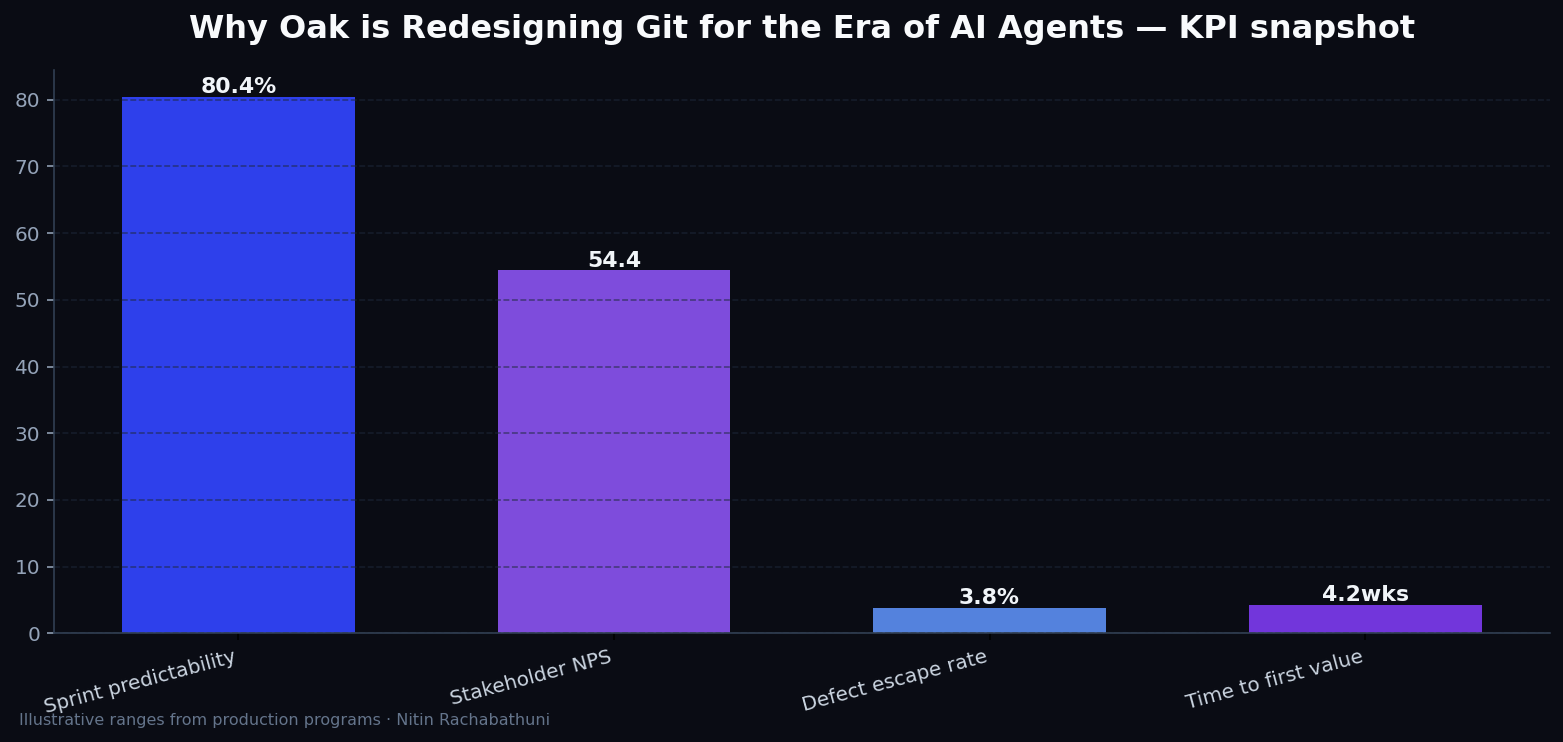
Illustrative consulting KPI ranges observed on programs like “Why Oak is Redesigning Git for the Era of AI Agents” — validate against your own telemetry before setting SLOs. Methodology: production-like staging traces + weekly review with product and ops.
Architecture flow

Code sketches
/* Integration sketch */
// Why Oak is Redesigning Git for the Era of AI Agents
export async function rolloutOakGitAlternativeAiAgents() {
  const checks = ["telemetry", "auth", "rollback"];
  return { ok: true, checks };
}
Official references
Related on this site
Related case study
Juiceit.ai — AI platform — document intelligence, agent workflows, enterprise automation.
Article slug: oak-git-alternative-ai-agents · Engineering notes by Nitin Rachabathuni — MVP in 2 days specialist.
Juiceit style straight through document processing
AI Agents
Shopify Acquires Tailwind CSS: The Strategic Shift from Independent Tooling to Core Infrastructure
leadership
Tailwind CSS Joins Shopify: A Masterclass in Strategic Infrastructure Pivot
tech
The Illusion of Quality: Why AI Agents Fail at Test Verification
tech
Beyond the Vector Database: Why Git-Native Memory is the Future for AI Coding Agents
leadership
Agentic Context Management: Solving the Memory vs. Cost Architecture Problem
tech