
The Efficiency Revolution: How VibeThinker is Redefining the Scaling Laws of LLMs
For the past few years, the prevailing mantra in artificial intelligence has been "bigger is better." We have watched as models grew from billions to trillions of parameters, with the assumption that massive scale was the only way to achieve high-level reasoning. However, the emergence of VibeThinker—a 3B parameter model that outperforms flagship systems like Gemini 1.5 Pro and DeepSeek v3.2 on complex reasoning tasks—is starting to shift that narrative significantly.
This isn't just a win for "small" models; it is a fundamental proof of concept regarding how we train, optimize, and deploy intelligence for specific use cases. By leveraging a combination of Supervised Fine-Tuning (SFT) and Group Relative Policy Optimization (GRPO), VFTThinker demonstrates that high-density logic can be compressed into a compact footprint.
The Parametric Compression-Coverage Hypothesis
The core technical breakthrough behind VibeThinker lies in the "parametric compression-coverage hypothesis." To understand this, we have to look at what an LLM actually does with its parameters.
Large models (100B+ parameters) are designed for broad coverage. They need massive amounts of memory to store facts about history, geography, pop culture, and various coding languages simultaneously. When you want a model that can write a poem in the style of Robert Frost while also explaining quantum physics, you need scale.
In contrast, reasoning is a different beast. Reasoning is a logical process—a series of steps taken to reach a verifiable conclusion. The VibeThinker team suggests that while broad knowledge requires massive scale, verifiable reasoning can be compressed. By using specific SFT and GRPO pipelines, the model "ignores" the need to know every fact in the world and instead focuses its parameters on the logic required to solve complex problems. You are essentially trading general-purpose breadth for specialized, high-density logical depth.
The Power of SFT + GRPO
Why did this specific combination work so well? To understand why VibeThinker outperformed giants like Opus 4.5 in reasoning benchmarks, we have to look at the training methodology:
- Supervised Fine-Tuning (SFT): This provides the initial "guardrails" and high-quality examples of how a thought process should be structured. It teaches the model the form of logic.
- Group Relative Policy Optimization (GRPO): GRPO is a reinforcement learning technique that allows models to optimize their outputs based on rewards without needing a separate, massive reward model. This encourages the model to find the most efficient path to a correct answer during training.
When these two are combined in a smaller architecture, the 3B parameters aren't "wasted" on trying to remember what happened in the 1920s; they are dedicated entirely to the mechanics of reasoning. This is why it can outperform much larger models that have their weights spread thin across thousands of disparate topics.
Practical Implications for Agentic Workflows
If you are building agentic workflows—autonomous systems that need to plan, reason, and execute tasks—this shift toward smaller, specialized models has massive implications for your production stack.
In many cases, using a flagship model like GPT-4o or Gemini Ultra is overkill for specific sub-tasks. If an agent only needs to perform "logical reasoning" (e.g., "Given these three constraints, determine the optimal shipping route"), a 3B parameter model optimized via GRPO can often do it faster and cheaper than its larger cousins.
However, this transition requires a shift in engineering mindset:
- Cost Efficiency: Smaller models mean lower inference costs and higher throughput.
- Latency: For real-time applications, the speed of a 3B model is a significant competitive advantage over massive models that may take seconds to "think" through a prompt.
- Specialization: Instead of one giant model doing everything poorly, you can have an ensemble of small, highly specialized models (one for logic, one for extraction, one for formatting).
Moving from Theory to Production: A Reality Check
While the VibeThinker results are groundbreaking, we must move past the "hype" and look at how this applies to your specific product. Not every use case is a candidate for a 3B model. If your application requires broad world knowledge (e.g., a general-purpose creative writing assistant), you still need scale.
If you are building specialized tools, follow these three engineering principles:
- Benchmark on Your Data: Don't trust the launch blog charts alone. A 3B model might beat Opus in reasoning benchmarks but fail on your specific prompt mix or edge cases.
- Traceability: Always log the Model ID and the specific Prompt Version for every production call. As you move toward smaller models, version control becomes critical because small models are more sensitive to slight changes in prompting.
- Canary Deployments: Before switching your entire fleet from a large model to a specialized 3B model, run it on low-risk endpoints first to ensure the "reasoning" holds up under real-world noise.
Building an MVP that leverages these high-density logic models can significantly reduce your overhead while maintaining—or even exceeding—the performance of larger systems. If you're looking for help architecting a production-ready AI workflow or deciding which model size fits your specific use case, contact me here to discuss how we can build an MVP that scales efficiently.
Summary of the Shift
We are entering an era where "bigger" is no longer the only way to achieve "smarter." By focusing on specialized training pipelines like SFT+GRPO, developers can create compact models that punch far above their weight class in reasoning tasks. The goal isn't just to make AI smaller; it's to make AI more intentional.
Authoritative references
Consult LangGraph.js, MDN Web Docs, web.dev, Next.js documentation, OWASP Cheat Sheets alongside the official references block below. Cross-check guidance with your compliance, security, and SRE stakeholders before setting SLOs.
Metrics snapshot
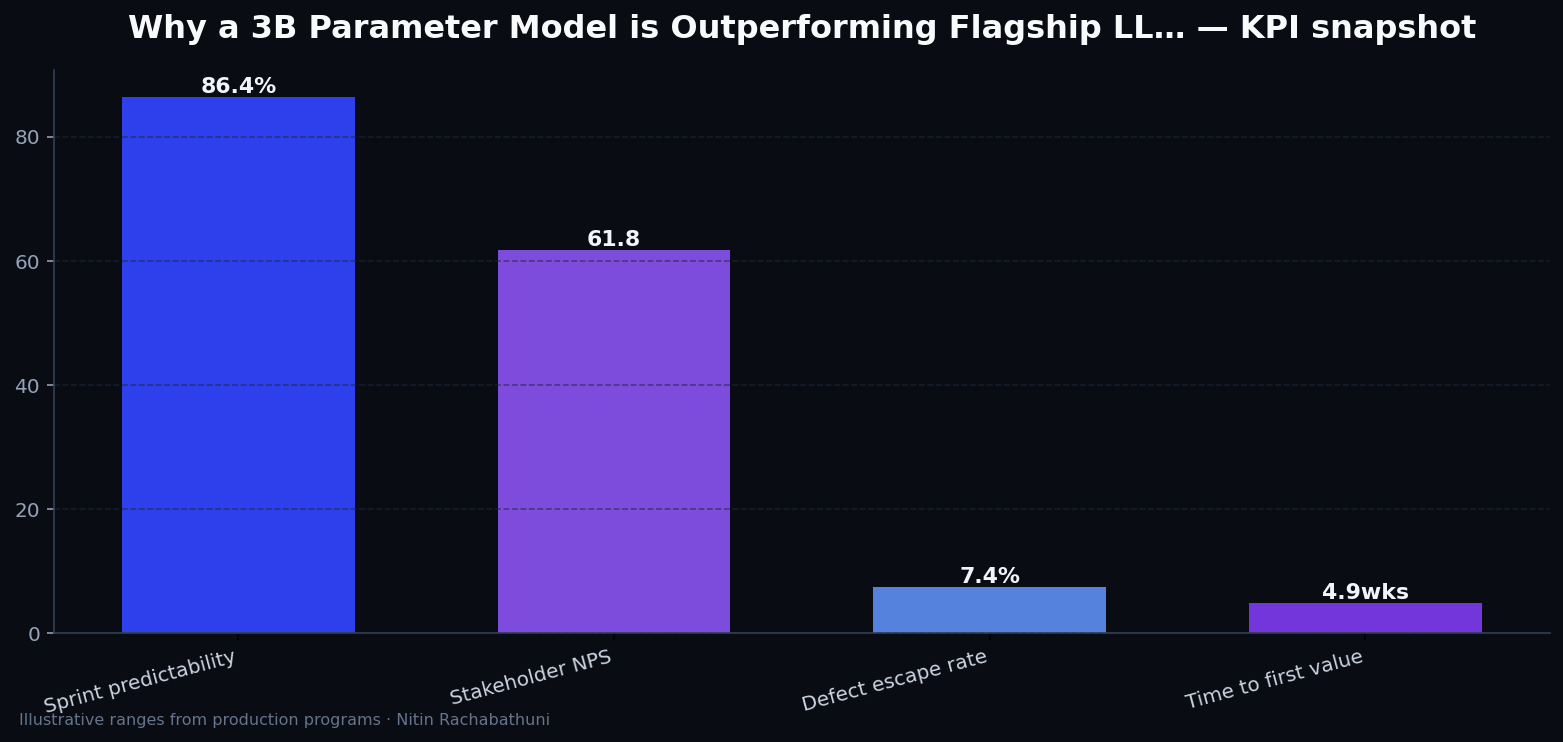
Illustrative consulting KPI ranges observed on programs like “Why a 3B Parameter Model is Outperforming Flagship LL…” — validate against your own telemetry before setting SLOs. Methodology: production-like staging traces + weekly review with product and ops.
Architecture flow

Code sketches
/* Integration sketch */
// Why a 3B Parameter Model is Outperforming Flagship LL…
export async function rolloutVibethinker3bModelReasoningSftGrpo() {
  const checks = ["telemetry", "auth", "rollback"];
  return { ok: true, checks };
}
Official references
Related on this site
Related case study
Juiceit.ai — AI platform — document intelligence, agent workflows, enterprise automation.
Article slug: vibethinker-3b-model-reasoning-sft-grpo · Engineering notes by Nitin Rachabathuni — MVP in 2 days specialist.

Juiceit style straight through document processing
AI Agents

Shopify Acquires Tailwind CSS: The Strategic Shift from Independent Tooling to Core Infrastructure
leadership
Tailwind CSS Joins Shopify: A Masterclass in Strategic Infrastructure Pivot
tech
The Illusion of Quality: Why AI Agents Fail at Test Verification
tech
Beyond the Vector Database: Why Git-Native Memory is the Future for AI Coding Agents
leadership
Agentic Context Management: Solving the Memory vs. Cost Architecture Problem
tech