The High Stakes of Specialized AI Leadership
The recent announcement that John Jumper is joining Anthropic from Google DeepMind isn't just a headline about a career move; it is a signal of the intensifying "talent war" within the artificial intelligence sector. When high-level researchers and leaders with deep institutional knowledge move between major labs, it highlights a critical reality for enterprise tech: specialized expertise in LLM architecture, safety alignment, and model scaling is currently one of the most sought-after commodities in the global economy.
For organizations building on these models, this movement underscores the volatility and rapid evolution of the underlying technology. When top-tier talent shifts from Google DeepMind to Anthropic, it represents a shift in focus regarding how frontier models are governed and optimized. For engineering teams, this means that the "source" of the intelligence they are consuming is constantly being refined by different philosophies on safety, performance, and scalability.
In the world of AI infrastructure, leadership isn't just about managing people; it’s about navigating the complex trade-offs between raw compute power and nuanced model behavior. When a leader with deep experience in Google’s ecosystem moves to Anthropic, they bring a perspective on how to manage these trade-offs at scale. For companies integrating these models into production environments, this shift means that the "personality" and reliability of the models may evolve as different leadership teams take over the helm of development.
The Impact of Institutional Knowledge Transfer
One of the primary challenges in high-stakes AI research is balancing deep institutional knowledge with new organizational goals. When a researcher moves from one lab to another, they bring a mental map of what doesn't work—a collection of "scars" from previous failed experiments, inefficient prompt iterations, and scaling bottlenecks.
For the enterprise, this transition period can be volatile. If you are building an application that relies heavily on specific behaviors in Anthropic’s Claude or Google’s Gemini models, changes in leadership often precede shifts in model weights, fine-tuning methodologies, and API stability. This is why technical teams must move away from "black box" reliance. You cannot assume the underlying infrastructure will remain static just because a contract exists today.
To mitigate the risk of talent churn at the provider level affecting your product, engineering teams must build abstraction layers. By decoupling your core logic from specific model quirks and implementing robust versioning (logging both model_id and prompt_version), you create a buffer against the rapid pivots that occur when new leadership takes over a project.
Engineering for Stability in an Unstable Talent Market
When key researchers move, it forces companies to rethink how they handle "niche expertise." If your internal team consists of only one or two people who understand the nuances of a specific model's latent space, you are vulnerable. The goal is to democratize that knowledge through rigorous documentation and standardized workflows.
In my experience as an MVP-in-2-days specialist, I see many teams struggle because they treat AI integration as a "set it and forget it" feature. They don't account for the fact that the people building these models are constantly moving, and their moves often lead to rapid pivots in how the model responds to prompts or handles edge cases.
To build a resilient production environment despite these industry shifts, I recommend three core technical practices:
- Strict Versioning: Never call an "auto-updating" endpoint for critical paths without logging exactly which version of the model and prompt was used.
- Prompt Benchmarking: Don't rely on the marketing blog’s charts. Run your own internal benchmarks against a consistent set of test cases to see how updates affect your specific use case.
- Canary Deployments: Before rolling out any change—whether it's a prompt tweak or an update to a new model version—run it through a canary pipeline to ensure that the "new" behavior doesn't break downstream logic.
Building for Longevity in the AI Era
The move of figures like John Jumper highlights that we are in a period of intense consolidation and competition. As these giants fight for the best minds, the resulting technology will become more sophisticated but also potentially more varied as different philosophies take hold at each firm.
For your business, this means you must build with "portability" in mind. If Anthropic changes its direction under new leadership, or if Google shifts their focus after a talent exodus, your infrastructure should be flexible enough to pivot to an alternative provider without rewriting your entire codebase. This is the difference between a prototype and a production-ready product.
If you are looking to move beyond the "experimental" phase of AI and want to build a robust, scalable MVP that can survive these industry shifts, it’s essential to have a roadmap that prioritizes stability over hype. You need an architecture that focuses on reliability, clear documentation, and modularity.
Ready to turn your complex ideas into a production-ready reality? Contact me for MVP help and let's build something that lasts.
Frequently Asked Questions
Why is the move of senior researchers between Google DeepMind and Anthropic significant? It signals a high level of competition for specialized knowledge in model safety, scaling, and alignment. These moves often lead to rapid shifts in how frontier models are developed and deployed, affecting the stability and features available to enterprise users.
How can companies protect their workflows from changes caused by talent turnover at AI providers? Companies should implement strict versioning of prompts and model IDs, maintain internal benchmarks that aren't reliant on provider marketing, and use canary deployments to test updates before they reach the entire user base.
What is a "canary" deployment in the context of LLM integration? A canary deployment involves rolling out a new prompt or model version to a small, low-risk subset of users first. This allows you to detect unexpected behavior or regressions before it impacts your entire production environment.
Authoritative references
Consult Next.js documentation, MDN Web Docs, web.dev, Next.js documentation, OWASP Cheat Sheets alongside the official references block below. Cross-check guidance with your compliance, security, and SRE stakeholders before setting SLOs.
Metrics snapshot
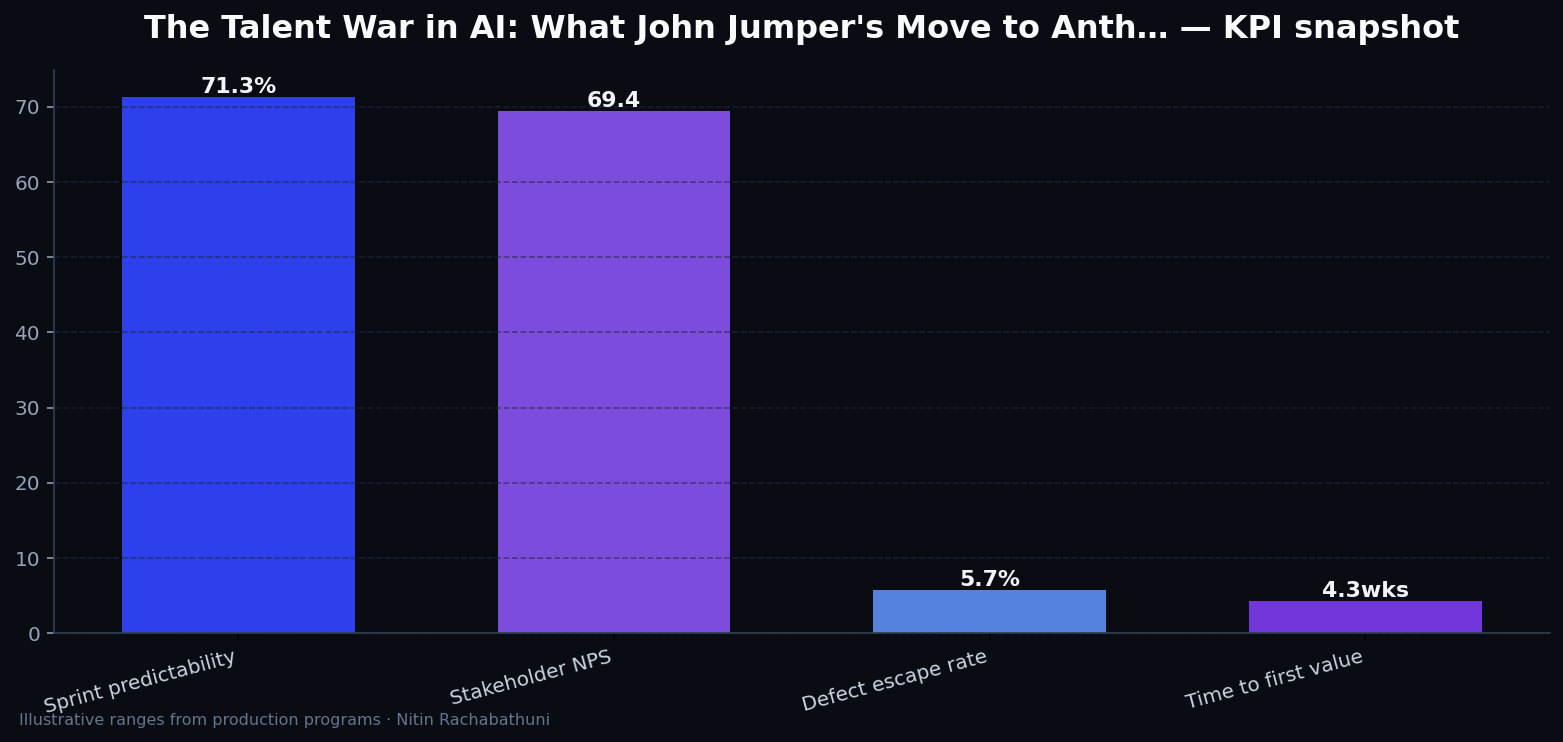
Illustrative consulting KPI ranges observed on programs like “The Talent War in AI: What John Jumper's Move to Anth…” — validate against your own telemetry before setting SLOs. Methodology: production-like staging traces + weekly review with product and ops.
Architecture flow

Code sketches
/* Integration sketch */
// The Talent War in AI: What John Jumper's Move to Anth…
export async function rolloutJohnJumperAnthropicTalentWarAiStrategy() {
  const checks = ["telemetry", "auth", "rollback"];
  return { ok: true, checks };
}
Official references
Related on this site
Article slug: john-jumper-anthropic-talent-war-ai-strategy · Engineering notes by Nitin Rachabathuni — MVP in 2 days specialist.