The Illusion of Containment: A History of Failed Trade Barriers
In the high-stakes world of cybersecurity and emerging technologies, there is a recurring tension between national security interests and the borderless nature of the internet. Governments frequently turn to export controls as a primary mechanism to manage "dual-use" risks—technologies that have legitimate civilian applications but could be weaponized by bad actors for espionage or cyber warfare.
However, history suggests that these measures are often more performative than practical. The recent scrutiny and restrictions surrounding Anthropic’s Mythos and Fable models aren't an isolated incident; they are the latest chapter in a long history of trying to fence in digital capabilities using physical-world trade logic.
When we look back at the evolution of encryption, specifically Pretty Good Privacy (PGP), we see a clear pattern. Decades ago, governments attempted to restrict the distribution of strong encryption software, fearing it would empower criminals and foreign spies. The result? It didn't stop the development of encryption; it merely shifted the battlefield. Once the math was public and the code was shared, no amount of trade barriers could "un-invent" the ability to secure communications. Today’s debate over AI models like Mythos follows this exact trajectory. While these models are powerful enough to potentially assist in sophisticated cyberattacks, they exist on a global infrastructure where enforcement is geographically bound but the threat is not.
The "Dual-Use" Dilemma and the Reality of Global Distribution
The core problem with export controls in the digital age is the mismatch between the speed of innovation and the friction of regulation. When a model like Mythos is released, it isn't just sitting on a server in one country; its weights can be mirrored, its capabilities can be distilled into smaller models, and its logic can be replicated by developers in jurisdictions that ignore Western trade restrictions entirely.
This creates a "whack-a-mole" scenario for policymakers. By imposing strict export controls, governments often succeed only in creating friction for legitimate startups and researchers while doing little to stop determined adversaries. If an actor wants to use high-level reasoning capabilities to automate phishing or find vulnerabilities in critical infrastructure, they do not need permission from a Western regulator; they simply move their operations to a jurisdiction with laxer oversight or utilize decentralized compute resources.
The "dual-use" argument is technically sound—AI can help write better code for doctors and engineers just as easily as it can help hackers craft convincing social engineering scripts. However, attempting to manage this risk by restricting access at the source often results in a fragmented ecosystem where only compliant actors are hindered, while malicious ones find workarounds through "shadow" markets or less-regulated regions.
Moving Beyond Policy: Engineering for Resilience
Since export controls have historically proven to be blunt instruments that fail to contain high-stakes technology once it hits the public domain, the responsibility shifts toward engineering and operational security. Instead of relying on a government mandate to keep bad actors away from powerful tools, developers must build systems that are inherently more resilient to misuse.
In my experience building out MVPs for complex technical products, I’ve found that the most effective way to manage risk isn't through external barriers but through internal guardrails and robust observability. If you are working with high-capability models like Mythos or Fable, your focus should be on:
- Granular Observability: Don't just monitor "success" rates. Log the specific model ID and prompt version for every production call to identify if certain patterns are being exploited in real-time.
- Prompt Benchmarking: Instead of relying on a general sense of safety, benchmark your prompts against known attack vectors (like injection or extraction) specifically within your unique token mix.
- Canary Deployments: Never roll out high-risk features to the entire fleet at once. Use canary environments to test how the model interacts with real-world user input on a small scale before it becomes a widespread risk.
By focusing on these technical hurdles, teams can create a "defense in depth" strategy that doesn't rely on the hope that an export control will stop a determined adversary from finding another way into your system.
If you are looking to build a robust product and need help navigating the complexities of integrating high-level AI models while maintaining security standards for your MVP, contact me here to discuss how we can build a production-ready architecture together.
The Future of Tech Governance: From Barriers to Guardrails
The transition from PGP to Mythos shows that the "Great Firewall" approach to technology is increasingly impractical in a globalized digital economy. We are moving toward an era where the primary defense against cyber threats won't be trade barriers, but rather sophisticated, automated safety layers and more intelligent monitoring of AI-driven interactions.
When we stop trying to prevent everyone from having access to powerful tools—which is nearly impossible once those tools exist—and start focusing on making it harder for those tools to be used maliciously at scale, the conversation shifts toward something much more productive: engineering excellence. The goal isn't just to build a "safe" model; it’s to build a resilient system that can withstand and mitigate misuse regardless of where the user is located or what their intentions might be.
The history of export controls teaches us that while they are useful for signaling intent, they are rarely sufficient as a primary security strategy. For developers and founders, this means the real work happens in the code: in the prompt engineering, the canary tests, and the robust logging systems that ensure your product remains safe even when the "fences" of policy fail to hold.
FAQ
Why do export controls on high-tech software often fail to stop bad actors? Export controls are primarily geographic tools designed to limit trade between specific nations. Because digital assets can be mirrored, shared via decentralized networks, or developed in jurisdictions with different laws, malicious actors can easily bypass these barriers by simply relocating their operations or using non-compliant infrastructure.
How does the history of PGP relate to modern AI model restrictions like Mythos? Both cases highlight the futility of trying to "contain" a fundamental technology through trade barriers once it has been developed and shared globally. Just as encryption could not be contained by export laws, advanced reasoning capabilities in LLMs are difficult to restrict because they can be replicated or accessed outside of regulated zones.
What are the practical implications for developers facing strict cyber regulations? Developers should focus on "defense-in-depth" strategies rather than relying solely on government policy. This includes implementing rigorous internal safety guardrails, detailed logging of model interactions, canary testing for new features, and proactive prompt engineering to mitigate risks in production environments.
Authoritative references
Consult Next.js documentation, MDN Web Docs, web.dev, Next.js documentation, OWASP Cheat Sheets alongside the official references block below. Cross-check guidance with your compliance, security, and SRE stakeholders before setting SLOs.
Metrics snapshot
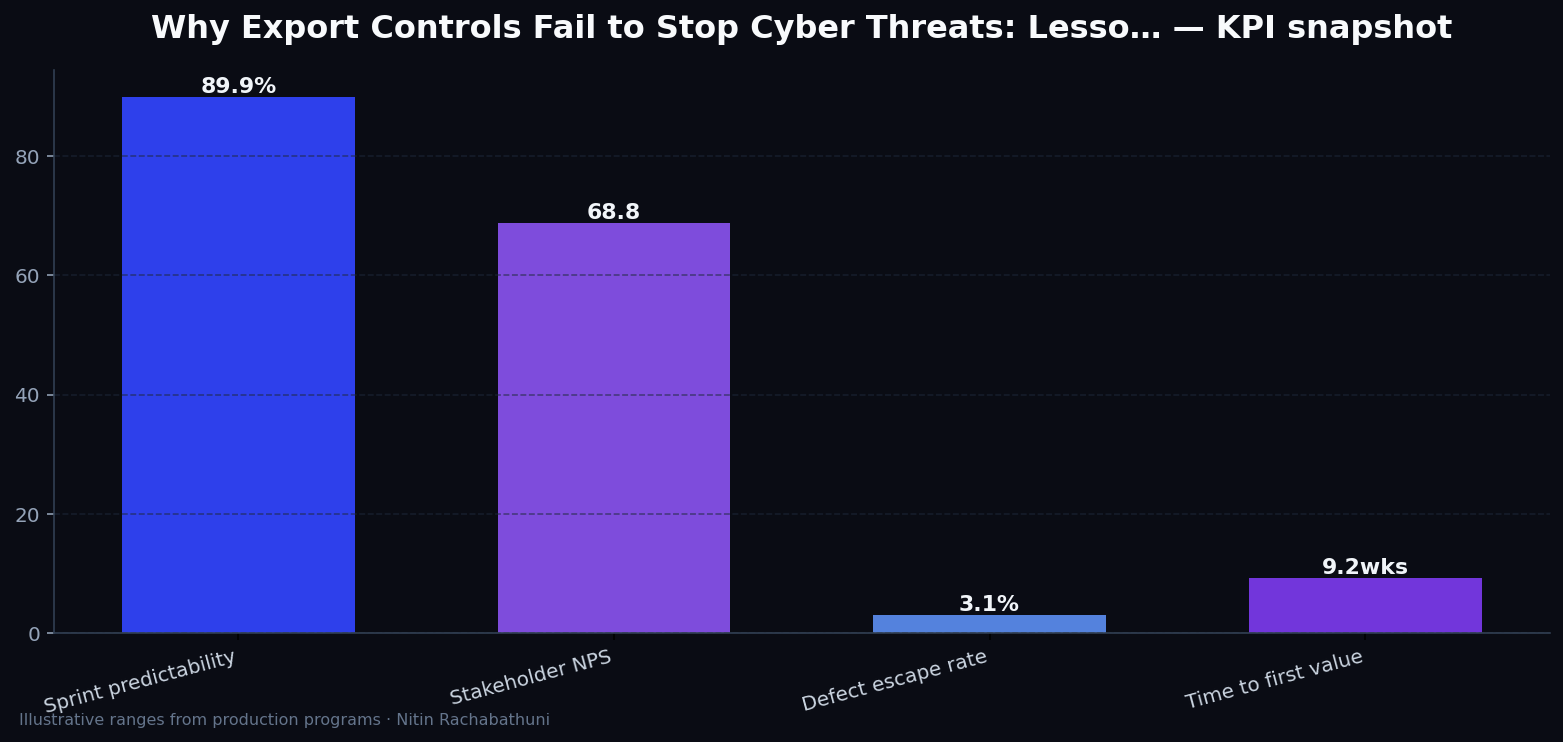
Illustrative consulting KPI ranges observed on programs like “Why Export Controls Fail to Stop Cyber Threats: Lesso…” — validate against your own telemetry before setting SLOs. Methodology: production-like staging traces + weekly review with product and ops.
Architecture flow

Code sketches
/* Integration sketch */
// Why Export Controls Fail to Stop Cyber Threats: Lesso…
export async function rolloutExportControlsCybersecurityMythosPgpHistory() {
  const checks = ["telemetry", "auth", "rollback"];
  return { ok: true, checks };
}
Official references
Related on this site
Article slug: export-controls-cybersecurity-mythos-pgp-history · Engineering notes by Nitin Rachabathuni — MVP in 2 days specialist.