The Shift from Innovation to Integration
The news that Hyundai has taken full control of Boston Dynamics by acquiring SoftBank’s remaining stake for $325 million is more than just a corporate consolidation. For those of us in the engineering and product space, it represents a fundamental shift in how we value technology.
For years, Boston Dynamics was the poster child for "cool" tech. Their robots performed backflips, navigated obstacle courses, and captured the imagination of the public at trade shows. However, there is a massive chasm between a robot that can navigate a backyard and a robot that can safely operate on an automotive assembly line 24/7.
By taking full ownership, Hyundai is signaling that they are no longer content with "borrowing" a future built by others; they want to own the infrastructure of that future. They aren't just buying hardware; they are acquiring the ability to integrate advanced locomotion and manipulation into their core manufacturing DNA. This moves the needle from R&D (Research & Development) toward industrial application where reliability is the only metric that matters.
The Engineering Trade-off: Perfection vs. Iteration
One of the most critical questions this acquisition raises for engineering leaders is how we approach product maturity. In a lab setting, you can iterate until something works perfectly before it ever touches a customer's hand. This is the "perfect" path—it minimizes risk but delays market entry and limits real-world data collection.
In contrast, many modern manufacturing environments are moving toward a model of iterative deployment on live floors. The question becomes: Does a product need to be perfect before it hits production, or can we iterate on live factory floors?
When you move from a startup environment (like Boston Dynamics' early years) into an industrial giant like Hyundai, the stakes for "perfection" change. In a lab, if a robot falls over, it’s a data point. On a manufacturing line, if a robot malfunctions, it can halt production or cause safety hazards. The engineering challenge here is finding the middle ground: building a system robust enough to be safe in a factory environment while remaining flexible enough to improve through real-world usage.
Moving from "Feature Rich" to "Reliability First"
In early-stage product development, we often fall into the trap of adding features because they are technically impressive. We want the robot that can do everything. But for Hyundai’s manufacturing goals, a robot that does ten things well is less valuable than a robot that does one thing perfectly every single time without human intervention.
This transition requires a shift in engineering philosophy:
- Standardization over Novelty: Replacing custom-coded "hacks" with standardized protocols that can be maintained by technicians who aren't robotics PhDs.
- Predictive Maintenance: Moving from "fixing it when it breaks" to systems that signal failure before it happens.
- Edge Case Management: Identifying the 1% of scenarios that could cause a system halt and engineering around them specifically for industrial environments.
By owning Boston Dynamics, Hyundai can now focus these efforts internally. They can strip away the "show" elements and double down on the "work" elements—durability, safety certifications, and seamless integration with existing ERP (Enterprise Resource Planning) systems.
Practical Lessons for Engineering Leaders
As we look at this move through the lens of product leadership, there are several takeaways for those building products in any space, not just robotics.
First, identify your "core" value proposition early. For Hyundai, it’s manufacturing efficiency; for Boston Dynamics, it was high-mobility movement. When these two goals align under one roof, you can strip away the distractions and focus on what actually moves the needle for the end user.
Second, understand the cost of scale. A prototype that works in a controlled environment often fails when exposed to the "noise" of reality—dust, varying temperatures, human unpredictability, and inconsistent power supplies. If your product is meant for industrial use, you must build for the worst-case scenario from day one.
Lastly, focus on the path to MVP (Minimum Viable Product). Instead of trying to build a robot that can do everything at once, start with a robot that solves one specific bottleneck in the assembly line perfectly. You can iterate and add capabilities over time, but your initial "win" must be based on reliability.
If you are struggling to define what your MVP should look like or how to navigate the transition from a high-concept prototype to a production-ready product, I can help you map out that roadmap. Reach out for MVP consulting to turn your complex engineering goals into actionable milestones.
Conclusion: The Era of Industrial Robotics
The acquisition is a clear signal that the "wow" factor phase of robotics is evolving into the "work" phase. We are moving away from robots as toys for demonstration and toward robots as tools for production. For engineers, this means our roles will increasingly involve making complex systems more robust, predictable, and integrated.
The goal isn't just to make something that works; it’s to build something that stays working in the hands of someone else. That is the ultimate engineering challenge, and it is exactly what Hyundai is betting on for the next decade of manufacturing.
Authoritative references
Consult Next.js documentation, MDN Web Docs, web.dev, Next.js documentation, OWASP Cheat Sheets alongside the official references block below. Cross-check guidance with your compliance, security, and SRE stakeholders before setting SLOs.
Metrics snapshot
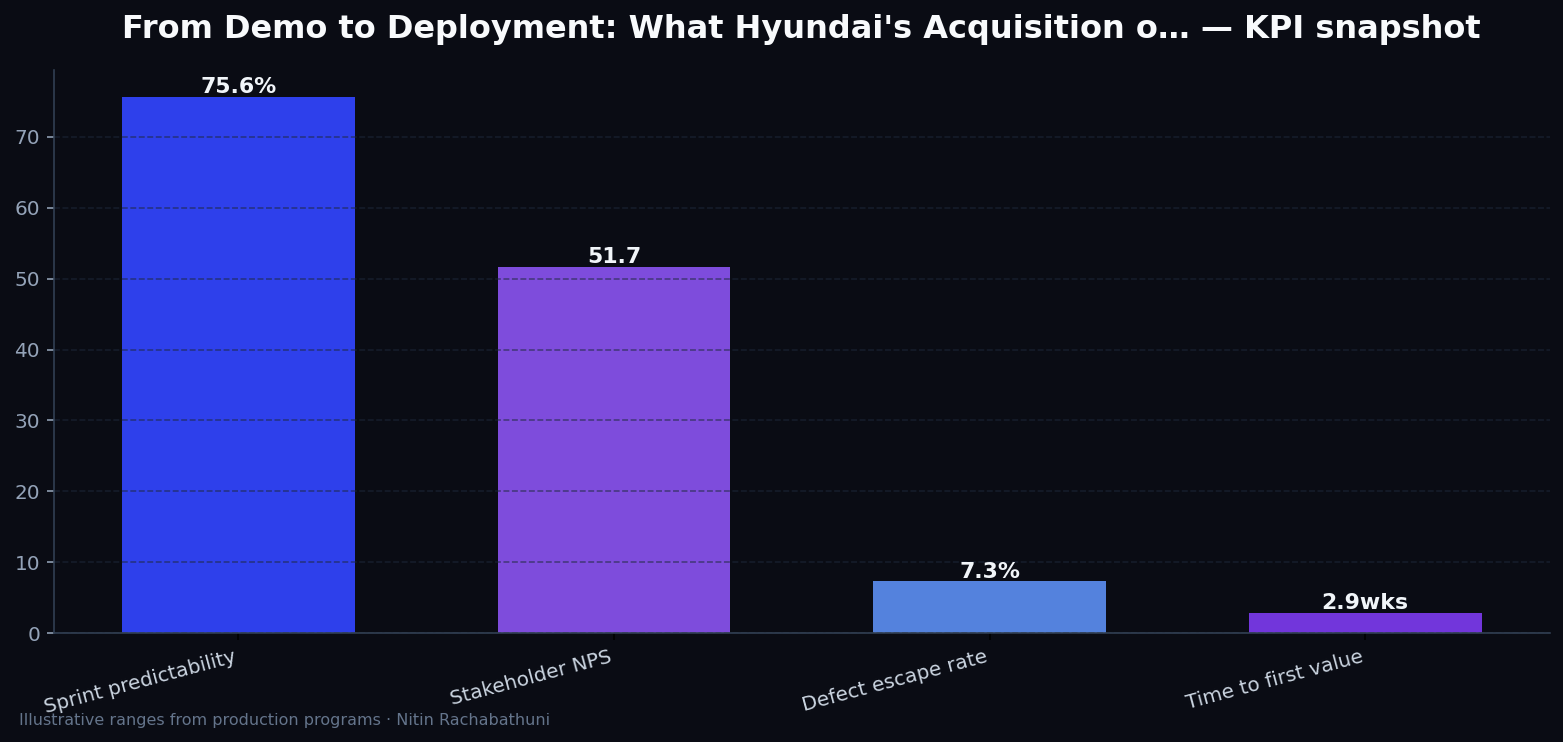
Illustrative consulting KPI ranges observed on programs like “From Demo to Deployment: What Hyundai's Acquisition o…” — validate against your own telemetry before setting SLOs. Methodology: production-like staging traces + weekly review with product and ops.
Architecture flow

Code sketches
/* Integration sketch */
// From Demo to Deployment: What Hyundai's Acquisition o…
export async function rolloutHyundaiBostonDynamicsAcquisitionEngineeringStrategy() {
  const checks = ["telemetry", "auth", "rollback"];
  return { ok: true, checks };
}
Official references
Related on this site
Article slug: hyundai-boston-dynamics-acquisition-engineering-strategy · Engineering notes by Nitin Rachabathuni — MVP in 2 days specialist.