
Navigating the Efficient Frontier: Engineering Real-World LLM Inference
In the current era of generative AI, the most common challenge isn't just getting a model to work—it’s making it work at scale. As organizations move from experimental prototypes to production-grade applications, they hit a fundamental wall in infrastructure: the "Efficient Frontier."
When we talk about efficiency in Large Language Model (LLM) inference, we aren't talking about a single metric like "tokens per second" or "cost per million tokens." Instead, we are looking at a multi-dimensional trade-off between intelligence and resource cost. To build a sustainable product, engineers must understand where they sit on this frontier and, more importantly, how to move it.
Understanding the Trade-offs: Moving Along vs. Pushing Out
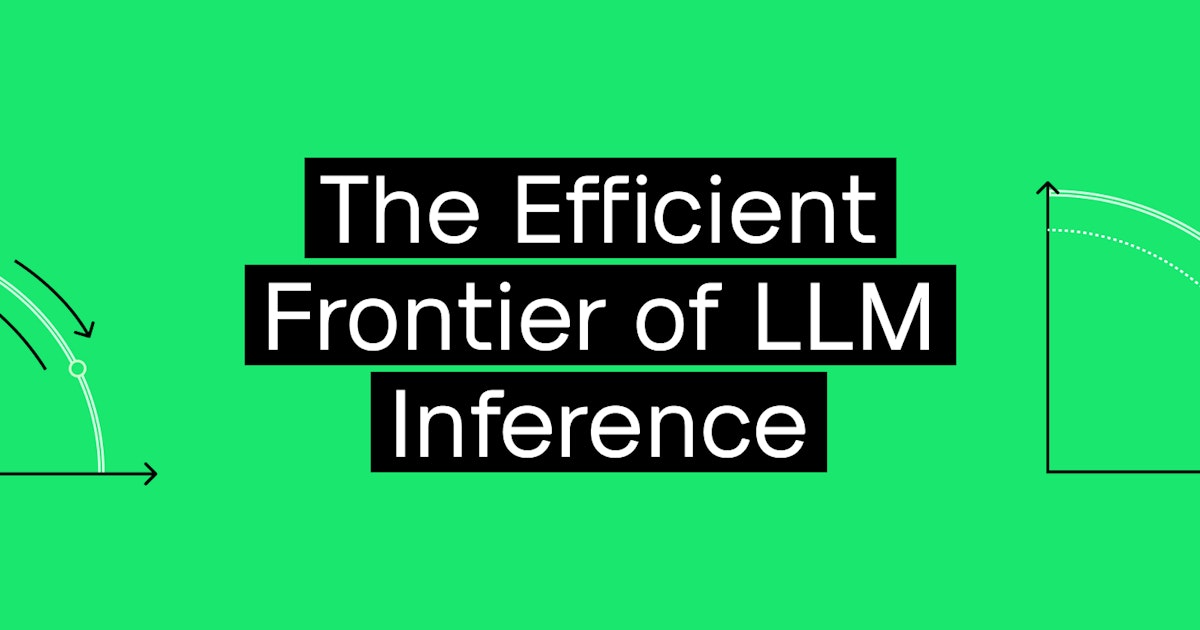
Not all engineering optimizations provide the same value. In high-scale systems, we categorize optimization into two distinct types: moving along the existing curve and pushing the boundary outward.
Moving along the curve involves making trade-offs that are already inherent in the model's architecture or current deployment state. For example, if you decide to use a smaller parameter count (e.g., switching from Llama 3 70B to an 8B variant) to achieve lower latency, you are moving along the curve. You gain speed and reduce costs, but you sacrifice "intelligence" or nuance in complex reasoning tasks.
Pushing the frontier outward, however, involves engineering techniques that improve efficiency without sacrificing intelligence. This is where high-level infrastructure engineering shines. Techniques like optimizing CUDA kernels, implementing advanced KV caching strategies, or utilizing modern quantization formats (such as mxfp4) allow you to serve a higher quality model faster and cheaper than was previously possible. When you push the frontier, you are making the "high intelligence" option more accessible to your users without compromising on output quality.
The Role of Quantization in Modern Inference
One of the most effective ways to push the inference frontier today is through sophisticated quantization. Early methods often resulted in significant "perplexity" degradation, forcing developers to choose between a fast-but-dumb model or a slow-but-smart one.
Modern formats like mxfp4 have changed this calculus. By utilizing specialized data types that maintain high precision where it matters most while reducing the overall memory footprint, these techniques allow models to run on less expensive hardware with significantly higher throughput. When you implement these optimizations, you aren't just making a "faster" model; you are enabling a more capable model to serve a larger audience at a lower cost basis.
Data-Driven Decision Making in Production
One of the biggest mistakes engineering teams make is optimizing for the wrong metric. It is easy to get distracted by high-level benchmarks published during a model's launch, but those numbers rarely reflect your specific production environment.
To navigate the frontier effectively, you must ground your decisions in your own data:
- Analyze Your Prompt Mix: Not all tokens are created equal. If 80% of your traffic consists of short classification tasks and only 20% involves complex reasoning, optimizing for a "general-purpose" high-intelligence model might be overkill. You can often achieve better ROI by identifying the specific capabilities required for each endpoint.
- Log Everything: Every production call should log both the Model ID and the specific Prompt Version. This allows you to see exactly where performance degrades or where cost spikes occur, enabling targeted optimizations rather than "blanket" changes across your entire fleet.
- Canary Deployments: Never swap a core inference engine or quantization method globally at once. Use canary deployments on low-risk endpoints first. This allows you to validate that the optimization hasn't introduced regressions in output quality before it affects your primary user base.
Building for Scale: From Prototype to Production
Transitioning from an MVP (Minimum Viable Product) to a production-scale AI application requires moving away from "brute force" solutions toward elegant engineering. If you are constantly struggling with high inference costs or inconsistent latency, the problem might not be your prompt—it might be where you sit on the efficient frontier.
By identifying whether you need to make a trade-off (moving along the curve) or if you need better infrastructure (pushing the boundary), you can allocate engineering resources more effectively. Instead of spending weeks tweaking prompts for a model that is fundamentally too heavy for your use case, focus on implementing quantization and kernel optimizations that allow your high-performing models to scale efficiently.
If you are looking to move past the prototype stage and need help architecting an LLM infrastructure that balances performance with cost-efficiency, contact me for expert guidance on building production-ready AI systems.
Summary of Key Takeaways
- Efficiency is a frontier: It’s the balance between intelligence and resource consumption.
- Identify your goal: Decide if you need to trade speed for quality or use engineering to improve both simultaneously.
- Quantization matters: Modern formats like mxfp4 are key tools for pushing the boundary outward.
- Data-driven optimization: Use your own prompt mix and production logs to guide infrastructure decisions rather than relying solely on public benchmarks.
Implementation help
Let's align on scope and next steps. Nitin Rachabathuni, Senior Full-Stack Engineer and MVP in 2 Days specialist — technical audits, implementation support, advisory, and flexible hourly collaboration shaped to your product. Reach out anytime; available across time zones and countries.
- Contact form
- Email: nitin.rachabathuni@gmail.com
- WhatsApp: +91-9642222836
