
The Economics of Intelligence: Defining the Efficient Frontier
In the early stages of LLM adoption, many developers treated model selection as a simple binary choice: pick the smartest model available. However, as these applications move from experimental prototypes to high-traffic production environments, that luxury disappears. You are suddenly forced into a three-dimensional optimization problem involving Intelligence, Latency, and Cost.
This is where the concept of the "Efficient Frontier" becomes critical for engineering teams. In traditional portfolio theory, an efficient frontier represents a set of optimal portfolios that offer the highest expected return for a defined level of risk. In LLM inference, it serves as a framework for navigating trade-offs.
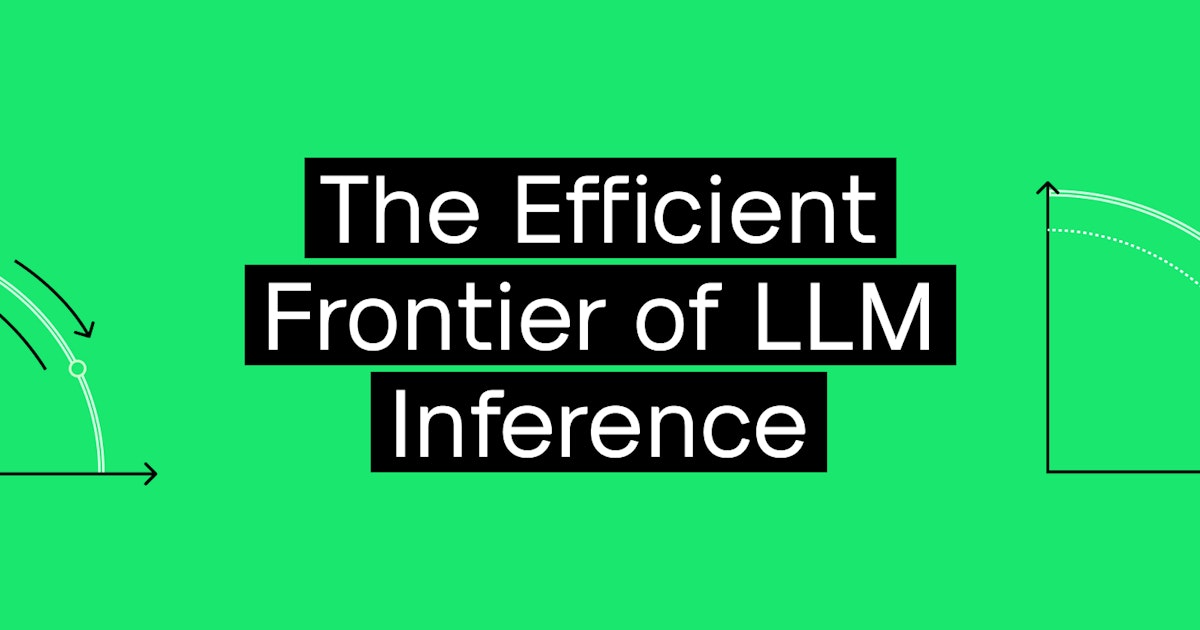
When you plot your options on a graph where one axis is "Quality" and the other is "Cost/Latency," most models exist within a specific curve. If you want a faster response (lower latency), you usually have to settle for a smaller, less capable model. If you want higher reasoning capabilities, you must accept slower speeds and higher costs. The "frontier" is that outer edge of possibilities—the point where any move toward better performance would necessitate an unacceptable jump in cost or a drop in quality.
Understanding this frontier allows engineers to stop guessing and start calculating. Instead of asking "Which model is best?", the question becomes: "Where on the frontier does our specific use case live?" A customer service chatbot might sit comfortably on the lower-intelligence/lower-cost end, while a complex legal reasoning agent must occupy the high-intelligence/high-cost peak.
Moving Along the Curve vs. Pushing the Frontier
One of the most common mistakes in AI infrastructure is confusing "moving along the curve" with "pushing the frontier."
Moving along the curve involves choosing your preferred trade-off based on existing technology. For example, if you decide that a sub-second response time is non-negotiable for your UI, but you still need high accuracy, you might choose to move toward a highly optimized smaller model (like a fine-tuned Llama 3 or Mistral) rather than using a massive frontier model like GPT-4o. You are staying on the existing line of possibility; you are simply choosing where to stand on it based on your business requirements.
Pushing the frontier outward, however, involves technical innovations that improve the underlying infrastructure so that "better" becomes possible at the same cost or speed as before. This is where techniques like Quantization and Speculative Decoding play a massive role.
Take quantization as a prime example. By reducing the precision of model weights (e.g., from FP16 to INT8 or 4-bit), you can serve larger models on smaller hardware with significantly higher throughput. Because these techniques often result in negligible hits to accuracy while providing massive gains in inference speed, they effectively push the entire frontier outward. You aren't just choosing a different point on the curve; you are moving the curve itself so that high-quality outputs become accessible at lower price points.
Practical Engineering Strategies for Production Inference
When it is time to move from theory to production code, "vibe-based" engineering won't cut it. To manage the trade-offs of the efficient frontier effectively, your team should adopt a rigorous technical framework:
1. Benchmark on Your Specific Data
The most common pitfall in LLM deployment is relying on public benchmarks (like MMLU or GSM8K). These are general measures of "intelligence," but they don't reflect how a model performs on your specific prompt mix. A model might score highly on math tests but perform poorly on your specific brand-voice requirements for customer support. You must benchmark against the actual prompts and token distributions you expect to see in production.
2. Granular Observability
You cannot optimize what you do not measure. Every inference call should be logged with metadata including:
- Model ID: To track performance across different versions or providers.
- Prompt Version: Because a slight change in system prompting can drastically alter both latency and output quality.
- Token Distribution: Tracking the ratio of input to output tokens helps identify where costs are spiraling out of control.
3. The Canary Strategy
Never flip the switch on an entire fleet based on a single test run. Use canary deployments for low-risk endpoints first. This allows you to observe how different models on the frontier perform under real-world traffic conditions before making them the default choice for your end users.
If you are looking to move from a prototype to a production-ready system and need help navigating these infrastructure complexities, contact me to discuss how we can build an MVP that balances performance with cost efficiency.
Conclusion: Finding Your Equilibrium
The goal of inference engineering isn't just to find the "best" model; it’s to find the most efficient point on the frontier for your specific business goals. By understanding whether a problem requires you to move along the curve (optimization) or if it requires pushing the boundary (innovation), you can build more resilient, cost-effective AI products.
Stop chasing the largest models and start building systems that intelligently navigate the trade-offs of scale, speed, and intelligence.
Implementation help
Let's align on scope and next steps. Nitin Rachabathuni, Senior Full-Stack Engineer and MVP in 2 Days specialist — technical audits, implementation support, advisory, and flexible hourly collaboration shaped to your product. Reach out anytime; available across time zones and countries.
- Contact form
- Email: nitin.rachabathuni@gmail.com
- WhatsApp: +91-9642222836