Designers play a crucial role in shaping the web as we know it today. Their creative vision and innovative approaches have revolutionized the way we interact with websites and digital content. In this blog post, we will explore the contributions of some influential designers who have left a lasting impact on the web.
1. Jony Ive
Jony Ive, the former Chief Design Officer at Apple, played a pivotal role in transforming the aesthetic and user experience of Apple products. His minimalist and sleek designs, seen in iconic products like the iPhone and MacBook, set new standards for user-centered design and simplicity.
"Design is not just what it looks like and feels like. Design is how it works." - Jony Ive
2. Sara Soueidan
Sara Soueidan is a front-end web developer and designer known for her expertise in SVG and CSS. Her extensive contributions to the web include advocating for accessible and inclusive design practices. Sara's tutorials, articles, and speaking engagements have empowered countless designers and developers to create more inclusive web experiences.
"Our job is to push the boundaries, break the rules, and bring forth new ideas." - Sara Soueidan
3. Ethan Marcotte
Ethan Marcotte is widely credited with coining the term "responsive web design." His groundbreaking article on responsive design sparked a paradigm shift in web development, emphasizing the need for websites to adapt seamlessly across different devices and screen sizes. Today, responsive design is a standard practice in the industry.
"The goal of a designer is to listen, observe, understand, sympathize, empathize, synthesize, and glean insights that enable them to 'make the invisible visible.'" - Ethan Marcotte
These designers have transformed the web landscape through their visionary ideas and commitment to user-centric design. Their influence continues to shape the way we navigate and experience the online world. As we move forward, let's celebrate and learn from their contributions, inspiring the next generation of web designers to make their mark on the digital realm.
Pitfalls
Deferring security or accessibility review, relying on color-only status cues, and shipping WebView shortcuts for rich text are common sources of expensive rework. Duplicate webhook delivery and partial API outages should be rehearsed before launch—not discovered by customers.
Authoritative references
Consult Next.js documentation, MDN Web Docs, web.dev, Next.js documentation, OWASP Cheat Sheets alongside the official references block below. Cross-check guidance with your compliance, security, and SRE stakeholders before setting SLOs.
Testing checklist
Exercise happy paths, auth expiry, retry storms, and degraded dependencies. Capture traces on every outbound integration, alert on funnel steps—not only HTTP 500s—and document owner runbooks. Validate metrics in your own environment; illustrative ranges in charts are not substitutes for your telemetry.
Leadership takeaway
Designers who changed the web succeeds when teams align scope, measurable outcomes, and inclusive UX from sprint zero. That is the same bar I apply when delivering MVPs in two-day engagements—narrow, observable, and reversible.
Document integration contracts, run weekly reviews with product and SRE partners, and keep rollback paths rehearsed while Designers who changed the web scales from pilot to full traffic.
Document integration contracts, run weekly reviews with product and SRE partners, and keep rollback paths rehearsed while Designers who changed the web scales from pilot to full traffic.
Document integration contracts, run weekly reviews with product and SRE partners, and keep rollback paths rehearsed while Designers who changed the web scales from pilot to full traffic.
Document integration contracts, run weekly reviews with product and SRE partners, and keep rollback paths rehearsed while Designers who changed the web scales from pilot to full traffic.
Document integration contracts, run weekly reviews with product and SRE partners, and keep rollback paths rehearsed while Designers who changed the web scales from pilot to full traffic.
Metrics snapshot
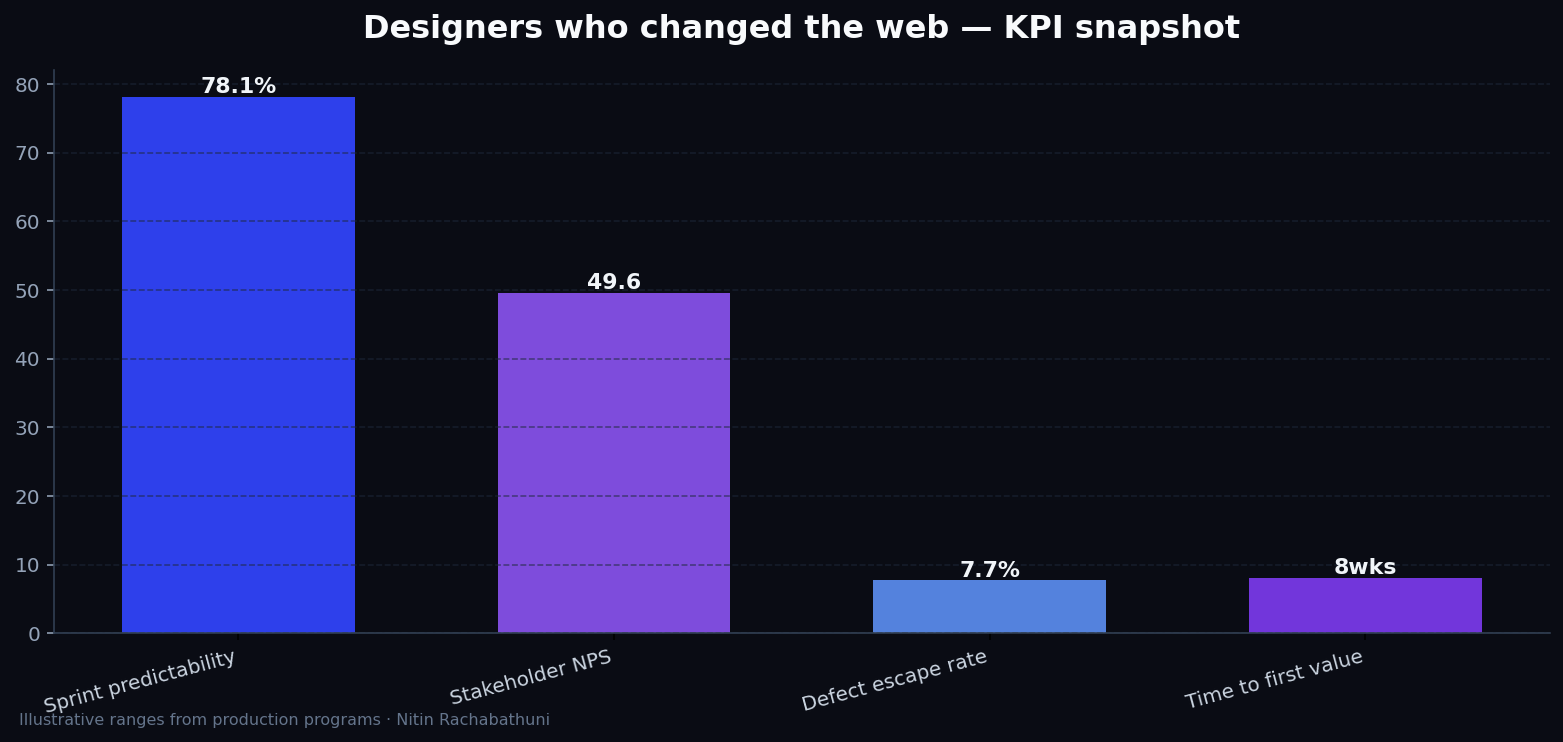
Illustrative consulting KPI ranges observed on programs like “Designers who changed the web” — validate against your own telemetry before setting SLOs. Methodology: production-like staging traces + weekly review with product and ops.
Architecture flow

Code sketches
/* Integration sketch */
// Designers who changed the web
export async function rolloutDesignersWhoChangedTheWeb() {
  const checks = ["telemetry", "auth", "rollback"];
  return { ok: true, checks };
}
Official references
Related on this site
Article slug: designers-who-changed-the-web · Engineering notes by Nitin Rachabathuni — MVP in 2 days specialist.