The Fragility of Decentralized Trust in Open Source
The recent security incident involving the Arch Linux Arch User Repository (AUR) serves as a stark case study for anyone involved in software engineering, systems administration, or cybersecurity. When news broke that over 1,500 packages were potentially compromised due to a malicious injection, it wasn't just an "Arch thing"—it was a systemic warning about the inherent risks of decentralized trust models.
In many community-driven ecosystems, the speed of innovation is fueled by the willingness of users and contributors to share code freely. The AUR operates on this principle: it allows users to easily compile and install software from various sources. However, this "open" nature creates a massive surface area for attackers. When a single upstream dependency becomes compromised, the lack of centralized gatekeeping means that malicious code can propagate through hundreds of downstream packages almost instantly.
The jump from an initial discovery of a few hundred affected packages to over 1,500 highlights how quickly contamination spreads in a web-like dependency graph. For engineers, this underscores a fundamental truth: if your build pipeline trusts a third-party repository without rigorous verification, you are effectively inheriting the security posture (or lack thereof) of every contributor in that ecosystem.
The Mechanics of Propagation: Why One Bug Becomes a Thousand
To understand why the Arch Linux incident was so significant, we have to look at how modern software is built. Most packages do not exist in isolation; they are composed of dozens, if not hundreds, of dependencies. In a decentralized repository like the AUR, many "packages" are actually just build scripts (PKGBUILDs) that pull code from external sources.
When an attacker successfully compromises a common library or a widely used utility, they aren't just hitting one target. They are poisoning the well. Every subsequent project that pulls in that specific dependency during its build process becomes a vector for the malware.
In this instance, the sheer volume of affected packages (1,500+) demonstrates how "dependency hell" can be weaponized. When we prioritize ease of use and rapid deployment over strict verification, we create an environment where a single successful exploit at the bottom of the stack results in a massive blast radius at the top. This is why security professionals advocate for a "Zero Trust" approach to third-party components—every external call should be treated as potentially hostile until verified by your own internal checks.
Mitigating Risk: Practical Strategies for Engineering Teams
So, how do we balance the need for rapid development with the necessity of secure software? The answer lies in moving away from "implicit trust" toward "verified integrity."
First, narrow the blast radius. If a team identifies that a dependency is compromised, they shouldn't just wait for an official advisory. They must immediately audit their internal builds to see exactly where that package appears and rotate any secrets or credentials that could have been exposed during the window of infection.
Second, harden the supply chain. Instead of pulling directly from community repositories in production environments, teams should mirror these dependencies into a private repository (like Artifactory or Nexus). This allows for automated scanning and manual "gatekeeping" before an update is pushed to internal developers.
Third, implement proactive monitoring. Use tools that alert you when a dependency's hash changes unexpectedly. If a package in your build pipeline suddenly updates its signature without a corresponding version change or official announcement, it should trigger an immediate investigation. By automating these checks, you move from being reactive (responding to news) to being proactive (blocking the threat before it enters your environment).
If you are looking to harden your internal development workflows and want to implement robust security protocols that protect your team from supply chain risks without sacrificing speed, contact me for MVP-focused engineering consulting to help streamline your processes.
The "What If" Scenario: Building Resilience
The most effective way to prepare for an incident like the Arch Linux AUR breach is through tabletop exercises and scenario planning. Ask your team: "If a core dependency we use every day was found to be malicious at 6:00 PM on a Friday, what happens next?"
Do you have a manifest of all third-party libraries? Do you know exactly which systems they run on? Can you roll back the update in under an hour? If the answer is "we'd have to figure it out," then your process needs refinement.
The goal isn't to eliminate risk—that’s impossible in modern software development. The goal is to build a system that can withstand and recover from compromise quickly. This means having clear playbooks, automated auditing tools, and a culture of security where "it works on my machine" is never an excuse for bypassing safety checks.
Conclusion: Moving Toward a Secure Future
The Arch Linux incident isn't just a headline; it’s a technical warning about the scale at which modern software operates. As we continue to rely more heavily on community-driven tools and open-source libraries, our methods of verification must evolve in tandem. By implementing strict supply chain controls, auditing dependencies regularly, and preparing for "worst-case" scenarios, organizations can enjoy the benefits of open source while minimizing the risks inherent in decentralized ecosystems.
Frequently Asked Questions (FAQ)
What is the primary risk of using community-driven repositories like AUR? The main risk is the lack of centralized verification; because anyone can contribute, malicious code can be injected into a package and quickly adopted by others who rely on that same dependency. This creates a massive "blast radius" where one compromise affects hundreds of downstream users.
How can developers protect their systems from similar malware incidents? Developers should use tools to verify digital signatures, move toward private mirrors for production-grade software, and implement automated scanning for known vulnerabilities in third-party libraries. Reducing the number of direct external calls during build time also significantly lowers risk.
What is "Supply Chain Security" in this context? In this context, supply chain security refers to ensuring that every piece of code—whether written internally or pulled from an outside source—is verified and safe before it reaches production. It involves auditing dependencies, using checksums, and maintaining a clear inventory of all third-party components.
Authoritative references
Consult Next.js documentation, MDN Web Docs, web.dev, Next.js documentation, OWASP Cheat Sheets alongside the official references block below. Cross-check guidance with your compliance, security, and SRE stakeholders before setting SLOs.
Metrics snapshot
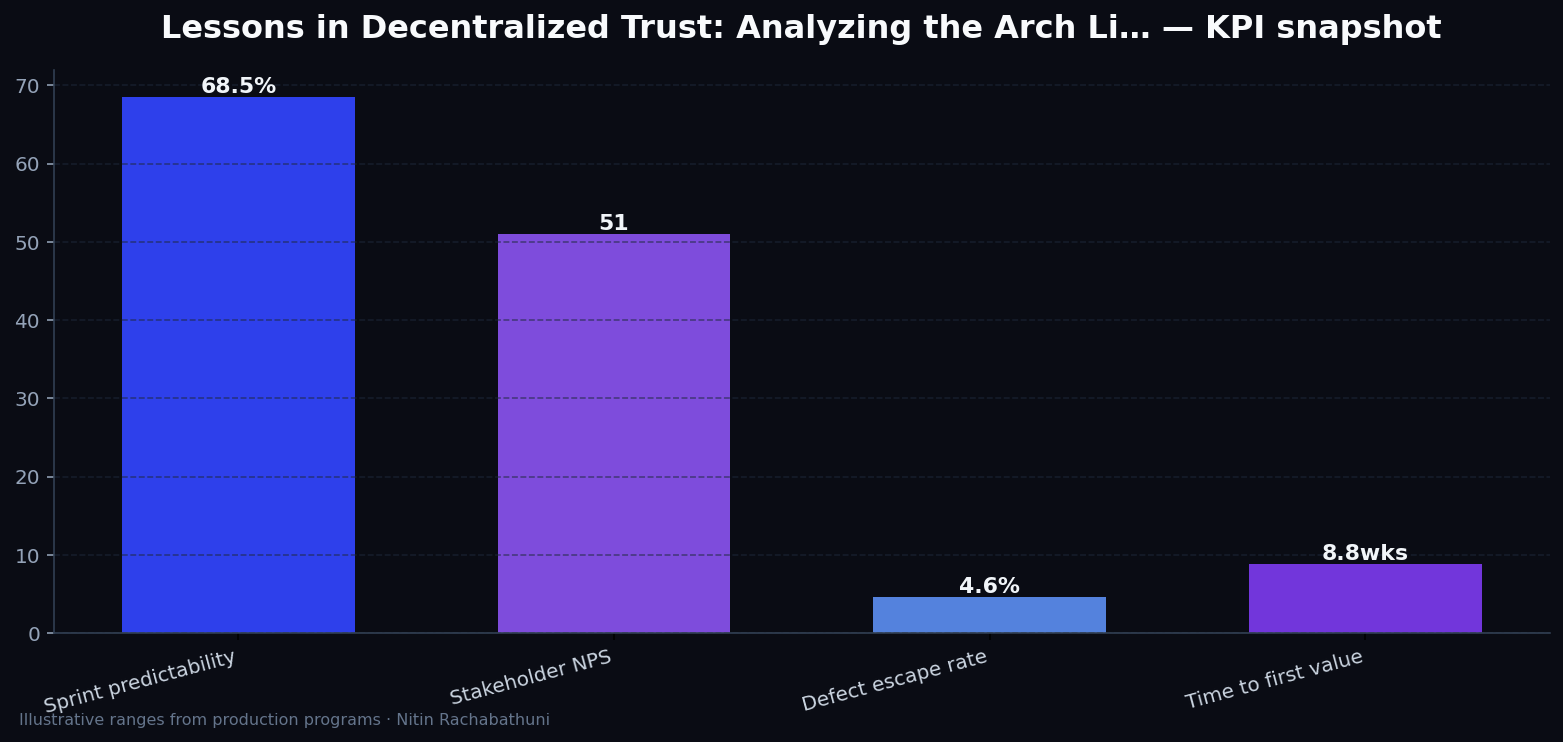
Illustrative consulting KPI ranges observed on programs like “Lessons in Decentralized Trust: Analyzing the Arch Li…” — validate against your own telemetry before setting SLOs. Methodology: production-like staging traces + weekly review with product and ops.
Architecture flow

Code sketches
/* Integration sketch */
// Lessons in Decentralized Trust: Analyzing the Arch Li…
export async function rolloutArchLinuxAurMalwareIncidentSecurityAnalysis() {
  const checks = ["telemetry", "auth", "rollback"];
  return { ok: true, checks };
}
Official references
Related on this site
Article slug: arch-linux-aur-malware-incident-security-analysis · Engineering notes by Nitin Rachabathuni — MVP in 2 days specialist.