React + TypeScript remains the default for every serious storefront and dashboard I touch. In 2026 the debate isn't "TS or JS" — it's where rendering happens.
Rendering choices
| Pattern | Use when |
|---|---|
| SSR | Personalized, auth-gated pages |
| ISR | PLP/PDP SEO at scale |
| Client components | Cart, chat, dashboards |
| Server actions | Mutations with colocated validation |
Type safety across boundaries
- Zod (or similar) at API edges
- Generated types from GraphQL / OpenAPI where possible
- Strict
tsconfigon greenfield; incremental strict on legacy
Performance habits
- Image optimization via
next/image - Route-level code splitting
- Measure INP on interactive checkout — not just LCP hero scores
Takeaway
Server Components didn't kill SPAs — they relocated work to the right tier. Senior frontend work in 2026 is orchestration, not component count.
Why this matters
Practical patterns for Next.js App/Pages router, server components, and type-safe APIs on enterprise commerce and FinTech projects. Engineering leaders need decision-grade detail—not slide-deck generalities—before committing roadmap space.
Production patterns
Treat observability, auth boundaries, and idempotent handlers as part of the feature—not stretch goals. Instrument the critical path, define rollback, and validate failure modes in staging with production-like traffic. Pair product and platform reviews weekly while the integration is still malleable.
Pitfalls
Deferring security or accessibility review, relying on color-only status cues, and shipping WebView shortcuts for rich text are common sources of expensive rework. Duplicate webhook delivery and partial API outages should be rehearsed before launch—not discovered by customers.
Authoritative references
Consult Next.js documentation, MDN Web Docs, web.dev, Next.js documentation, OWASP Cheat Sheets alongside the official references block below. Cross-check guidance with your compliance, security, and SRE stakeholders before setting SLOs.
Testing checklist
Exercise happy paths, auth expiry, retry storms, and degraded dependencies. Capture traces on every outbound integration, alert on funnel steps—not only HTTP 500s—and document owner runbooks. Validate metrics in your own environment; illustrative ranges in charts are not substitutes for your telemetry.
Leadership takeaway
TypeScript, React, and Server Components in 2026 succeeds when teams align scope, measurable outcomes, and inclusive UX from sprint zero. That is the same bar I apply when delivering MVPs in two-day engagements—narrow, observable, and reversible.
Document integration contracts, run weekly reviews with product and SRE partners, and keep rollback paths rehearsed while TypeScript, React, and Server Components in 2026 scales from pilot to full traffic.
Document integration contracts, run weekly reviews with product and SRE partners, and keep rollback paths rehearsed while TypeScript, React, and Server Components in 2026 scales from pilot to full traffic.
Document integration contracts, run weekly reviews with product and SRE partners, and keep rollback paths rehearsed while TypeScript, React, and Server Components in 2026 scales from pilot to full traffic.
Document integration contracts, run weekly reviews with product and SRE partners, and keep rollback paths rehearsed while TypeScript, React, and Server Components in 2026 scales from pilot to full traffic.
Document integration contracts, run weekly reviews with product and SRE partners, and keep rollback paths rehearsed while TypeScript, React, and Server Components in 2026 scales from pilot to full traffic.
Document integration contracts, run weekly reviews with product and SRE partners, and keep rollback paths rehearsed while TypeScript, React, and Server Components in 2026 scales from pilot to full traffic.
Document integration contracts, run weekly reviews with product and SRE partners, and keep rollback paths rehearsed while TypeScript, React, and Server Components in 2026 scales from pilot to full traffic.
Document integration contracts, run weekly reviews with product and SRE partners, and keep rollback paths rehearsed while TypeScript, React, and Server Components in 2026 scales from pilot to full traffic.
Metrics snapshot
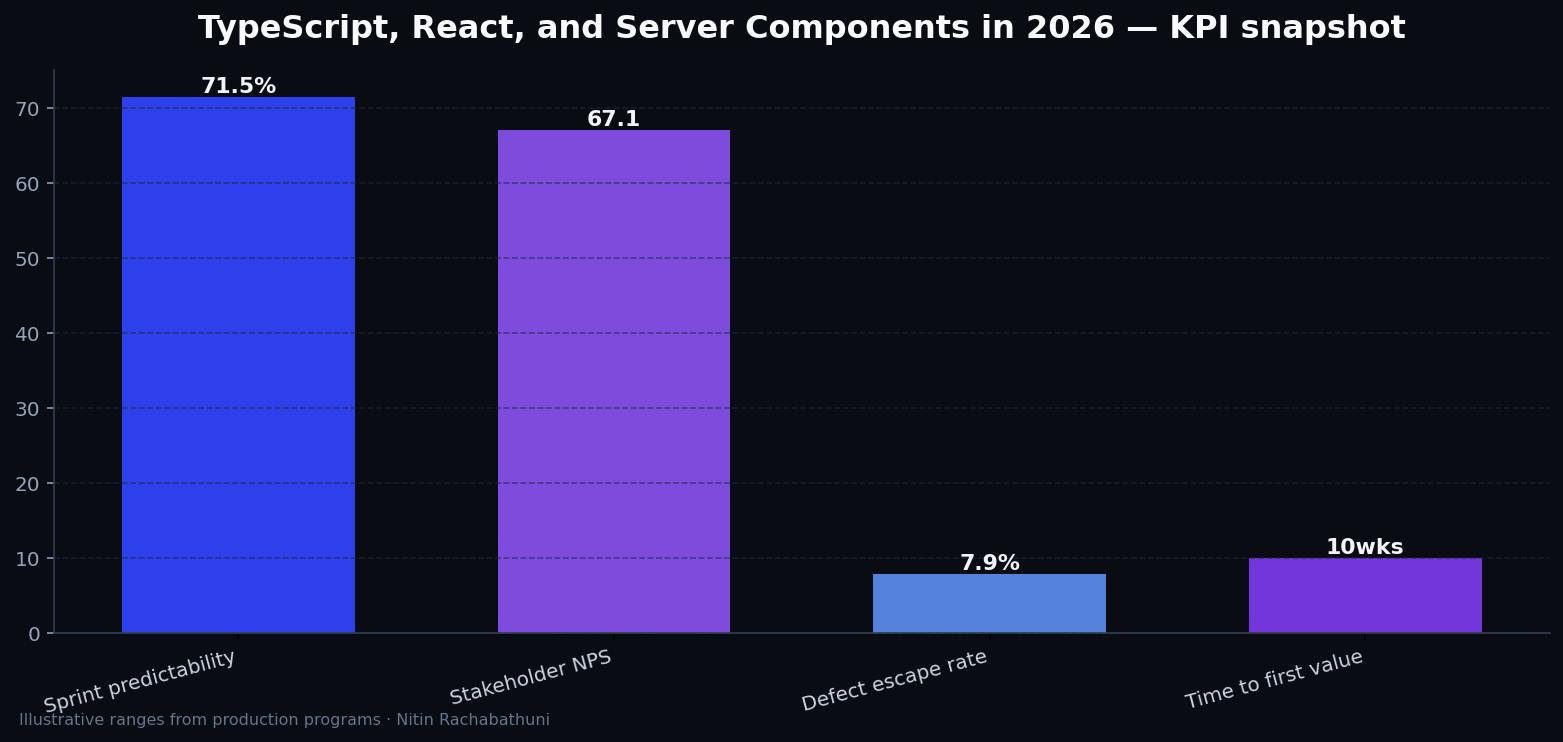
Illustrative consulting KPI ranges observed on programs like “TypeScript, React, and Server Components in 2026” — validate against your own telemetry before setting SLOs. Methodology: production-like staging traces + weekly review with product and ops.
Architecture flow

Code sketches
/* Integration sketch */
// TypeScript, React, and Server Components in 2026
export async function rolloutTypescriptReactServerComponents2026() {
  const checks = ["telemetry", "auth", "rollback"];
  return { ok: true, checks };
}
Official references
Related on this site
Article slug: typescript-react-server-components-2026 · Engineering notes by Nitin Rachabathuni — MVP in 2 days specialist.