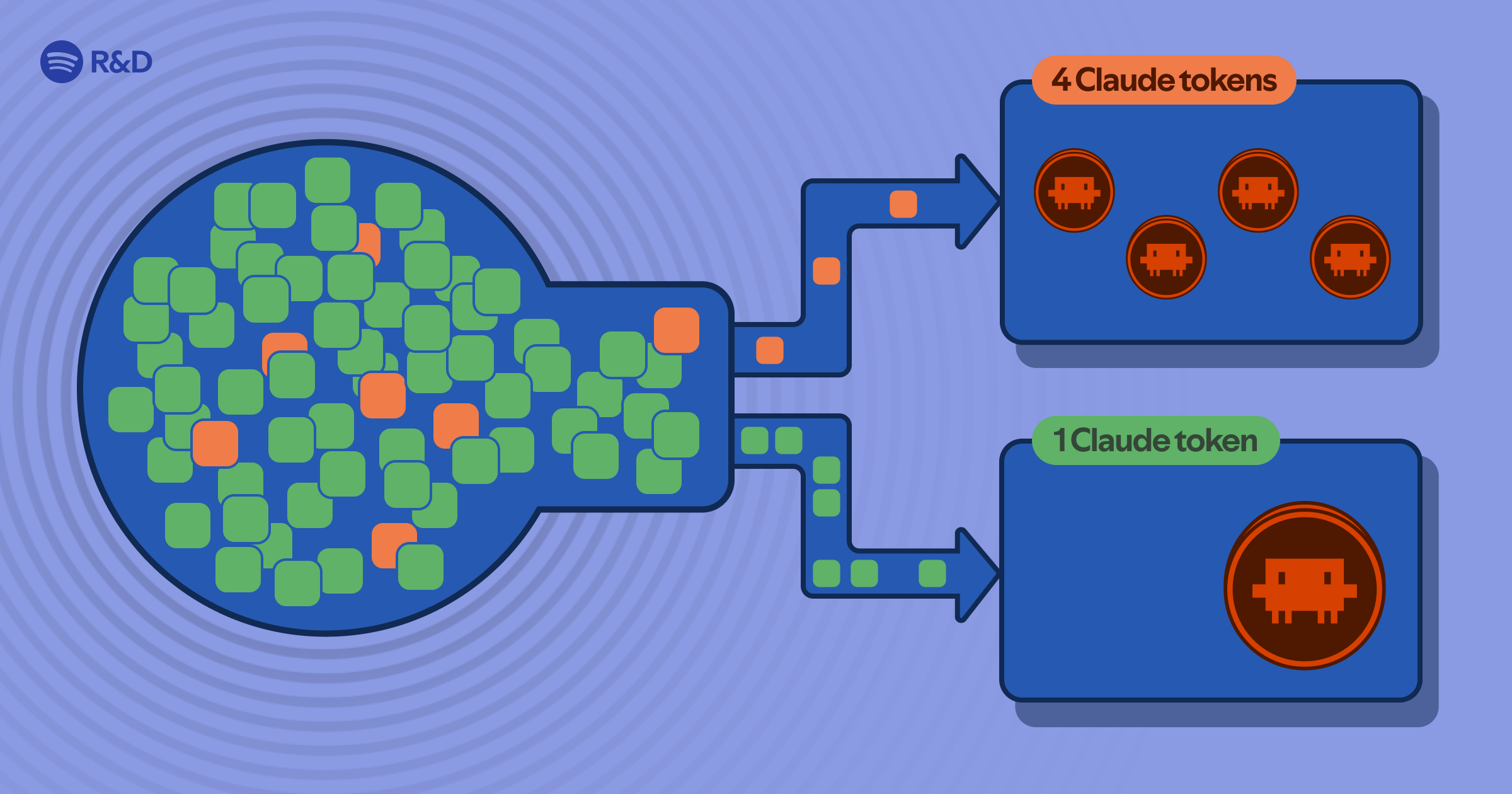
The Hidden Cost of AI Agency: Why Your Tokens are Vanishing
As we move deeper into the era of agentic workflows, one reality has become clear for engineering teams: LLM tokens are not free. When using tools like Claude Code to navigate large codebases, it is easy to fall into a trap where the model spends 90% of its "thinking" capacity on tasks that don't actually require intelligence.
The Spotify engineering team recently shared a compelling case study on how they tackled this exact problem. By implementing an architecture inspired by their internal tool, Portal, they managed to slash Claude Code token usage by a staggering 90%. This wasn't achieved through "better prompting" or switching to a more efficient model; it was achieved through architectural decoupling.
The core issue is that LLMs are often used as general-purpose engines for tasks that have specific, deterministic solutions. When an agent needs to read five files in a directory or generate 100 lines of boilerplate configuration, asking the LLM to "think" through those steps consumes massive amounts of context and tokens. By offloading these heavy I/O operations to specialized tools, you preserve the model's cognitive "budget" for actual problem-solving and logic.
The Architecture of a "Shunt": Decoupling Logic from I/O
The Spotify team introduced the concept of a shunt. In this context, a shunt is an intermediary layer that intercepts specific types of requests—specifically those involving high-volume data movement or repetitive boilerplate generation—and routes them to specialized workers.
When Claude Code interacts with a codebase, it often needs to perform "bulk" actions. For example:
- Reading the contents of multiple files in a directory.
- Searching for specific patterns across hundreds of lines of code.
- Generating standard scaffolding or repetitive boilerplate.
In a naive implementation, the LLM processes every byte of that data. In the Portal-inspired architecture, the agent sends a high-level command (e.g., "Read all files in /src/utils"). This request is intercepted by the shunt. Instead of the LLM reading the file content directly into its context window, the system executes a local script or tool to gather that data and returns only the relevant summary or specific segments needed for the next step.
By moving these tasks from "LLM-driven" to "tool-driven," you significantly reduce the amount of text the model has to process in every turn of the conversation. This doesn't just save money; it improves performance because the model stays focused on the logic rather than getting lost in a sea of repetitive data.
Practical Implementation: Moving from Theory to Production
If you are looking to implement a similar "shunt" for your internal AI agents, there are three critical engineering principles you should adopt based on the Spotify findings:
1. Audit Your Token Mix
Don't guess where your money is going; measure it. You need to identify which parts of your agent's workflow are consuming the most tokens. Is it the initial system prompt? The repeated context of large files? Or the repetitive output for boilerplate? By mapping out these "heavy" areas, you can target them with specific tools like Portal.
2. Log Metadata Rigorously
To optimize effectively, you must log more than just cost. You need to track model_id, prompt_version, and tool_call_type for every production call. This allows you to see exactly where the "leak" is occurring. If a specific tool-call consistently results in high token counts without a corresponding increase in success rate, it’s a prime candidate for a shunt.
3. Canary Deployments
When introducing an intermediary layer like a shunt, do not roll it out across your entire fleet immediately. New infrastructure adds complexity and potential points of failure. Use canary releases on low-risk endpoints to ensure the tool correctly interprets the agent's intent before making it the default path for all developers.
The Trade-off: Infrastructure Complexity vs. Cost Efficiency
It is important to be pragmatic here: there is no free lunch. By implementing a system like Portal, you are adding an extra layer of infrastructure between your developer and the codebase. This means more code to maintain, more potential points of failure in the "shunt" logic, and a slightly steeper learning curve for the initial setup.
However, for large-scale engineering organizations, this is often a necessary trade-off. The cost savings on API tokens, combined with the improved reliability of the agent (since it isn't getting overwhelmed by massive context windows), usually outweighs the overhead of maintaining the specialized tools.
The goal is to treat the LLM as the "brain" and your internal tools as the "hands." The brain shouldn't have to worry about how many fingers it has or how much weight a hand can carry; it should only focus on making decisions based on the information provided by those hands.
If you are struggling to balance the cost of AI integration with the need for high-performing developer tools, I can help you architect your MVP to ensure you aren't wasting resources on "heavy" tasks that don't require a massive LLM. Contact me here to discuss how we can build efficient, scalable AI workflows for your team.
Summary of Key Takeaways
- Identify the Waste: Use tools like Portal to move heavy I/O and boilerplate out of the LLM's primary context window.
- The Shunt Strategy: Implement a middle layer that handles "dumb" tasks (like bulk reading) so the model can focus on "smart" tasks (logic and reasoning).
- Data-Driven Optimization: Log prompt versions and model IDs to identify exactly where your token budget is being drained.
FAQ
What makes a task suitable for a "shunt"? Any task that involves high volumes of data but requires low levels of cognitive reasoning—such as reading multiple files, searching strings across a directory, or generating repetitive boilerplate—is an ideal candidate for offloading to a specialized tool.
How much can these optimizations actually save? In the case study shared by Spotify engineers, moving these specific tasks to a "shunt" architecture reduced Claude Code token usage by up to 90%, significantly lowering costs while maintaining developer productivity.
Does adding an extra layer of infrastructure hurt the user experience? While it adds complexity for the developers building the system, it often improves the end-user (the engineer's) experience because the AI agent becomes more focused and less likely to "hallucinate" or get lost in large amounts of irrelevant data.
Implementation help
Let's align on scope and next steps. Nitin Rachabathuni, Senior Full-Stack Engineer and MVP in 2 Days specialist — technical audits, implementation support, advisory, and flexible hourly collaboration shaped to your product. Reach out anytime; available across time zones and countries.
- Contact form
- Email: nitin.rachabathuni@gmail.com
- WhatsApp: +91-9642222836