
Scaling PgBouncer: Overcoming the Single-Threaded Bottleneck
In high-scale database architecture, connection management is often the first wall you hit. When your application grows and concurrent connections spike, a proxy like PgBouncer becomes essential to manage state and reduce the overhead of frequent connection establishment. However, many engineers encounter a frustrating plateau: they see their PostgreSQL instance sitting with plenty of CPU headroom while the PgBouncer layer reports 100% utilization or capped throughput.
The reason is often architectural rather than related to your database configuration. Because a single PgBouncer process is single-threaded, it can only utilize one CPU core at any given time. On modern multi-core machines—where you might have 16, 32, or even 64 vCPUs available—a lone PgBouncer instance leaves the vast majority of your compute resources idle while creating a massive bottleneck for incoming traffic.
The Mechanics of the Single-Threaded Bottleneck
To understand why this happens, we have to look at how PgBouncer handles requests. As a process-based tool, each instance is bound by the limitations of its single thread. When you run one instance on a 16-core machine, that instance "claims" only $1/16^{th}$ of your available compute power for connection pooling tasks.
When traffic spikes, this single process becomes saturated with context switching and packet processing. Even if Postgres is ready to handle more queries, the "gatekeeper" (PgBouncer) cannot pass them through fast enough because it has hit its physical limit on a single core.
This leads to increased latency for your end-users and can cause connection timeouts before the request even reaches the database engine. The solution isn't necessarily bigger hardware; it’s about parallelizing the pooling layer so that every available CPU core is contributing to the throughput of the system.
Implementing a Multi-Process Architecture with so_reuseport
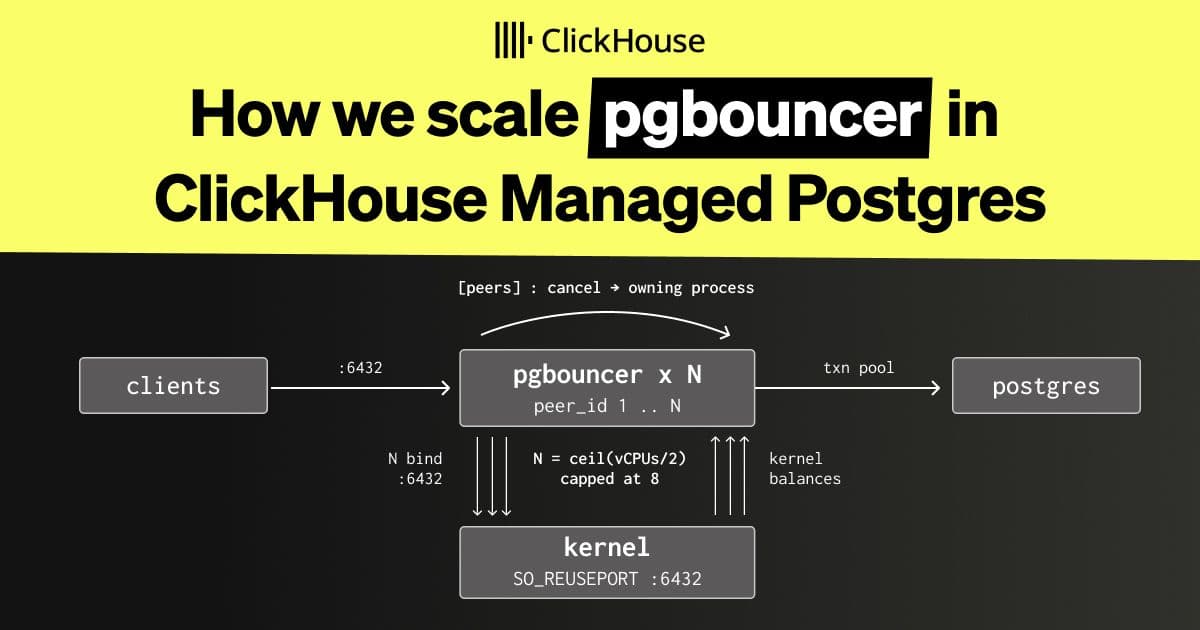
The most effective way to break through this ceiling is by deploying a fleet of PgBouncer processes on a single host (or across a cluster) and utilizing the so_reuseport socket option.
In standard networking, two processes cannot bind to the same IP and port simultaneously. However, so_reuseport allows multiple processes to share the exact same port by distributing incoming connections among them at the kernel level. This creates a "fan-out" effect:
- Single Entry Point: Your application still connects to one endpoint (e.g., port 5432).
- Distributed Load: The Linux kernel distributes incoming TCP connections across multiple PgBouncer processes.
- Parallel Execution: Each process handles a subset of the traffic, allowing you to utilize all available CPU cores on your server.
By moving from one instance to, for example, 16 instances (one per core), you can theoretically increase your throughput by up to 16x—though in practice, a 4x jump is often what's needed to move past the initial "bottleneck" phase of growth.
The Critical Trade-offs: Connection Budgets and Math
While moving to a multi-process architecture solves the CPU bottleneck, it introduces a new layer of complexity regarding connection management. When you have one PgBouncer instance, your max_db_connections is shared across that single process's pool.
When you move to $N$ processes using so_reuseport, you must divide your backend database capacity by the number of processes. If your Postgres server can handle 1000 concurrent connections and you run 4 PgBouncer processes, each process should only be allowed a maximum of 250 connections (plus some buffer for overhead).
If you fail to do this math correctly, you risk "over-subscribing" the database. If every one of your 4 PgBouncer instances thinks it has permission to open 1000 connections, they could collectively attempt to open 4000 connections, crashing the Postgres instance or causing a massive spike in connection errors.
Engineering Best Practices for High-Availability Pooling
When scaling infrastructure like this, "hope" is not a strategy. You must move from a simple deployment script to a robust system design:
- Multi-AZ vs. Multi-Region: Remember that multi-availability zone (AZ) is not the same as multi-region. If your PgBouncer fleet is in one AZ and your DB is in another, you face different latency profiles than if they were across regions. Know exactly where your failure points are.
- Game-Day Rollbacks: Don't just write a deployment script; game-day the rollback path. If a change to the
so_reuseportconfiguration causes a routing loop or a connection drop, you need an automated way to revert to the previous stable state in seconds. - Symptom-Based Alerting: Instead of only alerting on CPU graphs (which are lagging indicators), alert on customer-visible symptoms like "increase in 5xx errors" or "p99 latency spikes."
If you're looking to optimize your infrastructure for high availability and scale, I can help you navigate these architectural hurdles. Contact me here to discuss how we can build a robust MVP that scales with your user base.
Summary of the Scaling Strategy
To summarize the transition from a single instance to a multi-process fleet:
- Audit: Check if PgBouncer CPU usage is hitting 100% while Postgres remains low.
- Deploy: Implement
so_reuseportto allow multiple processes on one port. - Calculate: Divide your backend connection limits by the number of pooler processes.
- Monitor: Alert on end-user latency and success rates rather than just raw hardware metrics.
FAQ
Why does a single PgBouncer instance hit a performance ceiling even when Postgres has available resources? PgBouncer is architected as a single-threaded process, meaning one instance can only utilize one CPU core at a time. If your server has multiple cores, the remaining capacity stays idle while the single pooler becomes a bottleneck for incoming traffic.
What is the role of so_reuseport in scaling PgBouncer?
The so_reuseport option allows multiple processes to bind to the same IP and port simultaneously. This enables you to run several PgBouncer instances that share one entry point, distributing the load across all available CPU cores.
What is the primary trade-off when moving to a multi-process PgBouncer architecture? The main tradeoff involves connection math; your total allowed connections to the backend database must be divided by the number of pooler processes. This ensures that you do not oversubscribe the Postgres instance while scaling out your pooling layer.
Implementation help
Let's align on scope and next steps. Nitin Rachabathuni, Senior Full-Stack Engineer and MVP in 2 Days specialist — technical audits, implementation support, advisory, and flexible hourly collaboration shaped to your product. Reach out anytime; available across time zones and countries.
- Contact form
- Email: nitin.rachabathuni@gmail.com
- WhatsApp: +91-9642222836
