
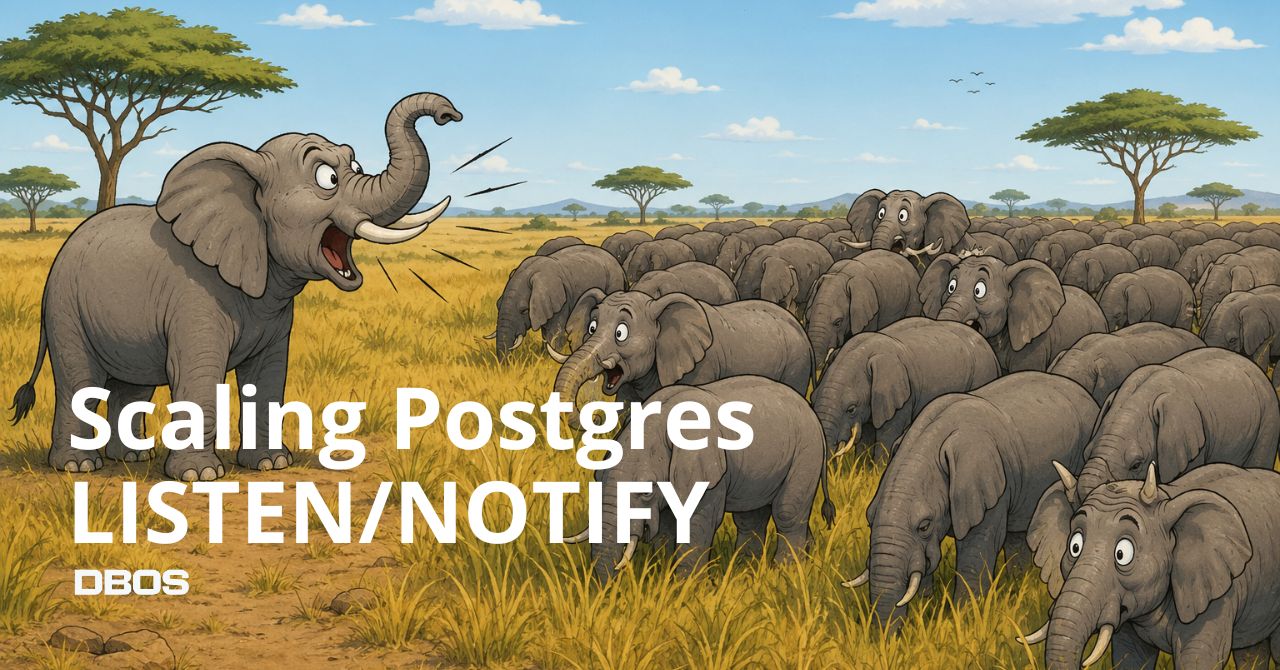
Why Postgres LISTEN/NOTIFY Actually Scales: Breaking the Myth of Locking Bottlenecks
In the world of backend engineering, there is a common tendency to label certain features as "not for production" or "unscalable" based on early architectural limitations. One of the most frequently cited examples in this category is PostgreSQL’s LISTEN/NOTIFY mechanism.
For years, many architects have avoided using it for high-throughput systems, citing concerns over internal locking mechanics and global contention. However, as recent benchmarks and engineering deep-dives show, these concerns often stem from a misunderstanding of how the feature is implemented versus how it can be architected. When you move away from one-to-one triggers and toward batched notification patterns, LISTEN/NOTIFY isn't just viable—it’s incredibly performant.
The Root of the "Unscalable" Reputation
To understand why people think LISTEN/NOTIFY won't scale, we have to look at what happens under the hood when a NOTIFY command is executed. When a transaction issues a notification, PostgreSQL must acquire an exclusive lock on certain internal structures to register that notice in the queue.
In a naive implementation—where every single row insert or update triggers its own individual NOTIFY call via a database trigger—this creates a bottleneck. If you have thousands of concurrent writes trying to fire individual notifications simultaneously, they will contend for those locks. This is the "standard" use case that leads people to conclude the system can't handle scale.
However, this isn't an inherent failure of the NOTIFY command; it’s a byproduct of high-frequency, low-volume operations hitting a shared resource too often. In reality, most production systems don't need a unique notification for every single row update in real-time. They need to know that something changed or that a batch of things changed.
Engineering the Workaround: Batching and Buffering
The key to unlocking high performance with LISTEN/NOTIFY lies in changing the granularity of your notifications. Instead of a 1:1 relationship between an update and a notification, you implement a buffered approach.
By grouping updates into batch transactions, you drastically reduce the number of times the system has to engage the internal locking mechanism for notifications. For example, if your application processes 100 records in a single transaction block, you only issue one NOT/NOTIFY command at the end of that block. This approach allows systems to bypass contention and achieve massive throughput—hitting upwards of 60,000 writes per second with millisecond latency on a single server.
This shift from "immediate individual notification" to "batched transactional notification" changes the math entirely. You aren't fighting the database’s internal locks anymore; you are optimizing your application logic to work within those constraints while still providing near-instant updates to downstream consumers.
Practical Implementation and Trade-offs
When designing a system using this pattern, there are several practical considerations that move beyond just "making it work." You have to decide on the acceptable window of latency for your subscribers.
If you are building a real-time chat application, you might want lower batching windows (e.g., every 100ms). If you are updating a dashboard showing inventory levels or analytics, a slightly larger buffer is perfectly acceptable and significantly more efficient. By decoupling the database write from the immediate notification dispatch via an internal buffer, you create a much more resilient architecture.
Furthermore, using LISTEN/NOTIFY reduces the need for complex "polling" logic in your worker services. Instead of workers constantly hitting the DB to ask, "Is there anything new?", they sit idle until the database pushes a signal. This reduces unnecessary load on the database and simplifies the state management of your background workers.
When to Stick with LISTEN/NOTIFY vs. External Brokers
A common question I get is: "If it scales this well, why do people still use RabbitMQ or Kafka?"
The answer lies in the scope of your infrastructure. LISTEN/NOTIFY is an incredible tool for internal system communication—notifying a worker that a job is ready, updating a cache, or signaling another service within your ecosystem to perform an action. It keeps your stack lean by removing the need for a separate message broker for many common use cases.
However, if you need complex routing rules, guaranteed "at-least-once" delivery across multiple independent microservices, or long-term persistence of messages that can be replayed, then a dedicated broker like Kafka is still the correct tool. The choice isn't about what can scale; it's about which architecture fits your specific requirements for reliability and complexity.
If you are currently grappling with scaling issues in your database architecture or need help designing an MVP that balances performance with simplicity, reach out to me here to discuss how we can build a robust system tailored to your needs.
Summary of the Scalability Shift
To summarize the shift in perspective:
- The Problem: High contention on internal locks during high-frequency, individual
NOTIFYcalls. - The Solution: Batching notifications into larger transaction blocks.
- The Result: Significant reduction in lock contention and a massive jump in throughput (60k+ writes/sec).
By understanding the underlying mechanics of PostgreSQL, we can move past "common wisdom" that limits our architectural choices and instead use the tools at our disposal in ways that actually meet modern scale requirements.
Implementation help
Let's align on scope and next steps. Nitin Rachabathuni, Senior Full-Stack Engineer and MVP in 2 Days specialist — technical audits, implementation support, advisory, and flexible hourly collaboration shaped to your product. Reach out anytime; available across time zones and countries.
- Contact form
- Email: nitin.rachabathuni@gmail.com
- WhatsApp: +91-9642222836