The Over-Engineered Doorbell: Why Your IoT Infrastructure Might Be a Rube Goldberg Machine
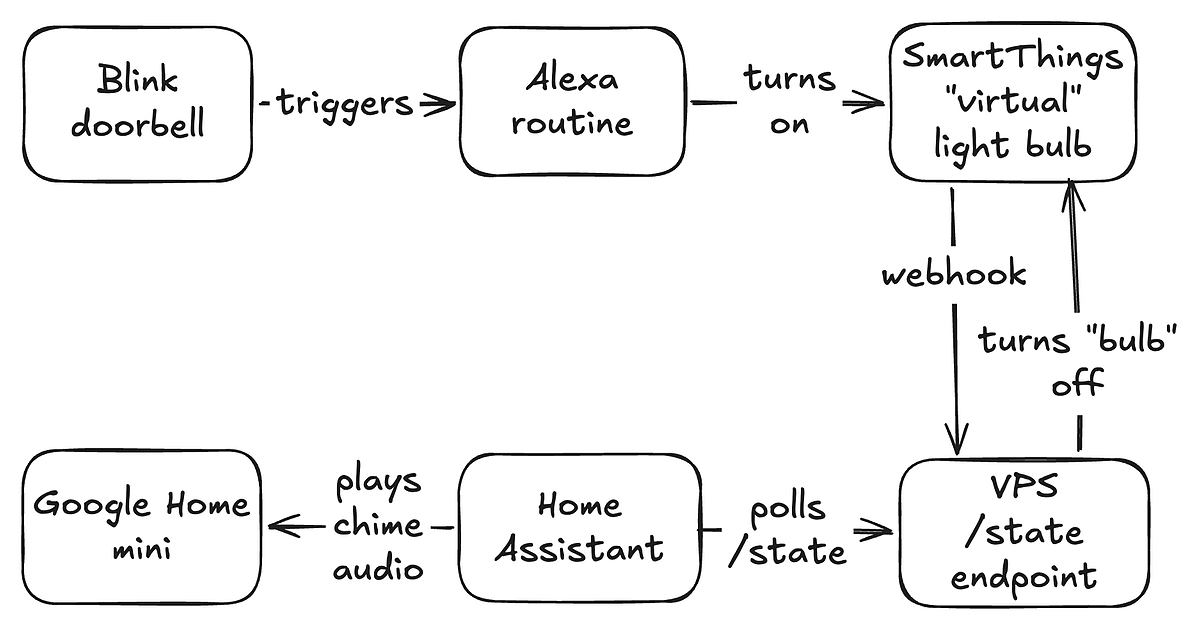
In the world of systems engineering, there is a fine line between "robust architecture" and "unnecessary complexity." Recently, a compelling example surfaced involving something as simple as a doorbell. To hear a notification when someone rings the bell, the system required five different cloud services to process a single bit of data.
This isn't just a humorous anecdote about a poorly designed smart home; it is a profound case study in how modern IoT (Internet of Things) ecosystems can force engineers into "Rube Goldberg" architectures—where a simple physical action triggers a convoluted chain of digital events before reaching the end user.
The Cost of Multi-Hop Integrations
When we look at why a doorbell needs five services to play a sound, we have to examine the reality of modern cloud ecosystems. Most IoT devices do not live in a vacuum; they are designed to be "interoperable." To make a device work with Amazon Alexa, Google Home, and an iPhone's notification system simultaneously, developers often rely on third-party bridges (like IFTTT or Zapier) or multi-layered cloud gateways.
Each of these layers adds what we call a "hop." In networking, every hop is a potential point of failure. If the doorbell signal travels from:
- The physical hardware to an IoT Gateway,
- From the Gateway to a Message Broker (like MQTT),
- To a Logic Engine to process the "If This Then That" rule,
- To a Push Notification Service, and
- Finally to a mobile device's notification handler...
...you have created a fragile chain. If any one of those five services experiences latency or an API timeout, the user doesn't hear the bell. The "simple" interaction is now dependent on the uptime and performance of half a dozen different companies’ infrastructures. This is the classic trade-off between high availability (via distributed cloud services) and architectural simplicity.
Complexity vs. Reliability: The Engineering Trade-off
As engineers, we often face the temptation to use "quick fix" automations. It is easy to plug into an existing API because it solves the immediate problem of getting a notification on a phone. However, this creates significant technical debt. When you choose a multi-hop path for a low-complexity task, you increase the surface area for failure at every integration point.
In high-stakes environments—such as industrial IoT or medical devices—this level of complexity is often unacceptable. If a sensor detects a gas leak, it shouldn't need to travel through three different cloud providers just to trigger an alarm. However, in consumer electronics, the "convenience" of cross-platform integration often wins out over architectural purity.
The challenge for the modern engineer is identifying where "good enough" becomes "too much." If a feature only requires a local signal (a button press), it should ideally be handled by edge computing or local logic rather than being routed through a global cloud infrastructure just to perform a basic function.
Security and Maintenance in Complex Pipelines
Beyond the risk of failure, there is the massive overhead of maintenance and security. Every time you add a service to your stack, you must manage:
- Credential Rotation: Each API key for each service needs to be secured and rotated.
- Rate Limiting: You have to monitor how many requests each hop can handle before it throttles the signal.
- Logging & Observability: When a notification fails to arrive, where did it die? In a five-service chain, debugging becomes a forensic exercise in tracing logs across different platforms.
To mitigate these risks, engineers should implement strict monitoring on every production call. This includes logging model IDs (if using AI components), tracking prompt versions, and canarying new integration points before rolling them out to the entire fleet. If you are building an MVP or a prototype, it is tempting to take the shortcut of "just making it work" via multiple cloud hops, but this must be weighed against the long-term cost of maintaining that infrastructure.
Moving Toward Leaner Architectures
The goal isn't to eliminate the cloud; it’s to use it intentionally. We should strive for a "flat" architecture where possible. If a task can be performed locally or via a single direct integration, we should avoid adding unnecessary middleware. By reducing the number of hops, we decrease latency, improve reliability, and simplify the security perimeter.
Building a product that is both innovative and maintainable requires a disciplined approach to system design. You need to decide early on which features require the power of complex cloud orchestration and which ones are "1-bit signals" that should stay as close to the hardware as possible.
If you are currently navigating the complexities of scaling an MVP or trying to simplify a bloated technical architecture, I can help you navigate these trade-offs to build something scalable without the unnecessary overhead. You can reach out for specialized consulting here: https://www.nitin-rachabathuni.com/contact.
Summary Checklist for System Design
To avoid building your own Rube Goldberg machine, keep these principles in mind:
- Evaluate the "Hop" Count: Every new service added to a chain is a potential point of failure and an increase in latency.
- Prioritize Edge Logic: If a task doesn't require global data processing, try to handle it at the edge or on-device.
- Audit for Technical Debt: Ask if a "quick fix" integration will require significant maintenance effort six months from now.
- Implement Robust Logging: Ensure that every hop in your architecture provides clear telemetry so you can identify exactly where a failure occurs.
Implementation help
Let's align on scope and next steps. Nitin Rachabathuni, Senior Full-Stack Engineer and MVP in 2 Days specialist — technical audits, implementation support, advisory, and flexible hourly collaboration shaped to your product. Reach out anytime; available across time zones and countries.
- Contact form
- Email: nitin.rachabathuni@gmail.com
- WhatsApp: +91-9642222836