The End of the "Cold" Data Center Era
For decades, the standard operating procedure for data centers was simple: keep the air cold. To manage the heat generated by servers, facilities relied on massive industrial chillers and cooling towers that evaporated millions of gallons of water to maintain a consistent ambient temperature. As we transitioned into the era of Generative AI and Large Language Models (LLMs), this "brute force" approach hit a physical and economic wall.
The hardware requirements for training models—specifically high-density GPU clusters like those powered by NVIDIA’s Blackwell architecture—generate heat at a scale that traditional air cooling simply cannot manage efficiently. When you are packing thousands of GPUs into a single rack, the sheer volume of air required to move heat away from the silicon becomes logistically impossible and environmentally costly.
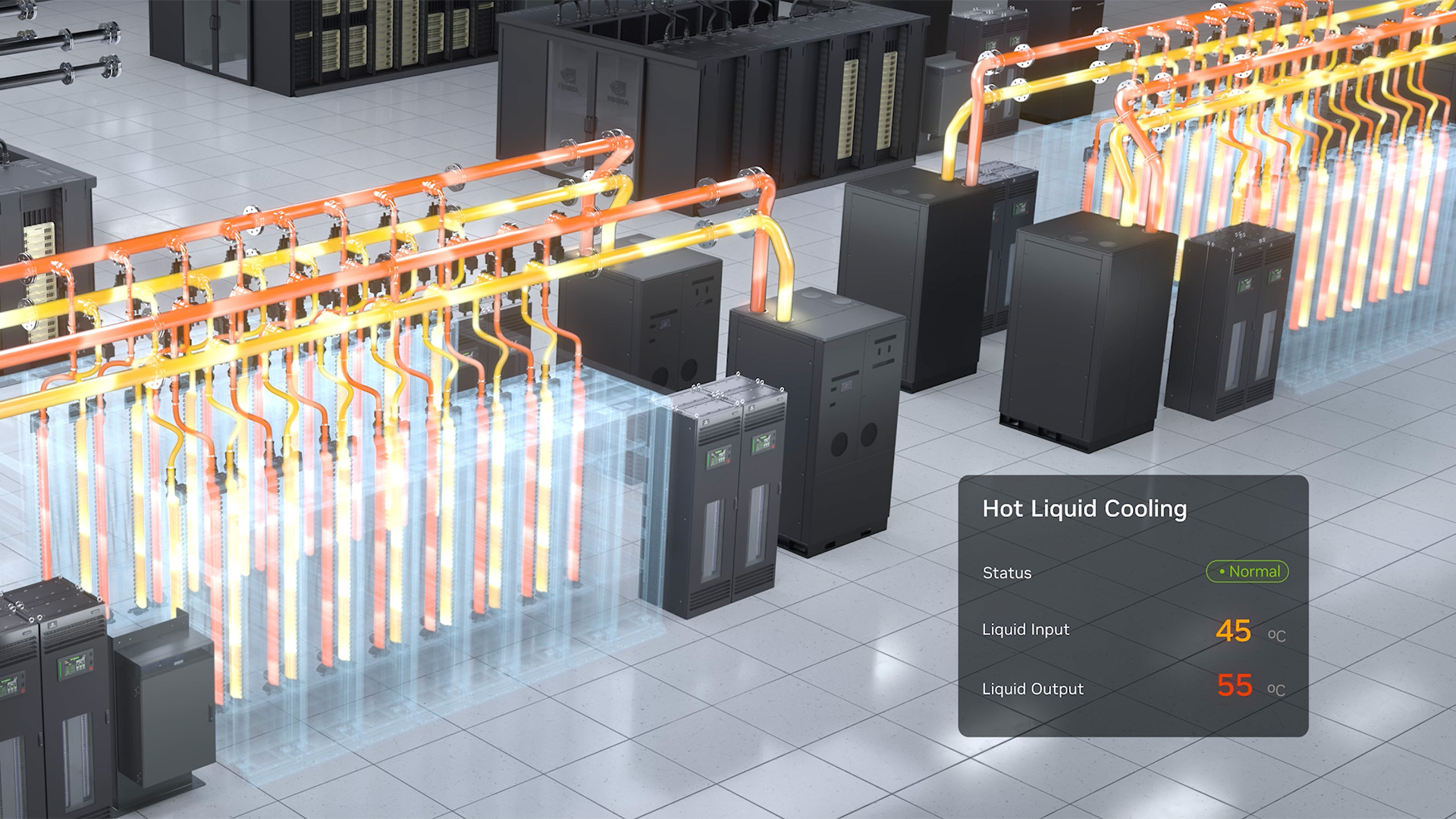
We are now moving toward an architectural shift where hardware no longer depends on chilled air for operation. By shifting the focus to liquid cooling at higher temperatures—specifically around 45°C (113°F)—the industry is decoupling high-performance computing from massive water consumption. This isn't just a marginal improvement in HVAC; it is a fundamental redesign of how we manage the thermodynamics of silicon.
The Physics of 45°C: Why Temperature Matters for Sustainability
The move to 45°C cooling represents a critical threshold in engineering. In traditional "wet" systems, water must be cooled significantly below the ambient outdoor temperature because it is being used to cool air before that air hits the server. This requires evaporative cooling towers, which are essentially massive fans blowing over wet pads—a process that consumes enormous amounts of water.
By moving to a liquid-cooled loop that operates at 45°C or higher, we can utilize "dry" coolers. Because the coolant is already hot enough to be rejected into the atmosphere via heat exchangers without needing to be chilled first, the facility no longer needs to evaporate water to achieve the target temperature.
This shift has three immediate impacts on infrastructure:
- Water Conservation: It moves data centers toward a "near-zero" water footprint because the cooling loop is closed and doesn't rely on evaporation.
- Energy Efficiency (PUE): By removing the need for massive refrigeration units to chill air, the Power Usage Effectiveness (PUE) of the facility improves significantly. You are spending electricity on computing, not on moving and chilling air.
- Density: Liquid cooling allows for much tighter packing of components. When heat is captured directly at the chip level (Direct-to-Chip), you can run high-wattage GPUs in configurations that would literally melt in a traditional air-cooled rack.
Engineering Trade-offs: From Air to Fluid Dynamics
Transitioning from an air-centric model to a liquid-centered one isn't just about swapping out pipes; it’s about managing different failure modes and operational risks. As engineers, we have to move away from "the fan is spinning" as our primary health metric and toward complex fluid dynamics and thermal gradients.
When you implement 45°C cooling, the infrastructure must be designed for high-density power requirements that were previously unthinkable. This means:
- Leak Detection: Moving fluids closer to electronics requires sophisticated sensors and secondary containment systems.
- Flow Dynamics: Ensuring consistent flow rates across thousands of nodes is critical. A drop in flow doesn't just mean a "hot" server; it can lead to immediate thermal throttling or hardware failure.
- Maintenance Accessibility: In high-density racks, the physical space for technicians to work is limited. Modular designs that allow for "hot-swappable" cooling components are becoming mandatory.
The goal here isn't just "better fans." It’s about creating a system where the infrastructure supports the hardware's peak performance without hitting environmental or operational ceilings. We are moving toward an era of "AI Factories," where the facility is designed as much for heat management as it is for compute power.
Strategic Planning for High-Density Infrastructure
For leadership teams and infrastructure architects, this shift requires a change in how we plan for growth. You cannot simply "bolt on" liquid cooling to an old air-cooled design and expect the same results. The plumbing, the pumps, and the heat exchangers must be integrated into the initial site architecture.
When planning your roadmap for high-density power requirements, consider these three pillars:
- Infrastructure Readiness: Is your facility capable of handling the weight and space requirements of liquid cooling manifolds?
- Monitoring Evolution: Are you alerting on customer-visible symptoms (like latency or packet loss) rather than just internal metrics like CPU temperature? In a high-density environment, by the time a "high temp" alert hits your dashboard, it might already be too late to prevent a failover.
- Scalability of Cooling: Can your cooling loop scale as you add more nodes, or will adding one extra rack overwhelm the local heat exchange capacity?
If you are navigating these complex infrastructure hurdles and need help moving from an MVP concept to a production-ready architecture that handles high-density demands, reach out for expert guidance here. We specialize in building robust systems that scale with your ambitions.
Summary of the Shift
The transition to 45°C liquid cooling is a pivot toward sustainability and performance. By removing the need for chilled air, data centers can slash costs by millions annually while drastically reducing their environmental footprint. It marks the end of "cold" data centers and the beginning of efficient, high-density AI factories.
Implementation help
Let's align on scope and next steps. Nitin Rachabathuni, Senior Full-Stack Engineer and MVP in 2 Days specialist — technical audits, implementation support, advisory, and flexible hourly collaboration shaped to your product. Reach out anytime; available across time zones and countries.
- Contact form
- Email: nitin.rachabathuni@gmail.com
- WhatsApp: +91-9642222836
:quality(85)/https://andros.dev/media/thumbnails/ai_thumbnail_94e69e19.png)