DoltLite: Bridging the Gap Between Database State and Version Control
In modern software engineering, we often find ourselves caught between two different worlds of state management. On one side, we have application code managed by Git—where branching, merging, and rolling back are standard operating procedures. On the other side, we have database states; traditionally, these are "live" entities where a mistake in a migration or a failed experiment can contaminate production data instantly.
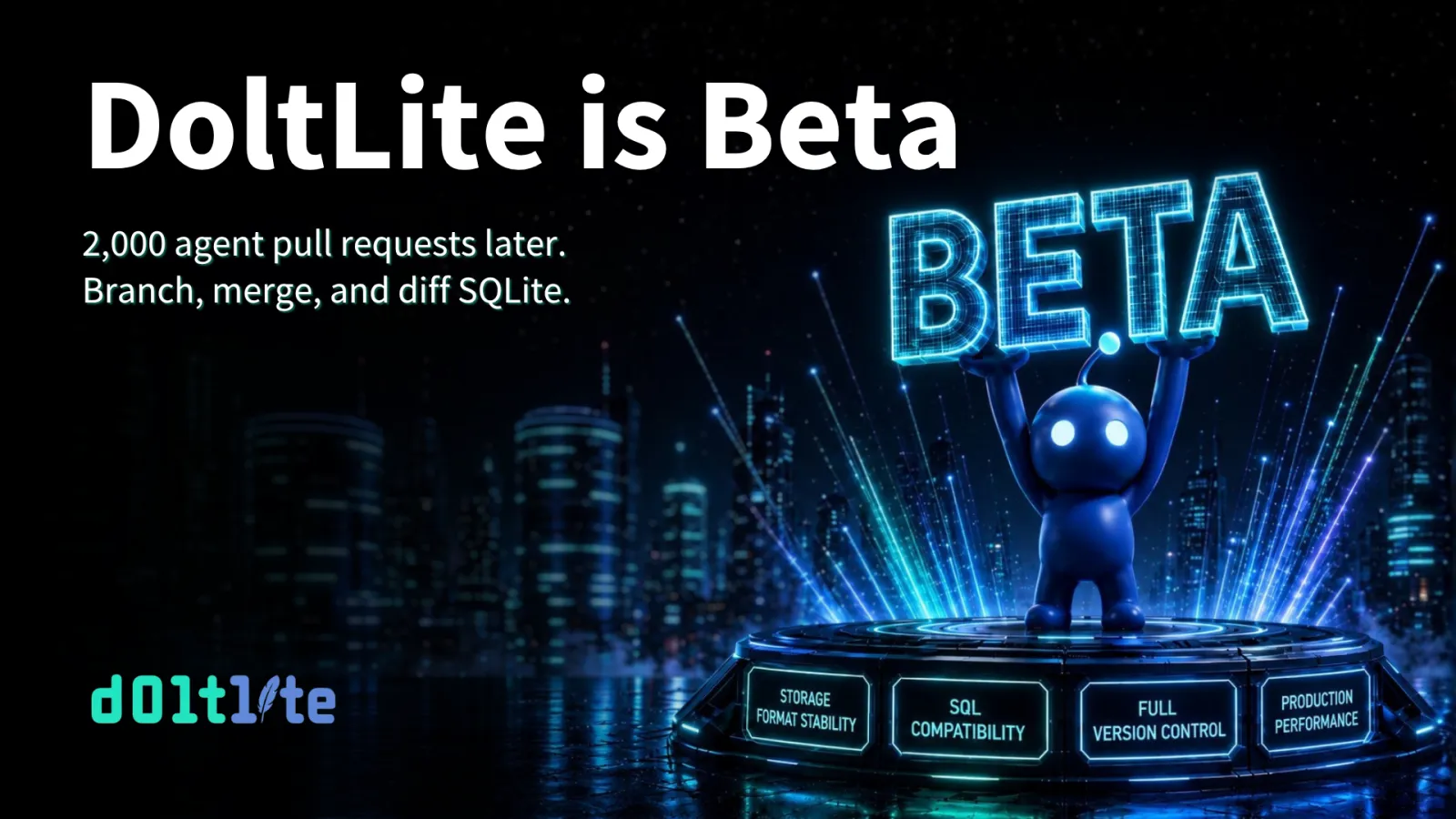
The emergence of Doltlite represents a significant shift in how we approach the latter. By providing an SQLite fork that incorporates Git-style version control, DoltLite aims to bring the safety and flexibility of versioned workflows directly into the database layer. This isn't just a wrapper; it is a fundamental architectural pivot for teams dealing with complex data states.
The Architecture: Why a Fork?
Doltlite doesn't just "mimic" Git functionality on top of an existing SQLite file. It is built as a fork, meaning the storage engine itself has been re-engineered to support push, pull, and clone operations natively. This allows developers to treat database states as first-class versioned objects.
For engineers who have struggled with managing "hotfix" branches for data migrations or trying to replicate production state in local environments without manual SQL dumps, this is a game changer. When you can clone a specific branch of a database, the boundary between development and operations becomes much more fluid. You are no longer just moving data; you are moving state history.
However, as with any significant architectural shift, there is no such thing as a free lunch. The integration of versioning logic into the storage engine introduces overhead. In early beta testing, it was observed that write speeds in DoltLite are roughly 60% slower than standard SQLite. This "performance tax" is the cost of maintaining the metadata and indices required to support branching and merging at scale.
Practical Trade-offs: Performance vs. Flexibility
When evaluating a tool like DoltLite, it is critical to move past the hype and look at the engineering trade-offs. The 60% write penalty isn't just a number; it’s a decision point for architects.
If you are building a high-frequency trading platform or a real-time telemetry ingestion engine where every microsecond of write latency matters, DoltLite might not be the primary choice for your "hot" path. However, if you are building:
- Data Science Pipelines: Where you need to branch data to test different feature engineering steps.
- Complex Migrations: Where a failed SQL script could brick an environment.
- Collaborative Data Products: Where multiple engineers need to work on the same schema simultaneously without overwriting each other's progress.
In these scenarios, the trade-off of slower writes for significantly higher "safety" and collaboration features is often a winning bargain. You are trading raw throughput for developer velocity and system reliability.
To truly understand if this fits your stack, you must move beyond local testing with three rows of data. Real performance impacts only surface under production-shaped loads where indexing complexity and concurrent access patterns come into play. When evaluating DoltLite (or any database fork), the p95 latencies are what matter—averages often hide the "jitter" that causes real-world user friction.
The Workflow Shift: Branching Your Database State
The most profound impact of DoltLite is how it changes the daily workflow of a data engineer or backend developer. Imagine a scenario where you need to test a new feature that requires a significant schema change and a complex data migration.
In a traditional SQLite setup, you might create a "test_db" file, manually export data from production (anonymized), run your scripts, and then try to replicate the logic in production. With DoltLite, you can simply branch the database. You work on feature-x branch of the database, verify the results, and merge it into the main branch once validated.
This mirrors the "Gitflow" for data. It allows for:
- Isolated Experimentation: Test complex SQL queries against a branched state without affecting other team members' work.
- Seamless Collaboration: Use
pushandpullto share specific database states across a distributed team. - Instant Rollbacks: If a migration goes wrong, you don't have to "undo" it; you simply revert to the previous commit/state of the database.
If you are looking to move your project toward an MVP (Minimum Viable Product) and need help navigating these architectural choices or determining how to integrate advanced data structures into your roadmap, contact me for expert consulting. I specialize in helping teams navigate complex engineering trade-offs to build scalable products.
Implementation Strategy: When to Adopt DoltLite?
Before integrating DoltLite into your production stack, it is vital to perform a "reality check" on your specific use case. Not every application requires versioned database states.
1. Identify the "State Complexity": If your data model changes frequently or if you have multiple teams working on different features that touch the same tables, DoltLite's branching capabilities are invaluable. 2. Audit Your Write Frequency: Analyze your write-to-read ratio. If your application is 90% reads (like a content management system or a catalog), the 60% slower writes might be negligible compared to the benefits of version control. 3. Monitor and Trace: When implementing, ensure you are caching keys with both deployment IDs and experiment IDs. This ensures that even within a branched database, you can trace exactly which version of your code is interacting with which version of your data.
By treating DoltLite as a specialized tool for high-complexity state management rather than a "faster" or "better" replacement for standard SQLite in all cases, teams can leverage its power without being blindsided by the performance trade-offs. It represents a sophisticated evolution in how we think about the relationship between code and data—moving toward a world where both are versioned as one cohesive unit.
FAQ
What is the primary performance impact of using DoltLite over standard SQLite? DoltLite introduces a measurable performance tax where write operations are approximately 60% slower than standard SQLite. This overhead is necessary to manage the underlying versioning and storage logic required for branching and merging.
How does DoltLite handle data consistency during branch merges? By utilizing a Git-inspired architecture, DoltLite allows developers to treat database states as branches. This enables safer experimentation where changes can be validated in isolation before being merged into main production paths.
Is DoltLite suitable for high-frequency write production environments? Because of the 60% write penalty, it is best suited for workflows requiring complex data versioning or experimental cycles. For ultra-high-throughput real-time writes where history isn't a priority, standard SQLite may still be more appropriate.
Implementation help
Let's align on scope and next steps. Nitin Rachabathuni, Senior Full-Stack Engineer and MVP in 2 Days specialist — technical audits, implementation support, advisory, and flexible hourly collaboration shaped to your product. Reach out anytime; available across time zones and countries.
- Contact form
- Email: nitin.rachabathuni@gmail.com
- WhatsApp: +91-9642222836