
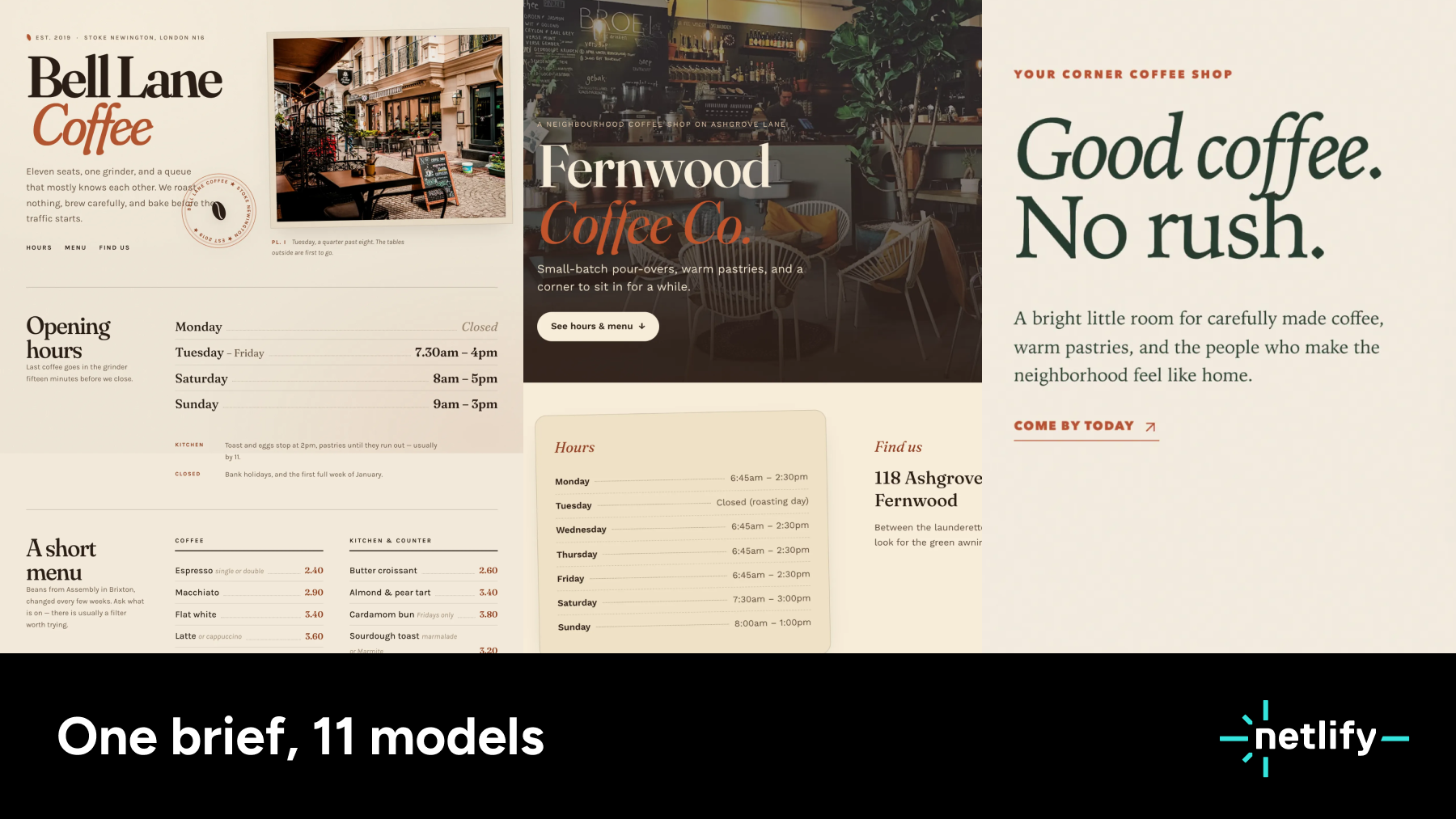
One Prompt, Eleven Models: Navigating the Complexity of LLM Selection
In the early days of generative AI adoption, choosing a model felt like picking a favorite tool. You’d try GPT-4o or Claude 3.5 Sonnet, see some impressive results, and integrate it into your workflow. However, as we move from "cool demo" to production-grade software engineering, that simplicity has vanished.
As the recent analysis of eleven different models responding to a single prompt highlights, there is no such thing as a "perfect" model in a vacuum. Every model represents a unique trade-off between reasoning depth, latency, and—most importantly for your bottom line—inference cost. When you are building an MVP or scaling a production app, choosing the right model isn't just about who gives the smartest answer; it’s about finding the most efficient path to a reliable user experience.
The Illusion of "Best" vs. The Reality of Optimization
When developers look at benchmark charts released by AI labs, they often see high scores for reasoning and coding capabilities in flagship models. While these are impressive, those benchmarks don't account for your specific token mix or the frequency of your production calls.
For example, a massive model might provide a nuanced, highly creative response to a complex prompt, but it may also consume significantly more credits per request than a specialized smaller model or an open-source alternative like DeepSeek. If you are building a feature that requires simple categorization or sentiment analysis, using a "frontier" model is often overkill—it’s the equivalent of hiring a PhD researcher to sort your mail.
To build a sustainable product, you must view model selection as an optimization problem:
- Complexity of Task: Does this require deep reasoning (logic/math/coding) or pattern matching (summarization/extraction)?
- Volume of Requests: How many times per day will this prompt be executed?
- Tolerance for Error: Can the user tolerate a slight hallucination, or is 100% accuracy required?
By mapping your features against these three pillars, you can create a "model map" that assigns different models to different parts of your application architecture rather than relying on a single, expensive general-purpose model.
Engineering for Reliability: Logging and Versioning
One of the biggest hurdles in moving from prototype to production is consistency. Because LLMs are non-deterministic by nature, even using the same model can result in varying outputs over time as providers update their weights or system prompts.
To combat this, your engineering stack must be robust enough to track exactly what happened during a failed request. You should never just log "an error occurred." Instead, you need to log:
- The Model ID: Exactly which version was used (e.g.,
gpt-4o-2024-05-13vsgpt-4o). - The Prompt Version: If you are iterating on your system prompts, use a versioning system to track which iteration produced the successful result.
- The Token Count: Track exactly how much each request cost so you can identify "runaway" costs in real-time.
By logging these metadata points alongside every production call, you gain the data necessary to perform A/B testing and switch models dynamically based on performance metrics rather than gut feeling.
Strategic Deployment: Canarying and Fallbacks
When it comes time to deploy a new model or update an existing prompt, "flipping the switch" for 100% of your users is a high-risk move. A change in a provider's backend can suddenly spike latency or cause a drop in output quality.
A more mature engineering approach involves Canary Deployments. By routing a small percentage of traffic (e.g., 5%) to a new model, you can monitor the "health" of the responses before it becomes your primary engine. This is particularly important when experimenting with newer, cheaper models that may have higher variance in their outputs.
Furthermore, implementing Fallback Logic is essential for high-availability apps. If an ultra-fast, low-cost model fails to produce a valid JSON or hits a rate limit, your system should be programmed to automatically "fail up" to a more robust—albeit slightly more expensive—model to ensure the user experience remains uninterrupted.
Building Your MVP with Purpose
The goal of any engineering project is to deliver value as quickly and efficiently as possible. In the world of AI-driven applications, this means avoiding over-engineering your stack while ensuring you don't waste capital on unnecessary "intelligence" that your users won't notice.
By auditing your prompts, identifying high-volume/low-complexity tasks for smaller models, and implementing rigorous logging and canary testing, you can build a scalable infrastructure that balances performance with cost-efficiency. If you are looking to move from an idea to a production-ready MVP and need help navigating the complexities of AI integration and software architecture, contact me here for expert guidance in building your next product.
FAQ
Why do different models give different results for the same prompt? Different models are trained on different datasets, use varying parameter counts, and employ unique fine-tuning techniques. These architectural differences mean that even a single identical prompt can trigger vastly different reasoning paths and output styles across various providers.
How do I decide between a high-end model and an open-source alternative? The decision should be based on your specific use case. If you need complex, multi-step reasoning for core features, a high-end model is often worth the cost; if you are performing high-volume, simpler tasks like classification or summarization, smaller or open-source models offer better ROI.
What is "canarying" in the context of LLM deployment? Canary testing involves rolling out a new model or prompt version to a small percentage of your users first. This allows you to monitor for hallucinations, latency issues, or cost spikes before making it the default choice for your entire production environment.
Implementation help
Let's align on scope and next steps. Nitin Rachabathuni, Senior Full-Stack Engineer and MVP in 2 Days specialist — technical audits, implementation support, advisory, and flexible hourly collaboration shaped to your product. Reach out anytime; available across time zones and countries.
- Contact form
- Email: nitin.rachabathuni@gmail.com
- WhatsApp: +91-9642222836
:quality(85)/https://andros.dev/media/thumbnails/kier-in-sight-archives-Sbxf5Dbyerk-unsplash.jpg)