
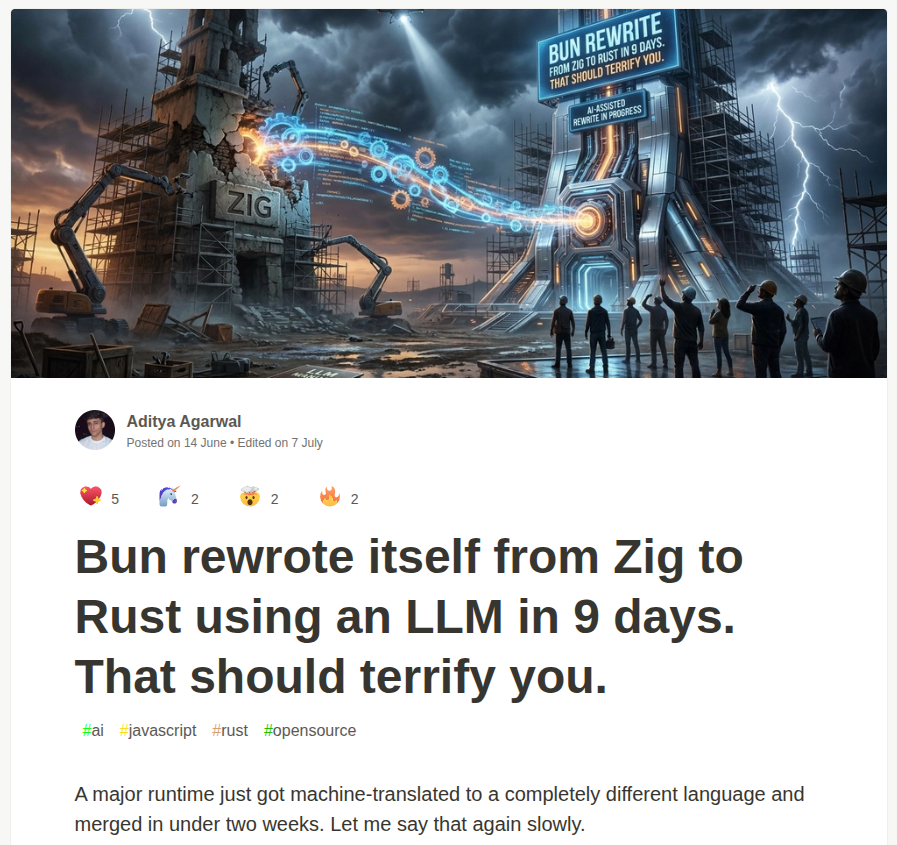
The Hidden Costs of AI-Assisted Engineering: Lessons from the Bun Rust Rewrite
In the current era of rapid technological shifts, few stories capture the tension between innovation and stability as clearly as the ongoing discussions surrounding the rewrite of components in the Bun runtime using Rust. While many observers look at these projects through a lens of pure technical achievement, leadership teams must view them through a different lens: the economics of AI-assisted engineering.
The narrative often starts with a seductive premise—that Large Language Models (LLMs) can significantly lower the barrier to entry for high-performance systems programming. By leveraging models capable of generating Rust code, developers can theoretically bypass months of manual boilerplate and complex syntax hurdles. However, as the Bun situation illustrates, there is a profound difference between "generating code" and "engineering a production system."
The Illusion of Cheap Development
One of the most striking aspects of this case study is the discrepancy between initial investment and long-term maintenance. Early reports suggested that certain portions of the rewrite were completed with an estimated cost profile that seemed incredibly low—some figures even suggesting costs primarily covering API calls rather than human engineering hours.
This creates a dangerous "mirage" for leadership. If a project appears to be finished because the code is syntactically correct and passes basic tests, it may still be riddled with hidden technical debt. AI models are excellent at producing functional snippets, but they often lack the holistic context of an entire ecosystem. They might not understand how a specific Rust implementation affects memory safety in a high-concurrency environment three layers deep in the stack.
When we see "completed" code that requires extensive human intervention to stabilize, it isn't actually cheap; the costs have simply been deferred. For engineering leaders, this means that any AI-assisted initiative must be budgeted not just for the tokens consumed during generation, but for the rigorous audit cycles required to ensure the output is production-grade.
The Trade-off: Speed vs. Stability
The core conflict in modern software leadership is often a choice between velocity and reliability. AI-assisted engineering offers an unprecedented boost to velocity. It allows teams to prototype faster, explore new architectural patterns rapidly, and generate boilerplate that would otherwise take days of manual labor.
However, the "Bun Rewrite" scenario highlights what happens when speed is prioritized without a corresponding investment in stability. When code is generated at scale by AI, it can introduce non-deterministic bugs or edge cases that are difficult to trace because no human "wrote" the logic in its entirety—the machine did. This leads to an explosion of technical debt where engineers spend more time debugging "ghosts in the machine" than building new features.
To navigate this, leadership must shift from a mindset of automation to one of augmentation. The goal isn't to let AI write the system; it is to use AI as a high-powered tool that produces work which human engineers then verify and harden. If you cannot afford the time for an engineer to deeply audit every line of AI-generated Rust, you shouldn't be using AI to generate that specific logic in your production path.
Strategic Frameworks for AI Integration
To avoid falling into the trap of "accelerated technical debt," leadership teams should adopt a structured framework when integrating LLMs into their development workflows:
- Quantify the Risk Profile: Not all code is created equal. A UI component generated by an LLM carries much lower risk than a low-level memory management module in Rust. Identify your "high-stakes" zones and apply more human oversight there.
- Log Everything: If you are using AI to generate production code, you must track the metadata of that generation. Log the model ID, the specific prompt version used, and the date of generation. This allows you to trace issues back to a specific "generation event" if something breaks in production.
- Canary Deployments: Never roll out AI-generated logic as a global default immediately. Use canary releases on low-risk endpoints to observe how the code behaves under real-world conditions before scaling it across your entire infrastructure.
By treating AI output as "untrusted" until proven otherwise, you can harness its speed without sacrificing the integrity of your system.
Building for the Long Term
The ultimate goal of any engineering leader is to build a sustainable product. The Bun rewrite serves as a cautionary tale about what happens when we mistake high-speed generation for high-quality engineering. When we cut corners on human oversight because "the AI did it," we are simply borrowing time from our future selves—interest will be paid in the form of production outages and difficult debugging sessions later.
As you navigate your own journey toward integrating more intelligent systems into your development pipeline, remember that the most successful teams aren't those who find ways to replace humans with machines; they are the ones who use machines to empower their humans to build better things faster.
If you are looking to move from prototype to a production-ready MVP while navigating these complex trade-offs in technical debt and AI integration, I can help you architect a path that balances speed with long-term stability. Contact me here to discuss how we can build your next product effectively.
Frequently Asked Questions
What is the primary risk of using AI for Rust development? The main risks include "hallucinated" logic, non-idiomatic code that may have subtle performance issues, and a lack of holistic architectural context which can lead to hard-to-debug errors in high-concurrency environments.
How does "accelerated technical debt" differ from traditional technical debt? Traditional debt is usually caused by making conscious shortcuts for speed; accelerated technical debt occurs when AI generates large volumes of code quickly, but that code lacks the human oversight necessary to ensure it meets long-term stability and maintainability standards.
What are best practices for tracking AI-generated production code? Teams should log the specific model ID and prompt version used for every piece of generated code. This creates a paper trail that allows engineers to identify which "generation logic" caused an issue if a bug is discovered in production later.**
Implementation help
Let's align on scope and next steps. Nitin Rachabathuni, Senior Full-Stack Engineer and MVP in 2 Days specialist — technical audits, implementation support, advisory, and flexible hourly collaboration shaped to your product. Reach out anytime; available across time zones and countries.
- Contact form
- Email: nitin.rachabathuni@gmail.com
- WhatsApp: +91-9642222836
