The Architectural Fallacy of the "Instance"
In the world of decentralized social media, terms are often used interchangeably because they describe similar user experiences. However, from an engineering and systems architecture perspective, the difference between a Mastodon-style federation and the ATProto protocol is profound.
When people discuss Mastodon, they talk about "instances." In that model, an instance is a bundled fiefdom—a single server where both the hosting (the hardware/cloud resources) and the application logic (the rules of engagement, the UI, and the database schema) are tightly coupled. When you join an instance on Mastodon, you are joining a specific silo that must negotiate its existence with every other silo in the network.
ATProto—the protocol powering Bluesky—takes a fundamentally different approach. As noted in recent architectural discussions, there are no "instances" in ATProto because the architecture intentionally decouples these layers. Instead of multiple copies of an app talking to each other, any client acts as a projection of the entire network's state. The infrastructure layer is separated from the logic layer. This isn't just a semantic distinction; it changes how we think about scalability, data integrity, and user autonomy.
Scaling Complexity: O(n²) vs. Decoupled Layers
To understand why this matters for engineering management and system design, we have to look at the math of federation.
In traditional federated models like Mastodon, because every instance is a unique "fiefdom," the network must manage an $O(n^2)$ complexity regarding relationships. If there are 10,000 instances, each one potentially needs to maintain and verify its connection with 9,999 others. This creates a massive overhead for discovery, permissioning, and cross-instance communication.
ATProto moves away from this by separating the hosting layer from the aggregation logic. In this model:
- The Hosting Layer handles where data lives (e.g., an S3 bucket or a specialized database).
- The Logic Layer defines how that data is interpreted and shared across the network.
Because the "app" isn't tied to the "host," you don't have thousands of different versions of the software trying to talk to each other. Instead, any client—regardless of where it is hosted—can pull from a common pool of state. This allows for much smoother scaling because the network doesn't need to negotiate with every individual server; it only needs to understand the protocol rules.
The Power of Decoupling in Distributed Systems
When we decouple layers, we gain "granularity." In an ATProto-style system, a user’s identity and their social graph are not trapped inside a specific server's database logic. Because the hosting is independent, users can swap out their underlying storage providers without losing their presence on the network.
This creates a more fluid form of decentralization. Instead of "moving" to a different instance (which implies leaving your current community and starting over in a new silo), a user simply changes how their data is hosted while remaining part of the same global atmosphere.
For engineers, this means:
- Simplified Maintenance: You don't have to worry about maintaining unique compatibility patches for every possible "neighbor" instance.
- Better Scalability: The network can grow without the overhead of managing thousands of distinct peer-to-peer relationships at the application level.
- True Portability: Users own their data in a way that isn't dependent on the specific software version of the server they happened to join first.
Practical Takeaways for Infrastructure Design
When you are building distributed systems, you must decide early: Are you building "fiefdoms" or decoupled layers?
If your goal is rapid community growth and high scalability, a bundled model (like Mastodon) can become an architectural debt trap as the number of participants grows. The complexity of managing cross-instance permissions and data synchronization becomes exponentially harder to manage at scale.
The ATProto approach suggests that for modern decentralized systems, we should aim for "windows into a shared atmosphere." By separating the hosting from the logic, you allow different applications to serve as views onto the same underlying truth. This allows developers to build diverse front-ends and features without worrying about whether those features will be compatible with every other app on the network—because they are all reading from the same decoupled data layer.
If you are currently navigating these architectural trade-offs for your own product or infrastructure, it is vital to choose a path that aligns with your long-term growth goals. Building an MVP requires making hard decisions about how much complexity you can manage today versus what you will need to scale tomorrow.
Need help architecting the right technical foundation for your next project? Contact Nitin Rachabathuni to discuss building a scalable MVP.
Summary of Technical Differences
| Feature | Mastodon (Federated) | ATProto (Decoupled) |
|---|---|---|
| Architecture | Bundled "Fiefdoms" | Decoupled Layers |
| Scalability | $O(n^2)$ complexity for peer relations | Linear scaling via shared atmosphere |
| User Mobility | Moving requires migrating to a new instance | Users can swap hosts while keeping identity |
| Client Role | A local node in a web of peers | A window into the global state |
By moving away from "instances" and toward decoupled layers, ATProto provides a blueprint for how decentralized systems can achieve scale without sacrificing user autonomy. It’s not just about where the data lives; it's about how much weight the network has to carry to make that data accessible.
Authoritative references
Consult Next.js documentation, MDN Web Docs, web.dev, Next.js documentation, OWASP Cheat Sheets alongside the official references block below. Cross-check guidance with your compliance, security, and SRE stakeholders before setting SLOs.
Metrics snapshot
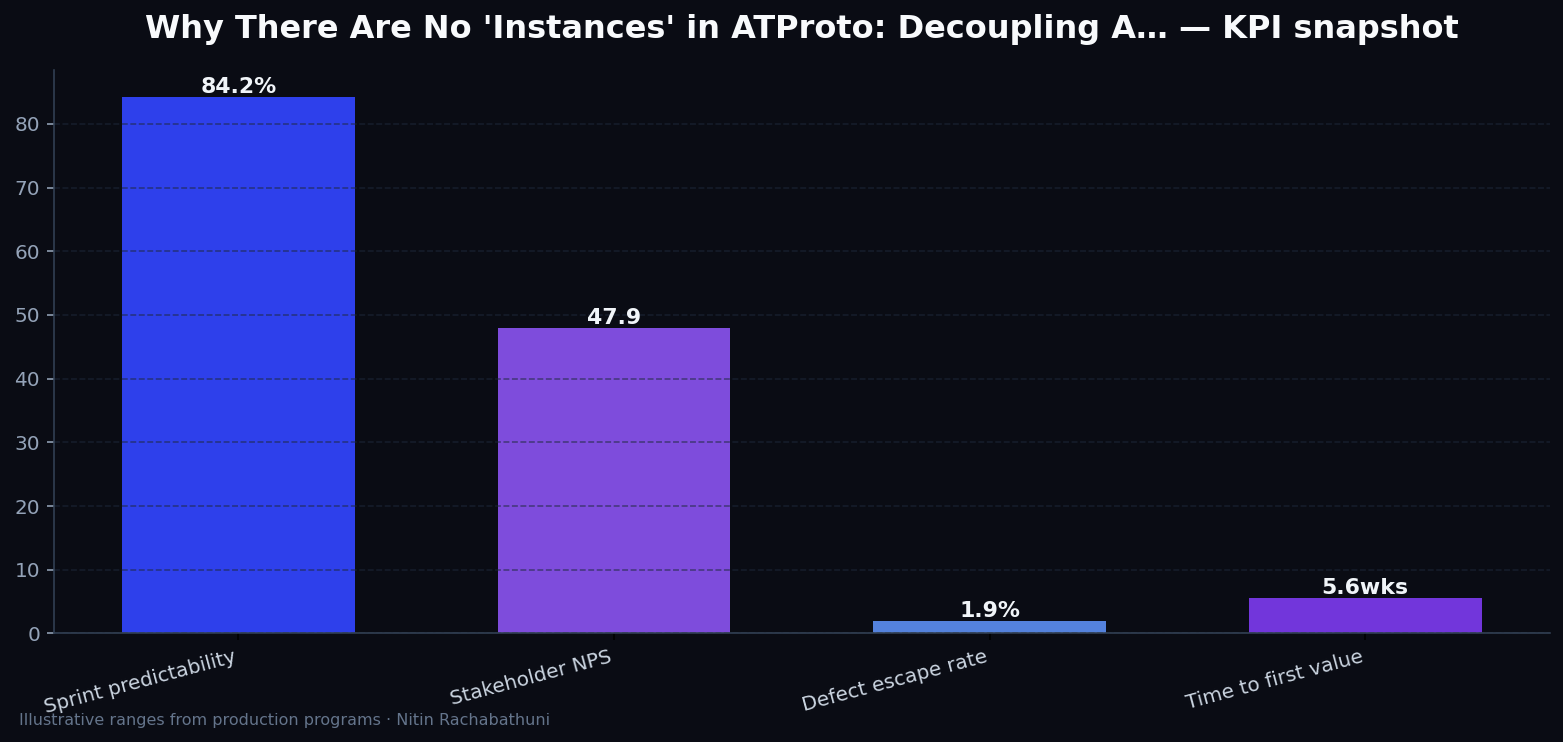
Illustrative consulting KPI ranges observed on programs like “Why There Are No 'Instances' in ATProto: Decoupling A…” — validate against your own telemetry before setting SLOs. Methodology: production-like staging traces + weekly review with product and ops.
Architecture flow

Code sketches
/* Integration sketch */
// Why There Are No 'Instances' in ATProto: Decoupling A…
export async function rolloutAtprotoVsMastodonArchitectureDecoupling() {
  const checks = ["telemetry", "auth", "rollback"];
  return { ok: true, checks };
}
Official references
Related on this site
Article slug: atproto-vs-mastodon-architecture-decoupling · Engineering notes by Nitin Rachabathuni — MVP in 2 days specialist.